
Meta Title: Best AI Tools to Try in 2026: Free, Writing & Productivity Tools
Meta Description: Discover the best AI tools to try in 2026, including free AI tools, writing assistants, and useful options for students and professionals.
Best AI Tools to Try in 2026
best-ai-tools-to-try-in-2026
Introduction
Artificial intelligence has quickly become part of everyday digital life. A few years ago, using AI often required technical knowledge or expensive software. Today, AI tools are available for writing, research, studying, coding, designing, brainstorming, productivity, communication, and many other tasks.
The growing number of AI applications is useful, but it also creates a new problem: which AI tool should you actually use?
Searching for the best AI tools can lead to hundreds of recommendations. Some tools are excellent for writing but weak for research. Others are designed for images, presentations, coding, or business workflows. Some offer useful free plans, while others require subscriptions for advanced features.
This guide explains the best AI tools to try in 2026, with a particular focus on free AI tools, AI writing tools, and solutions for students and professionals. More importantly, it explains how to choose an AI tool based on your actual needs instead of simply following a popular-name list.
What Are AI Tools?
AI tools are software applications that use artificial intelligence to perform tasks that traditionally required human effort.
Depending on the application, an AI tool may be able to:
- Generate or improve written content
- Answer questions
- Summarize information
- Analyze documents
- Generate images
- Create or edit videos
- Translate languages
- Assist with coding
- Organize information
- Generate ideas
- Automate repetitive work
- Help with research and learning
Modern AI tools can be especially useful when they are treated as assistants rather than replacements for human judgment.
For example, a student can use AI to explain a difficult concept, then verify the information and complete the assignment independently. Similarly, a professional can use AI to create a first draft of an email while reviewing and editing the final version personally.
1. Best AI Tools to Try in 2026
There isn’t one AI application that is perfect for everyone. The right choice depends on what you want to accomplish.
Here are some major categories of AI tools worth exploring in 2026.
AI Chat Assistants
AI chat assistants are among the most versatile AI applications available today.
They can help with:
- Brainstorming
- Writing
- Summarization
- Explanations
- Planning
- Research assistance
- Coding
- Translation
- Learning
A good AI chat assistant can be useful for both simple and complex tasks.
However, users should remember that AI-generated information can sometimes be incorrect. For important subjects, information should be checked against reliable sources.
AI Writing Assistants
AI writing tools can help users improve the quality and efficiency of their writing.
They can assist with:
- Grammar
- Sentence structure
- Rewriting
- Outlining
- Brainstorming
- Summarization
- Tone adjustment
These tools can be particularly useful when you know what you want to say but have difficulty organizing your thoughts.
For professional communication, AI can help create a starting point, but reviewing the final text is still important.
AI Image Generators
AI image generators allow users to create visual concepts from written descriptions.
They can be useful for:
- Blog illustrations
- Social media graphics
- Concept art
- Marketing ideas
- Presentation visuals
- Creative projects
The quality of generated images has improved significantly, but users should still understand the licensing and commercial-use rules of the specific service they choose.
AI Video Tools
AI video applications can assist with different parts of video production.
Depending on the platform, they may help with:
- Script creation
- Video generation
- Editing
- Captions
- Voiceovers
- Scene creation
- Background removal
For creators, this can reduce the time required to produce certain types of content.
AI Coding Assistants
Developers can use AI coding tools to:
- Explain code
- Generate code examples
- Find potential errors
- Refactor code
- Create documentation
- Brainstorm solutions
AI-generated code should always be tested. A program that looks correct can still contain security, performance, or logical problems.
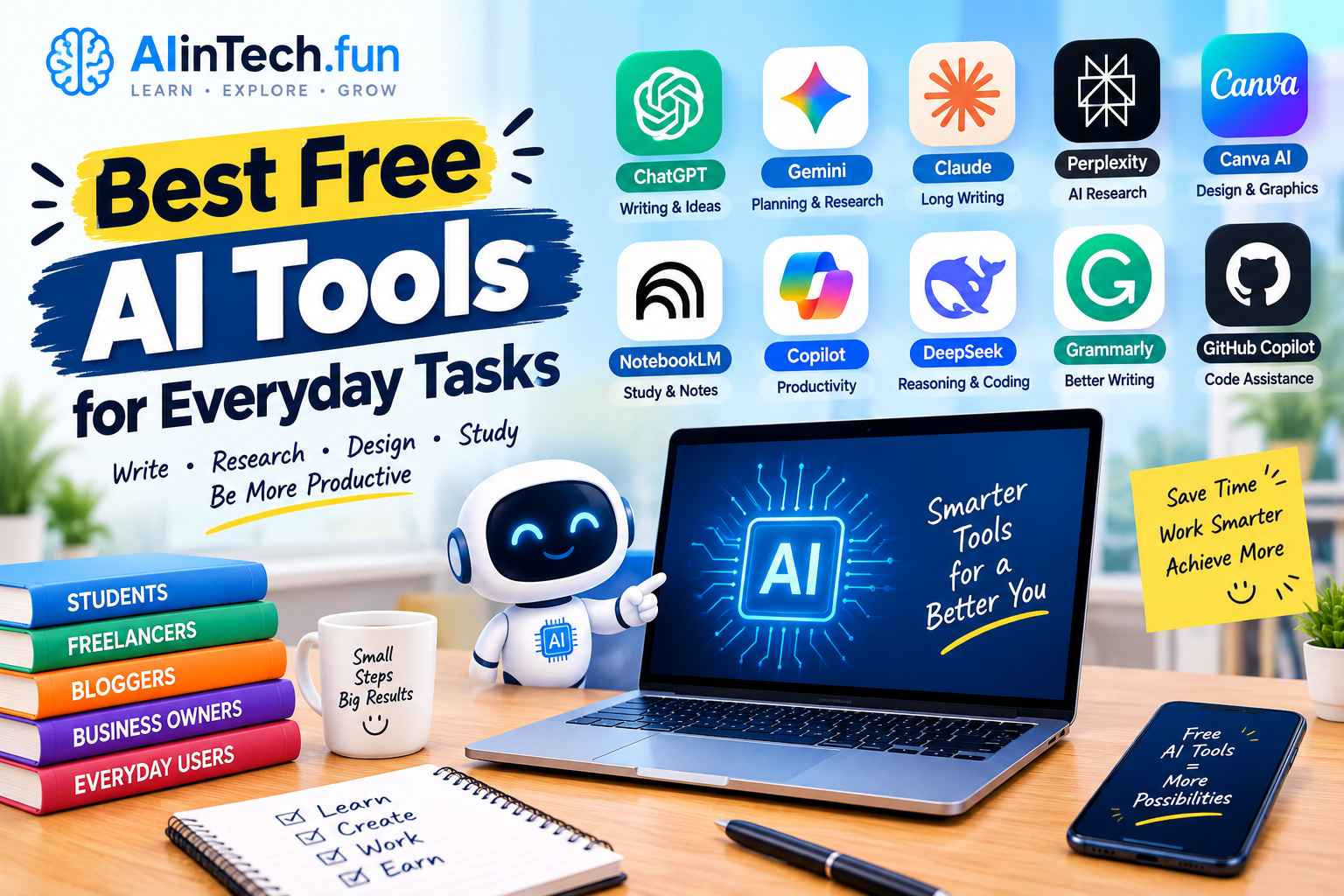
2. Best Free AI Tools for Everyday Tasks
You don’t always need to pay for an AI subscription.
Many AI services provide free access with some limitations. Free tools can be particularly helpful for beginners who want to understand how AI fits into their workflow before paying for premium features.
Writing and Rewriting
A free AI assistant can help you turn rough ideas into organized text.
For example, instead of asking:
“Write something about technology.”
You could provide a more specific request:
“Create a beginner-friendly outline explaining five ways artificial intelligence is changing office work.”
The second prompt gives the AI a clearer goal and usually produces a more useful response.
Summarizing Information
AI can save time when dealing with long text.
You can use an appropriate AI tool to summarize:
- Meeting notes
- Articles
- Reports
- Study material
- Business documents
Always consider privacy before uploading sensitive or confidential information to an AI service.
Brainstorming
AI is particularly useful for generating ideas.
A blogger might ask for:
- Article ideas
- Headlines
- FAQs
- Content outlines
- Social media concepts
Instead of accepting the first result, ask the AI to generate several different approaches and then select and improve the ideas that actually make sense.
Translation and Language Assistance
AI-powered language tools can help users understand or rewrite text in different languages.
They can be useful for:
- Basic translations
- Vocabulary
- Sentence improvement
- Language practice
- Cross-language communication
For legal, medical, or highly sensitive translations, professional verification may still be necessary.
Simple Planning
AI can also assist with everyday planning.
For example, you could ask it to organize:
- A study schedule
- A content calendar
- A project checklist
- A meeting agenda
- A travel preparation list
The important thing is to provide enough context for the tool to create something practical.
3. Best AI Writing Tools for Beginners
Writing is one of the easiest areas for beginners to explore with AI.
However, using AI effectively doesn’t mean simply asking it to “write everything.”
The strongest workflow usually involves human ideas + AI assistance + human editing.
AI Chat Assistants
General-purpose AI assistants can help beginners with almost every stage of writing.
You can use them to:
- Brainstorm ideas
- Create an outline
- Develop headings
- Explain difficult concepts
- Improve rough drafts
- Find gaps in an argument
- Rewrite unclear sentences
This makes them useful for bloggers, students, freelancers, and business owners.
Grammar and Editing Tools
Some AI-powered writing platforms focus heavily on editing.
They can identify issues involving:
- Grammar
- Spelling
- Clarity
- Repetition
- Sentence structure
- Tone
For beginners, this can be helpful because the tool can highlight problems that are easy to overlook during self-editing.
AI Research Assistants
Some AI tools are designed around research and information discovery.
They can help users organize questions, identify relevant information, and summarize material.
However, an AI response should not automatically be considered a reliable source.
When writing an article containing statistics, dates, scientific claims, financial information, or other factual statements, verify important information using trustworthy sources.
How Beginners Should Use AI for Writing
A simple workflow looks like this:
Step 1: Decide what you want to communicate.
Step 2: Create your own main points.
Step 3: Ask AI to help organize those points.
Step 4: Add examples, experience, explanations, and useful details.
Step 5: Check facts.
Step 6: Edit the final article in your own voice.
This approach creates content that is more useful and authentic than simply publishing unedited AI output.
4. Best AI Tools for Students and Professionals
Students and professionals have different responsibilities, but both groups can benefit from AI when it is used responsibly.
AI Tools for Students
Students can use AI as a learning assistant.
Useful applications include:
Explaining Difficult Topics
If a textbook explanation is confusing, ask AI to explain the concept using simpler language.
You can also request:
- Examples
- Step-by-step explanations
- Analogies
- Practice questions
- Short quizzes
Study Planning
AI can help create a study plan based on:
- Subjects
- Available time
- Exam dates
- Difficulty levels
- Personal priorities
The student should then adjust the schedule based on their actual progress.
Language Learning
AI can simulate conversations and help users practice writing.
For example, students can ask an AI assistant to:
- Correct a sentence
- Explain a grammar rule
- Provide vocabulary exercises
- Create practice conversations
Brainstorming
Students can use AI to generate ideas for presentations, projects, and research questions.
The goal should be to develop their own understanding rather than simply copying generated material.
AI Tools for Professionals
Professionals can use AI to reduce repetitive work and improve productivity.
Email Assistance
AI can help turn short notes into professional email drafts.
For example, you can provide three points and ask the tool to organize them into a clear message.
Always review the final email before sending it.
Meeting Summaries
AI-powered meeting tools can help convert conversations into notes, summaries, and action items.
This can reduce the amount of manual note-taking required.
However, companies should consider privacy, consent, and data-handling policies before using AI recording or transcription services.
Presentations
AI can assist with:
- Presentation outlines
- Slide ideas
- Speaker notes
- Visual concepts
- Summaries
The professional should still verify facts and make sure the presentation matches the audience.
Data and Document Analysis
Some AI tools can help users analyze large amounts of text or structured information.
Possible applications include:
- Summarizing reports
- Extracting key points
- Comparing documents
- Identifying patterns
- Creating initial analyses
Sensitive business information should only be processed through tools approved by the relevant organization.
5. How to Choose the Right AI Tool for Your Needs
With so many AI tools available, choosing one can feel difficult.
The best method is to start with the task, not the tool.
Instead of asking:
“What is the most popular AI tool?”
Ask:
“What problem am I trying to solve?”
This small change can make your decision much easier.
Identify Your Main Task
First, define exactly what you need.
For example:
| Your Need | AI Tool Category |
|---|---|
| Writing articles | AI writing assistant |
| Learning concepts | AI tutor/chat assistant |
| Creating images | AI image generator |
| Editing videos | AI video tool |
| Programming | AI coding assistant |
| Research | AI research assistant |
| Productivity | AI automation/productivity tool |
| Translation | AI language tool |
Once the task is clear, you can compare tools designed for that specific purpose.
Check the Free Plan
Before purchasing a subscription, check what the free version provides.
Look at:
- Daily or monthly limits
- Available models
- Export options
- File upload restrictions
- Image or video limits
- Commercial-use rules
A free plan may be enough for occasional users.
Consider Ease of Use
A powerful AI tool isn’t necessarily useful if its interface is difficult to understand.
Beginners should generally look for:
- Simple navigation
- Clear instructions
- Helpful documentation
- Easy export options
- Reliable performance
Check Privacy Policies
Privacy is especially important when working with AI.
Before uploading information, determine what the service says about:
- Data storage
- Data retention
- Training usage
- Account security
- Third-party sharing
Avoid uploading passwords, confidential business documents, financial credentials, or other sensitive information unless you have a clear reason and the service is appropriate for that information.
Look at Output Quality
Don’t choose an AI tool solely because it is popular.
Test it with a real task.
For example, if you’re looking for a writing assistant, give it a short piece of your own writing and see whether the suggestions actually improve clarity.
If you’re testing an image generator, try several prompts and evaluate consistency and quality.
Compare Pricing
AI pricing can vary significantly.
Consider:
- Free availability
- Monthly subscription
- Annual subscription
- Usage limits
- Team plans
- Business features
If you only use AI occasionally, an expensive subscription may provide little practical benefit.
How to Get Better Results From AI Tools
Choosing a good AI tool is only part of the process. The quality of your instructions also matters.
Give Clear Context
Instead of:
“Write an article about AI.”
Try:
“Create a beginner-friendly article explaining how AI tools can improve productivity for small business owners. Use simple language, practical examples, headings, and a short FAQ section.”
The second instruction gives the AI much more useful context.
Specify Your Audience
Tell the tool who will read the content.
For example:
- Beginners
- Students
- Freelancers
- Developers
- Business owners
- Teachers
The same subject can require completely different explanations depending on the audience.
Request a Specific Format
You can ask AI to provide:
- Tables
- Bullet points
- Step-by-step instructions
- FAQs
- Checklists
- Summaries
- Comparisons
This makes the output easier to use.
Review Everything
AI is powerful, but it isn’t automatically correct.
Before publishing or relying on AI-generated information:
- Check important facts
- Verify statistics
- Review links
- Remove unnecessary claims
- Correct errors
- Add your own perspective
Human review remains an important part of responsible AI use.
Common Mistakes When Using AI Tools
Using AI for Everything
AI should support your work rather than eliminate your own thinking.
If you depend on AI for every decision, you may lose opportunities to develop your own skills.
Copying AI Output Without Editing
Raw AI-generated content can contain repetitive language, factual errors, or generic explanations.
Editing makes the final result more useful.
Ignoring Privacy
Don’t assume that every AI service handles data in the same way.
Read the provider’s privacy information and follow your organization’s policies.
Choosing a Tool Because It Is Popular
Popularity doesn’t necessarily mean a tool is suitable for your specific task.
A less well-known application may be better for a particular workflow.
Not Testing the Free Version
If a free version is available, test it before paying.
This helps you determine whether the tool actually solves your problem.
Future of AI Tools
AI technology continues to evolve quickly.
Future AI applications are likely to become more integrated with the software people already use for work, education, communication, and creative projects.
We can expect continued development in areas such as:
- AI agents
- Multimodal AI
- AI-powered search
- Automated workflows
- AI coding
- Personalized education
- Content creation
- Business automation
- Voice interfaces
However, technological progress also creates new questions involving privacy, copyright, security, accuracy, and responsible use.
Learning how to evaluate AI tools may therefore become just as important as learning how to operate them.
Frequently Asked Questions
What are the best AI tools to try in 2026?
The answer depends on your goal. General AI assistants, writing tools, image generators, video tools, coding assistants, research applications, and productivity tools are among the major categories worth exploring.
Are free AI tools good enough?
For many everyday tasks, free AI tools can be sufficient. However, premium plans may provide higher usage limits, additional features, stronger models, or advanced capabilities.
Which AI tools are best for beginners?
Beginners should generally start with tools that have simple interfaces and clear documentation. General-purpose AI assistants and basic writing tools can be good starting points because they can be used for many different tasks.
Can students use AI tools?
Yes, AI can support learning through explanations, brainstorming, practice questions, language assistance, and study planning. Students should follow their school’s academic-integrity rules and avoid submitting AI-generated work as their own when prohibited.
Can AI tools replace professional writers?
AI can automate or assist with some writing tasks, but professional writing also involves judgment, research, creativity, subject knowledge, editing, and understanding an audience. AI is often most useful as an assistant within a human-led workflow.
How do I choose an AI tool?
Start by identifying your specific task. Then compare tools based on output quality, features, ease of use, privacy, pricing, usage limits, and whether the service fits your workflow.
Final Thoughts
The number of AI tools available in 2026 can feel overwhelming, but choosing one doesn’t have to be complicated.
Start with your problem. Determine what you want AI to accomplish, identify the appropriate tool category, test available options, and compare their features.
For beginners, free AI tools can provide an easy way to learn. Writers can explore AI assistants for brainstorming and editing. Students can use AI for explanations and study support, while professionals can use it to reduce repetitive work and improve productivity.
The most effective approach is not simply using more AI tools. It is learning how to use the right tool for the right task while keeping human judgment, creativity, fact-checking, and responsible decision-making at the center.
AI can save time and expand what you can accomplish, but the quality of the final result still depends heavily on how thoughtfully you use it.



Leave a Reply