

Meta Title: The Biggest AI Developments of 2026 | Latest AI Trends
Meta Description: Discover the biggest AI developments of 2026, including AI agents, reasoning models, robotics, multimodal AI, coding agents, physical AI, and AI infrastructure.
Focus Keyword: biggest AI developments of 2026
Secondary Keywords: AI developments 2026, latest AI technology, AI trends 2026, artificial intelligence 2026, future of AI, AI agents, reasoning AI, physical AI
Suggested URL Slug: /biggest-ai-developments-2026/
Introduction
Artificial intelligence has moved far beyond the idea of a chatbot that simply answers questions. In 2026, AI is becoming more capable of reasoning, planning, using tools, writing code, working with different types of information, and interacting with the physical world.
The biggest change is not just that AI models are becoming larger. AI systems are increasingly being designed to complete useful tasks rather than simply generate responses.
For example, modern AI agents can be connected to software tools, files, databases and other systems. Instead of asking an AI to explain how to complete a task, users can increasingly delegate parts of the task to an AI system.
OpenAI’s 2026 research describes this shift as moving knowledge work from short interactions toward longer tasks where agents can independently use tools and work through multiple steps.
At the same time, companies such as NVIDIA are developing technologies for physical AI, where AI systems can perceive and reason about the real world and help control robots, autonomous vehicles and other machines.
So, what are the biggest AI developments of 2026?
Let’s explore them one by one.
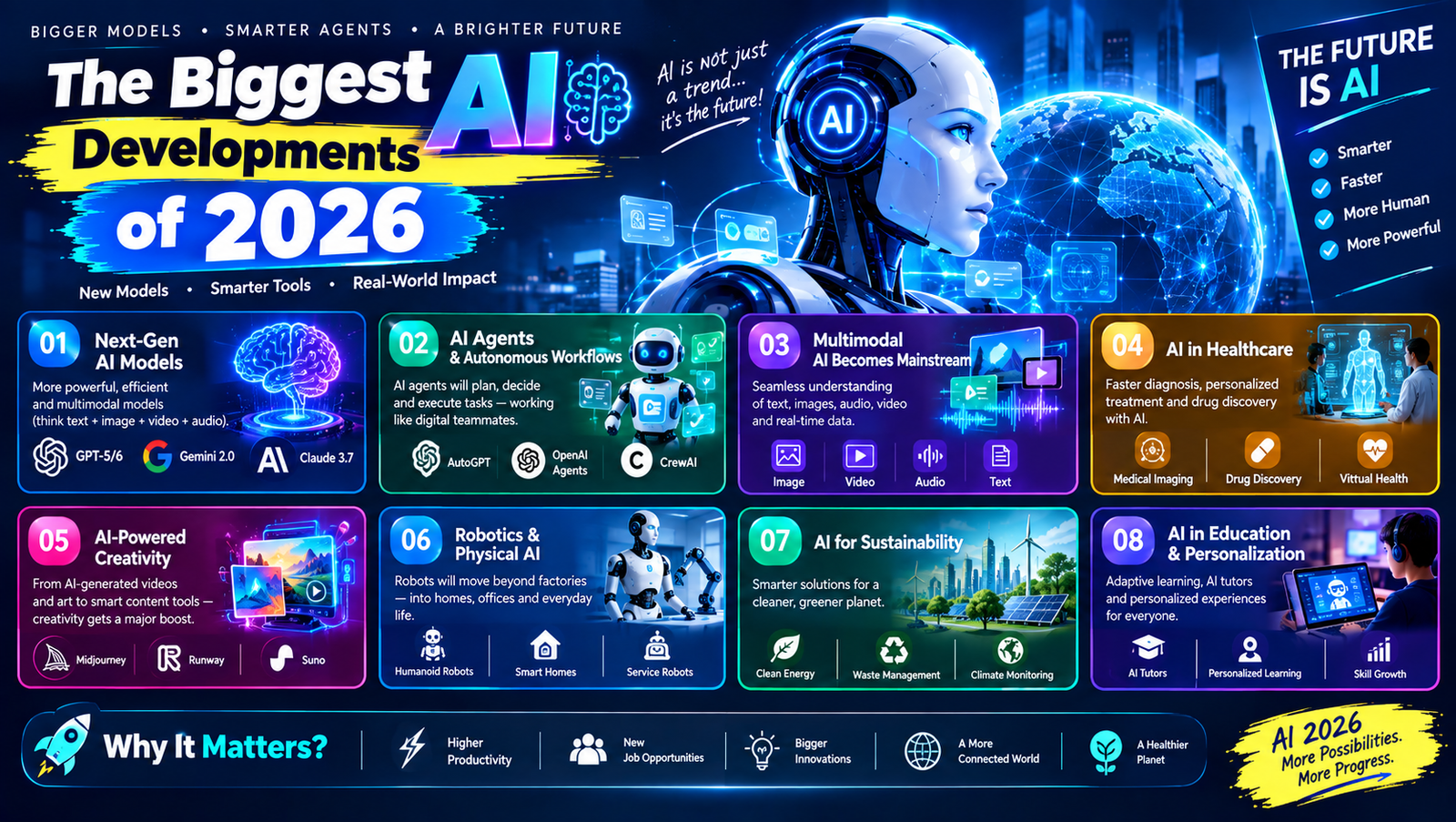
What Are the Biggest AI Developments of 2026?
The AI industry is developing in several directions at the same time.
| AI Development | What Is Changing |
|---|---|
| AI Agents | AI can perform multi-step tasks |
| Reasoning Models | Models spend more effort solving complex problems |
| Multimodal AI | AI understands text, images, audio, video and more |
| AI Coding Agents | AI can assist with or perform software-development tasks |
| Physical AI | AI is moving into robots and machines |
| AI Robotics | Robots are becoming more capable and adaptable |
| AI Infrastructure | Specialized computing is expanding rapidly |
| Open AI Models | More models and development tools are becoming openly available |
| AI for Science | AI is increasingly being applied to biology and scientific research |
| AI Security | Safety, privacy and governance are becoming more important |
These developments are connected. Better models require better computing infrastructure, while better reasoning and multimodal capabilities make AI agents and robotics more useful.
1. AI Agents Are Becoming More Powerful
One of the biggest AI developments of 2026 is the rapid growth of AI agents.
A traditional chatbot generally waits for a user prompt and then provides an answer.
An AI agent can potentially do much more.
It may:
- Understand a goal
- Break a task into steps
- Search for information
- Use software tools
- Work with files
- Write or modify code
- Analyze information
- Complete multiple actions
- Check results
- Continue working toward the goal
This changes the role of AI from a simple question-answering tool into something closer to a digital worker or assistant.
NVIDIA describes agentic AI as systems that use reasoning and planning to handle complex, multi-step problems and interact with multiple data sources.
OpenAI has also described agents as systems capable of working independently for longer periods while orchestrating tool calls and interacting with software environments.
Why AI Agents Matter
Imagine asking an AI:
“Research five competitors, compare their features, organize the information into a spreadsheet and prepare a summary.”
A traditional chatbot might explain how you could perform those steps.
An agent-based system is designed around actually carrying out the workflow.
This could eventually change how businesses handle:
- Research
- Customer support
- Marketing
- Data analysis
- Software development
- Administration
- Project management
- Sales operations
However, human review remains important because autonomous systems can still make mistakes.
2. Reasoning AI Is Becoming More Important
Another major development is the increasing importance of reasoning models.
Earlier generative AI systems were particularly impressive at generating natural language. Newer systems are increasingly optimized for problems requiring multiple steps of reasoning.
These can include:
- Mathematics
- Programming
- Research
- Data analysis
- Planning
- Complex instructions
- Technical problem-solving
For example, instead of immediately producing an answer, a reasoning-focused system can spend additional computation working through a complicated problem.
OpenAI’s GPT-5.4 release in March 2026 emphasized advances in reasoning, coding and agentic workflows for professional tasks.
NVIDIA has also expanded its reasoning-model work for both digital agents and physical AI applications.
Why Reasoning Matters
Better reasoning can make AI more useful for professional work.
Consider a software developer.
Instead of simply asking:
“Write this function.”
The developer might ask an AI system to:
- Understand an existing project
- Identify the relevant files
- Analyze the problem
- Propose a solution
- Modify the code
- Run tests
- Find errors
- Improve the implementation
This represents a significant change in how people can interact with AI.
3. Multimodal AI Is Becoming the Standard
AI is no longer limited to text.
Modern AI systems can increasingly work with multiple forms of information, including:
- Text
- Images
- Audio
- Video
- Documents
- Code
- Visual interfaces
This is known as multimodal AI.
Instead of describing an image to AI, a user can provide the image directly.
Instead of typing a long explanation about a document, the document itself can become part of the AI’s context.
This creates more natural interactions.
Real-World Examples
A business owner could provide:
- A product photograph
- A sales report
- Customer feedback
- A marketing plan
An AI system could then help analyze the different types of information together.
Multimodal capabilities are also becoming important for robotics because robots need to combine visual information, language instructions, sensor data and physical actions.
NVIDIA’s 2026 model developments include multimodal and physical-AI systems designed to help machines understand and act in real-world environments.
4. AI Coding Agents Are Changing Software Development
Software development is another area experiencing major AI changes.
AI coding tools are moving beyond simple autocomplete.
Modern coding agents can help developers:
- Understand large codebases
- Generate code
- Debug errors
- Refactor projects
- Write tests
- Explain unfamiliar code
- Work with development tools
- Automate repetitive programming tasks
The important difference is workflow automation.
Instead of generating one function at a time, an AI coding agent can potentially work across multiple files and perform several connected development tasks.
OpenAI’s 2026 work around Codex and its Agents API illustrates this movement toward longer-running development agents that can use tools, work with files and run code.
Does This Mean Developers Are No Longer Needed?
Not necessarily.
AI can generate incorrect code, misunderstand requirements or introduce security problems.
Developers still need to:
- Define requirements
- Review code
- Test applications
- Understand architecture
- Handle security
- Make technical decisions
- Manage production systems
The role of a developer may increasingly involve directing and reviewing AI-assisted development rather than manually writing every line.
5. Physical AI Is Bringing Intelligence Into the Real World
For years, much of the AI revolution happened inside computers.
In 2026, another major direction is physical AI.
Physical AI refers broadly to AI systems that can perceive, reason about and interact with the physical environment.
This includes:
- Robots
- Autonomous vehicles
- Industrial machines
- Smart manufacturing systems
- AI-powered devices
- Drones
- Robotics platforms
NVIDIA describes physical AI as bringing intelligence from digital systems into the real world, allowing robots and autonomous systems to perceive, reason, learn and act.
This is one of the reasons robotics is becoming closely connected with generative AI.
6. Humanoid and General-Purpose Robots Are Advancing
Robotics is receiving significant attention because AI models can provide robots with better capabilities for understanding instructions and environments.
A traditional robot might be programmed for a narrow set of movements.
Newer AI-powered robots are being developed with more flexible models that can interpret instructions and perform multiple tasks.
NVIDIA’s 2026 robotics work includes Isaac GR00T models designed for humanoid robots and vision-language-action systems that connect perception, language and physical action.
Where Could AI Robots Be Used?
Potential applications include:
- Manufacturing
- Warehouses
- Logistics
- Agriculture
- Healthcare
- Construction
- Inspection
- Dangerous industrial environments
The technology is still developing, and real-world deployment requires extensive testing, safety controls and reliable hardware.
7. AI Is Becoming More Connected to Autonomous Vehicles
Self-driving technology is another area where AI development is moving from software demonstrations toward physical deployment.
Autonomous vehicles need to understand:
- Roads
- Vehicles
- Pedestrians
- Traffic signals
- Weather
- Obstacles
- Navigation
- Unusual situations
This requires AI models capable of processing large amounts of visual and sensor information.
NVIDIA’s 2026 developments include Alpamayo reasoning vision-language-action models aimed at autonomous-driving applications.
The broader trend is important: AI is increasingly being designed to make decisions in environments where errors can have physical consequences.
8. AI Infrastructure Is Becoming a Major Technology Industry
Powerful AI requires powerful infrastructure.
Behind every advanced AI application are systems for:
- Training
- Inference
- Data processing
- Storage
- Networking
- Model deployment
- Security
- Monitoring
This means the AI revolution is also changing the computing industry.
NVIDIA’s 2026 announcements around its Rubin platform and AI infrastructure demonstrate the industry’s push toward specialized systems designed for increasingly demanding AI workloads.
Why AI Infrastructure Matters
If AI models become more capable but expensive to run, businesses need better efficiency.
Therefore, developers are working on:
- Faster chips
- More efficient inference
- Better memory systems
- Specialized accelerators
- Cloud AI infrastructure
- Local AI computing
The goal is not simply maximum performance.
Increasingly, performance per dollar and performance per watt matter too.
9. Open AI Models Are Expanding
Another important development is the growth of open and openly available AI models.
Companies and research organizations are releasing models, datasets, development frameworks and tools that allow developers to experiment without building everything from scratch.
NVIDIA has expanded open model families covering agentic AI, robotics, autonomous driving, healthcare and other fields during 2026.
Open models can be useful because they may provide:
- More customization
- Greater developer control
- Local deployment options
- Research opportunities
- Lower barriers to experimentation
- Greater flexibility for specialized applications
However, “open” does not always mean that every component has identical licensing or usage conditions. Developers should always check the specific model’s license and terms.
10. AI Is Entering Scientific Research
AI is also becoming increasingly important in scientific research.
Scientists can use AI to help with:
- Data analysis
- Protein research
- Drug discovery
- Simulation
- Weather research
- Materials science
- Biology
- Chemistry
NVIDIA’s 2026 announcements include AI models and platforms for healthcare and biological research, including BioNeMo-related work focused on protein and drug-discovery applications.
The important point is that AI is not only being used to create content.
It is increasingly being used as a research tool.
AI can help researchers explore large datasets and test ideas more quickly, although scientific conclusions still require expert validation and experimental evidence.
11. AI-Generated Content Is Becoming More Advanced
Generative AI continues to improve in:
- Text
- Images
- Video
- Audio
- Music
- Presentations
- Code
This has created new possibilities for:
- Bloggers
- YouTubers
- Social media creators
- Designers
- Marketers
- Small businesses
- Educators
A small team can now potentially produce content that previously required several specialized people.
But quantity is not the same as quality.
Businesses and creators still need:
- Original ideas
- Fact checking
- Human editing
- Strong storytelling
- Brand identity
- Audience understanding
The most useful approach is generally to use AI as a productivity tool rather than simply publishing everything it generates.
12. AI Is Becoming More Personalized
Another development is the movement toward personalized AI experiences.
Instead of providing exactly the same experience to everyone, AI systems can increasingly work with relevant:
- Preferences
- Documents
- Workflows
- Instructions
- Context
- Previous interactions
This can make AI assistants more useful.
For example, a business owner could have an AI assistant understand the company’s writing style and frequently used processes.
A student could use AI with course materials.
A developer could use AI with a specific codebase.
The challenge is privacy.
The more personal information an AI system can access, the more important it becomes to understand:
- What data is stored
- Where it is processed
- Who can access it
- How long it is retained
- What permissions the AI has
13. AI Security Is Becoming More Important
As AI systems become more autonomous, security becomes more complicated.
A chatbot that only generates text has one type of risk.
An AI agent that can:
- Access files
- Browse websites
- Run code
- Send messages
- Use business applications
has a much larger potential impact if it is misconfigured or compromised.
This is why agent security is becoming an important part of AI development.
NVIDIA’s 2026 Agent Toolkit work, for example, includes security and runtime controls intended to help enterprises operate autonomous agents more safely.
Businesses adopting AI agents should consider:
- Permission management
- Data isolation
- Human approval
- Monitoring
- Audit logs
- Secure tool access
- Prompt-injection protection
- Regular testing
14. AI Is Moving From Chatbots to Complete Workflows
Perhaps the biggest overall change is this:
AI is moving from individual answers toward complete workflows.
Consider a content creator.
A basic AI workflow might be:
Ask AI for an article.
A more advanced workflow could be:
- Research a topic
- Organize information
- Create an outline
- Draft the article
- Generate supporting images
- Check the structure
- Create social-media posts
- Prepare an email newsletter
- Analyze performance
The AI does not necessarily need to perform every step without supervision.
Instead, AI can become a connected layer across the entire workflow.
This is one reason AI agents are receiving so much attention in 2026.
15. Smaller and Local AI Is Also Important
While huge cloud models receive much attention, another trend is AI running closer to the user.
Local or edge AI can provide potential benefits such as:
- Lower latency
- Greater privacy
- Offline functionality
- Reduced cloud dependency
- Better control over data
This can be useful for:
- Smartphones
- Laptops
- Industrial machines
- Vehicles
- Cameras
- Robotics
- IoT devices
Not every AI task needs to be sent to a giant cloud model.
A future AI workflow may combine local and cloud models depending on the task.
How These AI Developments Connect
The biggest AI developments of 2026 are not isolated.
They form a larger ecosystem.
For example:
Better chips → better models → better reasoning → better agents → more useful software → more real-world applications.
Another chain looks like:
Multimodal AI → computer vision → physical reasoning → robotics → autonomous machines.
And another:
AI models → coding agents → automated software development → AI-powered applications.
This interconnected development is one reason AI is influencing so many areas of technology simultaneously.
How AI Developments Could Affect Businesses
Businesses can use these technologies in many areas.
Customer Service
AI agents can help answer questions, organize requests and assist human support teams.
Marketing
AI can help with:
- Content ideas
- Market research
- Copywriting
- Images
- Video
- Campaign planning
Software Development
Coding agents can help developers create, test and maintain software.
Data Analysis
AI can help users understand large amounts of information and identify patterns.
Administration
AI can assist with:
- Meeting notes
- Scheduling
- Reports
- Documents
- Research
The important consideration is that companies should introduce AI based on actual business problems rather than adopting technology simply because it is popular.
How AI Developments Could Affect Individuals
AI is also changing everyday digital work.
People can use AI to:
- Learn new skills
- Write documents
- Improve communication
- Create images
- Produce videos
- Analyze information
- Write code
- Organize projects
- Automate repetitive tasks
For students, freelancers, entrepreneurs and employees, understanding how to work with AI may become increasingly valuable.
But AI skills should not replace fundamental skills.
Someone who understands writing, marketing, programming, design or business can often use AI more effectively than someone who only knows how to type prompts.
What Skills Should You Learn in 2026?
If you want to prepare for the changing AI environment, focus on skills that work with AI.
1. AI Literacy
Understand what AI can and cannot do.
2. Prompting
Learn how to give clear instructions and useful context.
3. Critical Thinking
Always check AI-generated information.
4. Data Skills
Understanding spreadsheets, data and basic analysis is increasingly useful.
5. Automation
Learn how different software tools can be connected.
6. Coding
Even basic programming knowledge can make AI tools much more powerful.
7. Communication
Clear human communication remains important even when AI handles some writing tasks.
8. Domain Expertise
Knowing your industry gives you the ability to judge AI output intelligently.
Common Mistakes People Make With AI in 2026
AI is powerful, but it should not be treated as perfect.
Avoid these mistakes:
Mistake 1: Trusting Every AI Answer
AI can produce incorrect information.
Mistake 2: Giving AI Unlimited Access
Only provide the permissions necessary for the task.
Mistake 3: Publishing Everything Automatically
AI-generated content should be reviewed and improved.
Mistake 4: Ignoring Privacy
Avoid unnecessarily sharing confidential information.
Mistake 5: Learning Only Prompting
Prompting is useful, but broader technical and professional skills matter too.
Mistake 6: Automating Important Decisions Without Review
High-impact decisions should have appropriate human oversight.
A Simple Way to Start Using the New AI Technologies
You do not need to learn everything at once.
Start with this simple process:
Step 1: Choose One Problem
Find a repetitive task you perform regularly.
Step 2: Use AI to Assist
Ask an AI tool to help with that task.
Step 3: Create a Repeatable Prompt
Turn your successful instructions into a template.
Step 4: Add Useful Tools
If appropriate, connect AI to documents, spreadsheets or other software.
Step 5: Review the Results
Check accuracy and quality.
Step 6: Improve the Workflow
Remove unnecessary steps and improve your instructions.
Step 7: Automate Carefully
Only automate additional steps when you understand the risks.
Frequently Asked Questions
What is the biggest AI development of 2026?
One of the most significant developments is the growth of AI agents that can reason, use tools and perform longer multi-step tasks. The industry is also advancing rapidly in reasoning models, multimodal AI and physical AI.
What are AI agents?
AI agents are AI systems designed to pursue goals by planning actions, using tools and completing multiple connected steps rather than simply producing a single response.
Is AI becoming better at reasoning?
Yes. Major AI developers are increasingly focusing on reasoning capabilities for complex problems, coding and professional workflows. OpenAI’s GPT-5.4 release is one example of this direction.
What is physical AI?
Physical AI refers to AI systems designed to understand and interact with the physical world, including robots, autonomous vehicles and industrial machines.
Will AI replace programmers?
AI is increasingly capable of assisting with software development, but software engineering still requires requirements analysis, architecture, testing, security and human judgment.
Why is AI infrastructure important?
Advanced AI requires significant computing resources for training and inference. Better AI infrastructure can improve performance, efficiency and the cost of running AI applications.
Is AI-generated content reliable?
Not automatically. AI-generated content can contain factual errors, outdated information or misleading statements. Important information should be reviewed before publication or use.
What should beginners learn about AI?
Start with AI fundamentals, prompting, critical thinking, basic automation and a professional skill such as writing, coding, design, marketing or data analysis.
Final Thoughts
The biggest AI developments of 2026 are not limited to larger chatbots or better text generation.
AI is evolving toward reasoning systems, autonomous agents, multimodal models, coding assistants, physical AI, robotics and highly specialized infrastructure.
The most interesting shift is that AI is increasingly becoming something that can participate in a workflow rather than simply answer a question.
AI agents are being developed to perform longer tasks. Reasoning models are being designed for more complicated problems. Multimodal systems are connecting text, images, audio and video. Meanwhile, physical AI is bringing AI capabilities into robots, vehicles and machines.
For individuals and businesses, the practical lesson is simple: learn how to use AI effectively, but keep human judgment at the center of important work.
The people who understand both AI technology and their own field will be in a strong position to take advantage of these developments as the technology continues to evolve.





Leave a Reply