

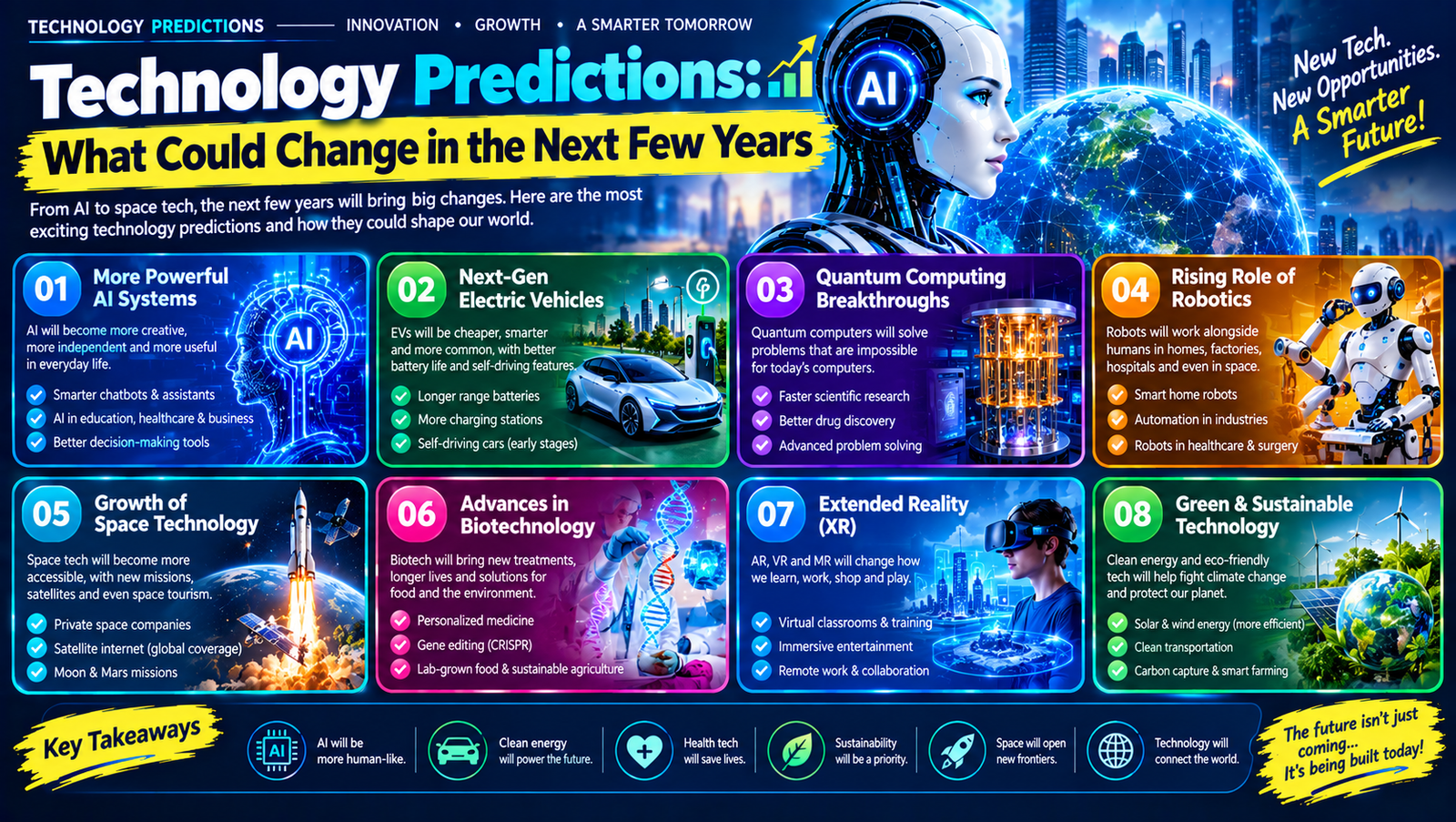
Meta Title: Technology Predictions: What Could Change in the Next Few Years?
Meta Description: Explore technology predictions for the next few years, including AI agents, robotics, quantum computing, smart devices, energy, cybersecurity and future workplaces.
Focus Keyword: technology predictions
Secondary Keywords: technology predictions 2026, future technology, technology trends, future of AI, AI agents, robotics future, quantum computing future, emerging technology
Suggested URL Slug: /technology-predictions-next-few-years/
Introduction
Technology rarely changes in a straight line.
Some innovations take decades to become practical. Others can move from research laboratories to everyday products surprisingly quickly. Artificial intelligence is a strong example. What once looked like an experimental technology is now being integrated into software, business workflows, research, devices and infrastructure.
Looking ahead from 2026, several technology trends could significantly influence the next few years.
AI agents may become more integrated into everyday software. Coding agents could change how applications are built. Robots may become more capable in selected real-world environments. Quantum technologies may move closer to practical applications. Energy systems may evolve alongside the growing power requirements of AI infrastructure. Cybersecurity may also become increasingly important as more systems become autonomous and connected.
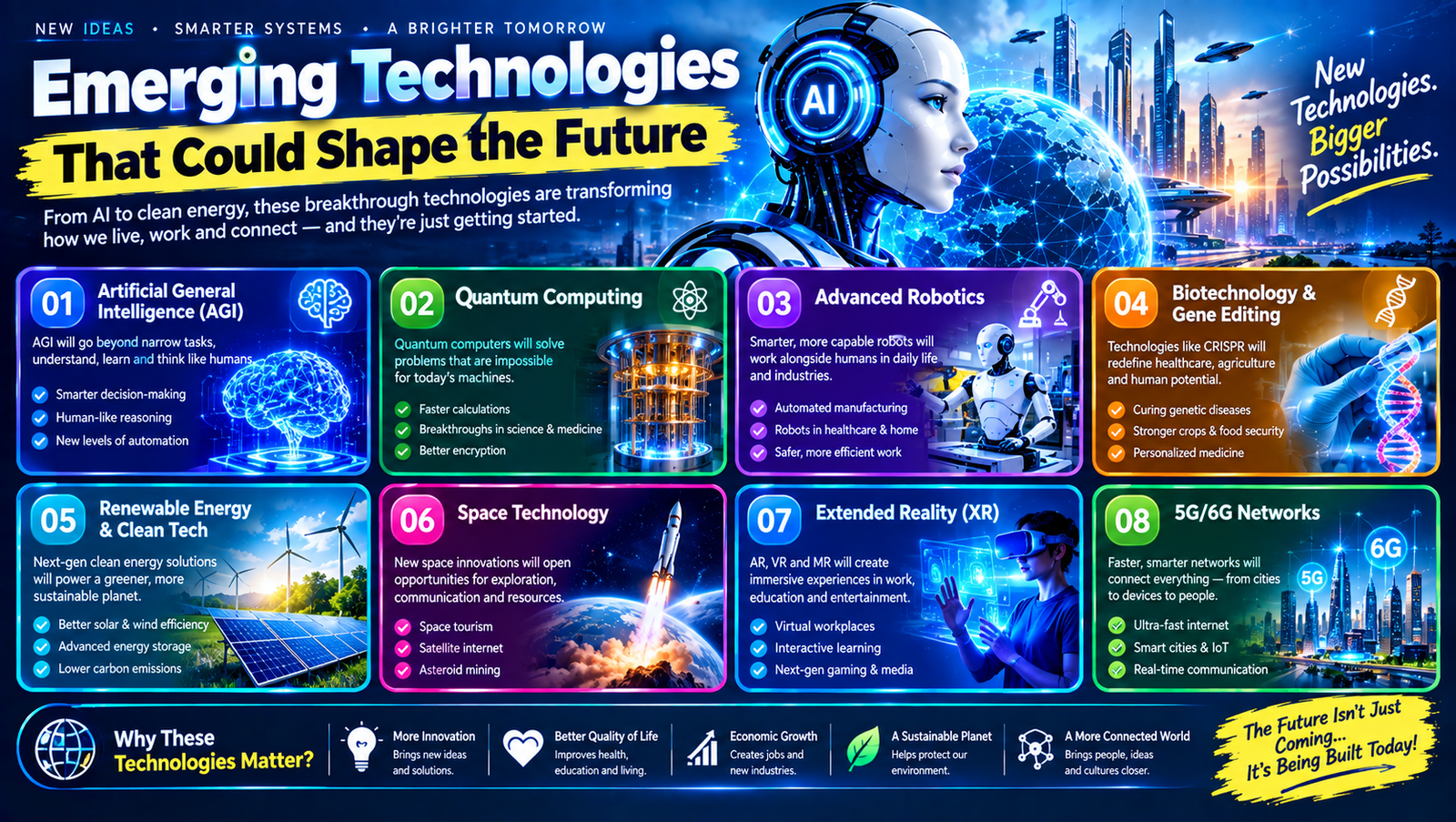
The World Economic Forum’s 2026 technology-convergence research identifies eight technology domains increasingly combining with one another: AI, omni computing, engineering biology, robotics, advanced materials, spatial intelligence, quantum technologies and next-generation energy.
McKinsey’s 2026 technology research similarly describes technology development moving beyond the screen into areas such as AI infrastructure, intelligent robots, power grids and advanced scientific applications.
These developments do not guarantee a particular future. Technology adoption depends on cost, reliability, regulation, infrastructure, consumer behavior and many other factors.
So rather than asking, “Exactly what will happen?”, a more useful question is:
“Which technologies are developing strongly enough today to potentially change how we live and work over the next few years?”
Let’s explore them.
1. AI Agents Could Become Part of Everyday Software
One of the strongest technology trends heading into the next few years is the development of AI agents.
Today’s AI assistants can already answer questions, generate content and help with many tasks.
The next step is more action-oriented AI.
An AI agent can be designed to:
- Understand a goal
- Plan multiple steps
- Use software tools
- Work with files
- Search information
- Write code
- Analyze data
- Perform actions
- Check results
McKinsey’s 2026 Global Tech Agenda reports that companies are increasingly investing in agentic AI systems that can plan, decide and act across workflows.
Its August 2026 State of AI research found that 40% of respondents from organizations with more than $1 billion in annual revenue reported scaling AI agents, compared with 27% the previous year.
What Could Change?
Instead of opening five different applications to complete a task, users may increasingly describe what they want and allow AI systems to coordinate parts of the workflow.
For example:
“Review these customer requests, identify urgent cases, prepare responses and create follow-up tasks.”
The AI may perform several connected actions instead of simply generating text.
This could affect:
- Customer support
- Administration
- Marketing
- Research
- Sales
- Finance
- Software development
However, agents will still require permissions, monitoring and human oversight for important tasks.
2. AI Could Become More Like a Digital Coworker
The next few years could see a change in how people think about AI.
Instead of viewing AI as a website or application that users open when needed, organizations may increasingly treat AI systems as part of their workforce.
McKinsey describes a future workplace involving partnerships between people, AI agents and robots. Its research emphasizes that automation potential does not directly equal job losses; actual adoption depends on technology, economics and how organizations redesign work.
A digital AI coworker could potentially:
- Prepare reports
- Research information
- Analyze documents
- Monitor dashboards
- Draft emails
- Update records
- Assist customers
- Write software
Humans would still be responsible for decisions, goals, quality and accountability.
The important change could therefore be less about humans versus AI and more about humans working with AI systems.
3. Software Development Could Become More AI-Driven
Software development is another area where the next few years could look very different.
AI coding tools already help developers write and understand code.
The next stage is agentic software development.
Instead of asking AI:
“Write this function.”
a developer could give a larger objective:
“Add this feature, update the relevant files, write tests and check for errors.”
AI coding agents can potentially work across multiple files and development tools.
McKinsey’s 2026 State of AI research found that about two in ten surveyed organizations were scaling software coding agents, with the share higher among large enterprises. It also reported that 32% of respondents said their organizations had decided against buying at least one software product or feature because they could build it internally using agentic coding tools.
Possible Impact
Software teams could potentially:
- Build prototypes faster
- Automate repetitive coding
- Test applications more efficiently
- Maintain older code
- Create internal tools
- Experiment with more ideas
But human developers will remain important for architecture, security, requirements and quality control.
4. AI Infrastructure Could Become a Major Part of the Economy
AI requires enormous computing infrastructure.
That includes:
- Chips
- Data centres
- Networking
- Storage
- Cooling
- Electricity
- Specialized AI hardware
This means the future of AI depends not only on software.
It also depends on the physical infrastructure underneath it.
The World Economic Forum reports that AI is driving a major infrastructure buildout involving computing, energy, water, minerals and land.
McKinsey’s 2026 technology outlook also highlights AI infrastructure as one of the major technology areas attracting substantial investment.
What Could Change?
Over the next few years, we may see continued development of:
- More efficient AI chips
- Larger AI data centres
- Specialized inference hardware
- Advanced cooling
- New data-centre designs
- More local AI computing
This could make AI services faster and potentially cheaper to operate.
5. AI Could Move Further Onto Personal Devices
Cloud AI is powerful, but not every AI task needs to be processed in a distant data centre.
More AI capabilities could increasingly run directly on:
- Smartphones
- Laptops
- Tablets
- Cars
- Cameras
- Wearable devices
- Industrial machines
This is sometimes called edge AI or local AI.
Why Does Local AI Matter?
Running AI locally can potentially provide:
- Faster responses
- Lower latency
- Offline functionality
- Greater control over data
- Reduced cloud dependency
For example, a smartphone might process certain voice, image or writing tasks locally rather than sending every request to the cloud.
The result could be a future where AI is less visible as a separate service and more deeply integrated into the devices people already use.
6. Smartphones Could Become More Like AI Assistants
The smartphone has already evolved from a communication device into a general-purpose computer.
AI could be the next major transformation.
Instead of manually opening applications, users could increasingly describe their goals.
For example:
“Find the photos from my trip, organize them and create a short video.”
Or:
“Summarize today’s important messages and show me anything that needs a reply.”
AI could potentially work across multiple applications, depending on the permissions available.
This could change the role of the traditional app interface.
Instead of:
Open app → find feature → perform action
the experience could increasingly become:
Tell AI what you want → AI coordinates the necessary tools.
7. Search Could Become More Conversational
Search is another area that could change significantly.
Traditional search usually involves:
- Enter a query
- Receive links
- Open multiple pages
- Compare information
AI-powered search can instead provide:
- Summaries
- Explanations
- Follow-up questions
- Comparisons
- Research assistance
- Contextual answers
This does not necessarily mean traditional search disappears.
Instead, search could become more conversational and task-oriented.
For example, instead of searching:
“Best laptop specifications for video editing”
a user might ask:
“I have a $1,000 budget and mainly edit 4K videos. Compare suitable options and explain which specifications matter.”
The system can potentially provide a more personalized research experience.
This could also change how websites attract visitors, making authoritative, original and useful content increasingly important.
8. Robotics Could Move From Factories Into More Real-World Environments
Robotics is another technology worth watching.
Industrial robots have existed for decades, but newer AI systems are making robots more adaptable.
The combination of:
AI + computer vision + sensors + robotics + simulation
could produce machines capable of handling more varied environments.
The World Economic Forum identifies robotics and physical AI as part of the broader convergence of emerging technologies.
Potential Applications
Over the next few years, robotics could expand in:
- Warehouses
- Manufacturing
- Logistics
- Agriculture
- Healthcare
- Inspection
- Construction
Humanoid robots may also become more visible in selected commercial applications.
However, widespread general-purpose household robots are not guaranteed. Cost, reliability, safety and hardware complexity remain significant barriers.
9. Physical AI Could Become a Major Technology Category
Most current AI operates digitally.
Physical AI aims to bring intelligence into machines that interact with the real world.
A physical AI system needs to understand:
- Space
- Objects
- Movement
- People
- Instructions
- Environmental changes
McKinsey’s September 2026 research describes physical AI as a frontier where machines perceive, reason and act in the real world, while noting that computational, sensing and safety challenges remain.
Why This Matters
A digital AI can make a recommendation.
A physical AI system can potentially act on that recommendation.
For example:
AI identifies an object → robot plans movement → robot picks up object → system checks result.
That combination could change industrial automation.
10. Quantum Computing Could Enter More Practical Applications
Quantum computing is often discussed as a technology of the distant future.
But the next few years may bring more experimentation and specialized commercial applications.
Quantum computing could potentially contribute to:
- Chemistry
- Materials science
- Optimization
- Drug discovery
- Cryptography
- Energy systems
- Scientific simulation
The World Economic Forum’s 2026 research notes that quantum technology is developing across computing, sensing and communications, while significant hardware and scaling challenges remain.
This means the likely near-term story is not:
“Quantum computers replace normal computers.”
Instead, it may be:
“Quantum systems begin solving selected problems alongside classical computers.”
Hybrid quantum-classical approaches are an area receiving attention.
11. Quantum Security Could Become More Important
Quantum computing creates a cybersecurity challenge because sufficiently capable quantum machines could threaten some existing cryptographic systems.
That makes post-quantum cryptography increasingly important.
Organizations may need to prepare their systems before large-scale quantum attacks become practical.
This could affect:
- Banking
- Government
- Cloud computing
- Healthcare
- Telecommunications
- Enterprise systems
The World Economic Forum’s 2026 Global Risks Report notes that quantum advances could create future risks to current cryptographic systems and emphasizes that quantum technology is still undergoing significant development.
For businesses, the lesson is simple:
Future cybersecurity planning needs to consider quantum technology today.
12. Energy Technology Could Become Just as Important as AI
AI needs electricity.
As AI data centres expand, energy infrastructure becomes increasingly important.
The World Economic Forum describes AI as triggering a large infrastructure expansion that involves energy, water, minerals and land.
This means future technology development may increasingly depend on energy innovation.
Important areas include:
- Battery storage
- Smart grids
- Renewable energy
- Nuclear energy
- Geothermal energy
- Grid optimization
- Energy-efficient computing
The technology industry may therefore become increasingly connected to the energy industry.
13. Everything-to-Grid Systems Could Change Energy Management
One emerging concept is everything-to-grid energy.
The basic idea is that buildings, vehicles and devices can potentially become active participants in electricity systems rather than simply consuming power.
For example, electric vehicles could store electricity.
When demand is low:
Vehicles charge.
When demand is high:
Some stored energy could potentially support the grid.
The World Economic Forum includes everything-to-grid energy among its Top 10 Emerging Technologies of 2026.
If deployed at scale, this could change how electricity systems manage supply and demand.
14. Batteries Could Become More Important
Battery technology is critical for:
- Electric vehicles
- Smartphones
- Laptops
- Renewable energy
- Data centres
- Robotics
As technology becomes more electrified, demand for efficient energy storage increases.
Research is continuing across different battery chemistries and designs.
At the same time, technologies such as direct lithium extraction could affect the supply side of battery materials.
The World Economic Forum’s 2026 emerging-technology report identifies direct lithium extraction as a technology moving toward larger-scale deployment.
Future battery improvements could focus on:
- Energy density
- Charging speed
- Cost
- Lifespan
- Safety
- Material availability
15. Biotechnology Could Become More Computational
Biology and computing are increasingly connected.
AI can help scientists analyze biological information and model complex systems.
Biotechnology can also be combined with engineering, automation and advanced materials.
The World Economic Forum’s 2026 technology-convergence report identifies engineering biology as one of eight major technology domains increasingly interacting with AI, robotics, materials and energy.
Potential Applications
This convergence could support:
- Drug discovery
- New materials
- Bio-manufacturing
- Agriculture
- Food technology
- Medical research
The important development is that biology is increasingly being treated as something that can be analyzed and engineered using advanced computational tools.
16. Personalized Healthcare Could Expand
Healthcare technology could become more personalized as AI, biotechnology and data systems improve.
Instead of treating every patient using exactly the same approach, healthcare could increasingly consider:
- Genetics
- Medical history
- Biomarkers
- Imaging
- Lifestyle
- Individual disease characteristics
The World Economic Forum’s 2026 emerging-technologies report highlights personalized mRNA cancer vaccines as one technology approaching broader real-world impact, while noting challenges around manufacturing, cost and access.
This does not mean personalized medicine will become universally available within a specific timeframe.
However, the direction of development is important.
17. Digital Twins Could Become More Useful
A digital twin is a digital representation of a real-world object or system.
For example, a factory can create a digital model of its production system.
Sensors can continuously provide information about the physical system.
AI can then analyze the information and help identify:
- Performance problems
- Maintenance requirements
- Energy waste
- Potential failures
Digital twins could become more useful as AI, sensors and simulation technology improve.
Possible applications include:
- Smart factories
- Buildings
- Energy grids
- Transportation
- Infrastructure
- Healthcare systems
18. Spatial Computing Could Change How We Use Computers
Today’s computing experience is largely based on flat screens.
Spatial computing offers a different approach.
Users can interact with digital objects in three-dimensional environments through technologies such as:
- Augmented reality
- Virtual reality
- Mixed reality
- Spatial interfaces
In the coming years, spatial computing could become more useful for:
- Training
- Engineering
- Education
- Healthcare
- Design
- Entertainment
The biggest opportunity may not be replacing smartphones or computers entirely.
Instead, spatial interfaces may become another way to interact with digital information.
19. AI Could Make Education More Personalized
Education could also change as AI systems become more capable.
A traditional online course gives every student approximately the same material.
An AI-powered learning system could potentially adjust based on:
- Student level
- Learning speed
- Mistakes
- Interests
- Previous knowledge
For example, if a student struggles with a mathematics concept, AI could explain it using a simpler example and generate additional practice questions.
This could make learning more adaptive.
However, teachers remain important because education involves motivation, social interaction, mentorship and human judgment.
20. AI Could Change Customer Service
Customer service is likely to become increasingly automated.
Basic questions may be handled by AI.
More complex problems could be transferred to human representatives.
Future customer-service systems could potentially:
- Understand the customer’s request
- Search company information
- Check account details
- Recommend a solution
- Complete authorized actions
- Escalate complicated cases
This could reduce repetitive work while allowing human employees to focus on more difficult situations.
The challenge will be ensuring that automated systems do not create frustrating experiences when they cannot understand a customer’s problem.
21. Cybersecurity Could Become More Automated
As organizations become more digital, cybersecurity becomes increasingly important.
AI can help security teams analyze enormous amounts of information.
Future security systems may increasingly use AI for:
- Threat detection
- Anomaly identification
- Incident investigation
- Automated alerts
- Vulnerability analysis
- Security monitoring
However, attackers can also use AI.
This creates an ongoing technology race.
As organizations automate more of their infrastructure, security systems will need to become faster and more intelligent.
22. AI and Robotics Could Change the Workplace
The workplace of the next few years may contain three types of workers:
Human Workers
People provide judgment, leadership, creativity and responsibility.
Digital Agents
AI systems perform software-based tasks.
Physical Robots
Robots perform physical tasks.
McKinsey’s research describes this emerging model as a partnership among people, agents and robots rather than simply a story of AI replacing humans.
This could create new job categories focused on:
- Managing AI agents
- Reviewing AI output
- Supervising robots
- AI workflow design
- AI security
- Human-AI collaboration
23. Technology Jobs Could Change Rather Than Simply Disappear
Predictions about jobs should be treated carefully.
Technology can automate some tasks while creating new ones.
For example, software developers may spend less time on repetitive coding but more time on:
- System design
- AI supervision
- Security
- Product development
Marketing professionals may spend less time producing basic content but more time on:
- Strategy
- Customer research
- Brand positioning
- Campaign optimization
The important distinction is between automating a task and automating an entire occupation.
McKinsey specifically notes that estimates of technical automation potential should not be interpreted as forecasts of job losses.
24. Technology Could Become More Personalized
Another possible change is the rise of personalized technology.
Instead of every user receiving the same software experience, systems could increasingly adapt to:
- Preferences
- Work habits
- Goals
- Context
- Devices
- Personal data
Imagine a personal AI system that understands your preferred writing style, knows which applications you use and helps organize your digital life.
This could make technology feel more like a personal assistant.
But personalization creates a major trade-off:
More personalization often requires more data.
Privacy and user control will therefore become increasingly important.
25. Technology Could Become More Invisible
One interesting possibility is that technology may become less visible.
Today, we consciously open apps and interact with interfaces.
In the future, many tasks may happen automatically.
For example:
- Your device organizes information automatically.
- AI summarizes messages before you read them.
- Your car adjusts systems based on conditions.
- Your home optimizes energy usage.
- Software agents handle routine administration.
Technology may increasingly operate in the background.
The user may care less about which technology is being used and more about whether the desired result is achieved.
26. Technology Convergence Could Create New Products
Perhaps the most important long-term prediction is the increasing combination of technologies.
The World Economic Forum’s 2026 Technology Convergence report identifies AI, omni computing, engineering biology, robotics, advanced materials, spatial intelligence, quantum and next-generation energy as major domains whose combinations could create new capabilities.
Consider some possible combinations:
AI + Robotics
More capable physical machines.
AI + Biology
Faster biological research.
AI + Quantum
New approaches to computational problems.
AI + Energy
Smarter energy management.
Robotics + Spatial Computing
Machines that better understand physical environments.
Advanced Materials + Energy
Potentially better batteries and energy systems.
This convergence may produce technologies that are difficult to predict by looking at individual fields separately.
27. The Next Few Years May Focus More on Real-World AI
Much of the early AI boom happened online.
AI generated:
- Text
- Images
- Code
- Audio
- Video
The next stage may increasingly involve the physical world.
McKinsey’s 2026 technology outlook describes this transition as technology moving “off the screen” into power grids, intelligent robots and other physical systems.
This could make the next phase of AI more dependent on:
- Hardware
- Sensors
- Batteries
- Robotics
- Energy
- Manufacturing
- Physical infrastructure
In other words, the future of AI may depend as much on the physical world as on software.
28. Not Every Technology Prediction Will Come True
This is one of the most important points about forecasting.
Technology predictions can be wrong.
A technology may fail because:
- It is too expensive
- It is difficult to manufacture
- Consumers do not want it
- Regulations slow adoption
- A better technology appears
- Infrastructure is unavailable
- Safety problems emerge
For example, a technology may work successfully in a laboratory but fail to become commercially viable.
Therefore, technology forecasts should be treated as possible scenarios, not guarantees.
The World Economic Forum’s 2026 technology foresight research emphasizes the importance of balancing long-term possibilities with practical realities rather than simply following short-term hype.
29. A Possible Technology Timeline
The exact timing is uncertain, but current developments suggest some broad areas to watch.
| Period | Technologies to Watch |
|---|---|
| 2026–2027 | AI agents, coding agents, AI infrastructure, edge AI |
| 2027–2029 | More enterprise agents, robotics pilots, advanced AI hardware |
| 2028–2030 | Broader physical AI applications, selected quantum use cases |
| 2030 and beyond | More advanced robotics, deeper technology convergence |
These are watch areas, not guaranteed dates.
Actual adoption will depend on technological progress, economics, regulation and infrastructure.
For example, McKinsey’s September 2026 analysis suggests that multipurpose robotics could remain focused on development and limited commercial deployment over the next three years, while improvements in batteries, dexterity and AI could support broader humanoid use cases over a longer horizon.
30. What Should Individuals Learn Now?
You do not need to become an expert in every future technology.
Instead, build adaptable skills.
Learn AI Fundamentals
Understand what AI can and cannot do.
Learn to Work With AI
Practice prompting, verification and AI-assisted workflows.
Learn Basic Data Skills
Data literacy will remain useful across many industries.
Learn Technology Basics
Understand cloud computing, cybersecurity, automation and software.
Develop Human Skills
Communication, creativity, critical thinking and decision-making remain important.
Learn Continuously
The ability to learn new tools may become more valuable than mastering one tool permanently.
31. What Should Businesses Prepare For?
Businesses can prepare without trying to predict everything.
Build Good Data Foundations
AI agents need reliable and well-organized information.
McKinsey’s 2026 research emphasizes that scaling agentic AI requires organizations to turn unstructured data into governed, reusable assets that AI systems can interpret and trust.
Experiment With AI
Start with practical use cases.
Improve Cybersecurity
More automation means more potential risk.
Train Employees
Employees need to understand both AI capabilities and limitations.
Monitor Costs
AI infrastructure can become expensive.
Keep Humans in the Loop
Important decisions require appropriate oversight.
Frequently Asked Questions
What will technology look like in the next few years?
Technology is likely to become more AI-driven, automated, connected and personalized. Areas such as AI agents, robotics, edge computing, cybersecurity, quantum technologies and energy systems are important areas to watch.
Will AI agents become common?
Current enterprise research shows growing adoption of AI agents, particularly among larger organizations. However, the pace of adoption will vary by industry and use case.
Will robots become common in homes?
That is uncertain. Robotics is advancing, but cost, safety, reliability and hardware complexity remain important barriers.
Will quantum computers replace normal computers?
There is no basis for expecting quantum computers to replace conventional computers generally. Their potential value is more likely to come from specialized problems where quantum algorithms may provide advantages.
What technology will have the biggest impact?
There is no reliable way to identify one guaranteed winner. AI is currently influencing many other technologies, but its future impact will depend on how it combines with computing, robotics, energy, biology and other fields.
Will technology eliminate jobs?
Technology can automate tasks and change occupations, but automation potential should not be treated as a direct prediction of job losses. New responsibilities and occupations can also emerge.
What should I learn to prepare for the future?
AI literacy, data skills, cybersecurity awareness, communication, critical thinking, problem-solving and continuous learning are useful across many possible technology scenarios.
Are technology predictions always accurate?
No. Predictions are scenarios based on available evidence and assumptions. Unexpected technical, economic, social and regulatory changes can alter the outcome.
Final Thoughts
The next few years could bring significant changes across technology, but the future is unlikely to follow a single predictable path.
AI agents may become more capable and more deeply integrated into business software. Coding agents could change software development. Robotics may gradually move into more real-world environments. Quantum computing could progress toward specialized applications. Energy technology may become increasingly important as computing demand grows.
At the same time, biotechnology, spatial computing, advanced materials and cybersecurity are likely to develop alongside these technologies.
The most important trend may be convergence.
The World Economic Forum’s 2026 research argues that major technology domains are increasingly combining rather than developing in isolation.
This means the future product may not simply be an “AI product,” a “robotics product” or a “quantum product.”
It could be a combination.
For example:
AI + robotics + sensors + advanced batteries
could create a new generation of physical machines.
Or:
AI + biotechnology + advanced computing
could support new approaches to scientific research.
Or:
AI + energy + smart grids + storage
could help manage increasingly complex electricity systems.
The biggest lesson is therefore not to predict one exact future.
Instead, watch the technologies that are becoming more capable, more affordable and more connected to real-world needs.
For individuals, the best preparation is to keep learning.
For businesses, the focus should be on solving real problems rather than following hype.
And for technology creators, the biggest opportunities may come from combining technologies that previously existed in separate industries.
The future of technology is not predetermined. But based on the developments already visible in 2026, the coming years could bring a deeper integration of AI, automation, robotics, computing, energy, biology and intelligent infrastructure.
The companies and people who understand these connections will be better positioned to adapt as technology continues to evolve.





Leave a Reply