
Meta Title: Top Technology Trends to Watch in 2026 | Future of Technology
Meta Description: Explore the top technology trends to watch in 2026, including AI, robotics, cloud computing, cybersecurity, smart devices, quantum computing, and more.
Focus Keyword: technology trends in 2026
Secondary Keywords: top technology trends, emerging technology 2026, future technology, latest technology trends, technology innovations, AI technology, future of tech
Suggested URL Slug: /top-technology-trends-2026/
Introduction
Technology is changing faster than ever.
Every year brings new software, devices, artificial intelligence systems, business tools, and digital services. Some technologies become part of everyday life almost immediately, while others need several years before their impact becomes visible.
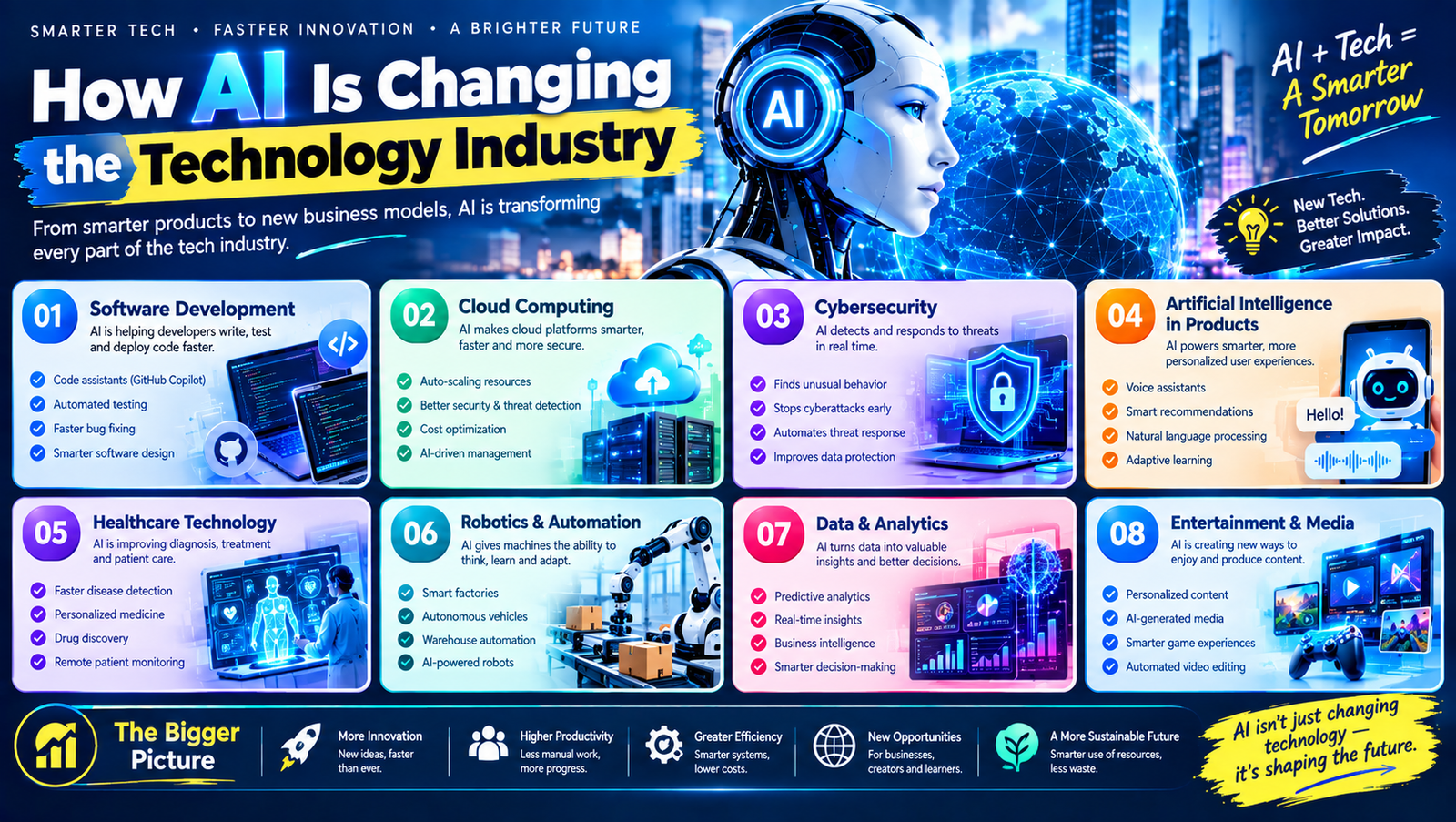
In 2026, technology is no longer developing in separate areas. Artificial intelligence is becoming part of cloud platforms, smartphones, software, cybersecurity, robotics, business applications, healthcare, education, and creative tools.
At the same time, other technologies are developing alongside AI. Robotics is becoming more capable, cybersecurity is becoming increasingly important, cloud computing is evolving, and organizations are exploring new approaches to computing and automation.
Understanding these developments can help individuals and businesses prepare for changes rather than simply reacting to them.
This guide explores the top technology trends in 2026, explains why they matter, and looks at how they could affect everyday users, businesses, developers, creators, and the wider digital economy.
What Are Technology Trends?
Technology trends are important developments, innovations, or changes in the way technology is created and used.
A technology trend does not necessarily mean that a completely new invention has appeared.
Sometimes a trend involves an existing technology becoming:
- More affordable
- More powerful
- Easier to use
- More widely available
- More deeply integrated into other products
- More useful for businesses and consumers
For example, artificial intelligence has existed for decades, but recent advances in generative AI have dramatically expanded the number of people using AI tools.
This makes AI not just a technology, but a major technology trend affecting many industries.
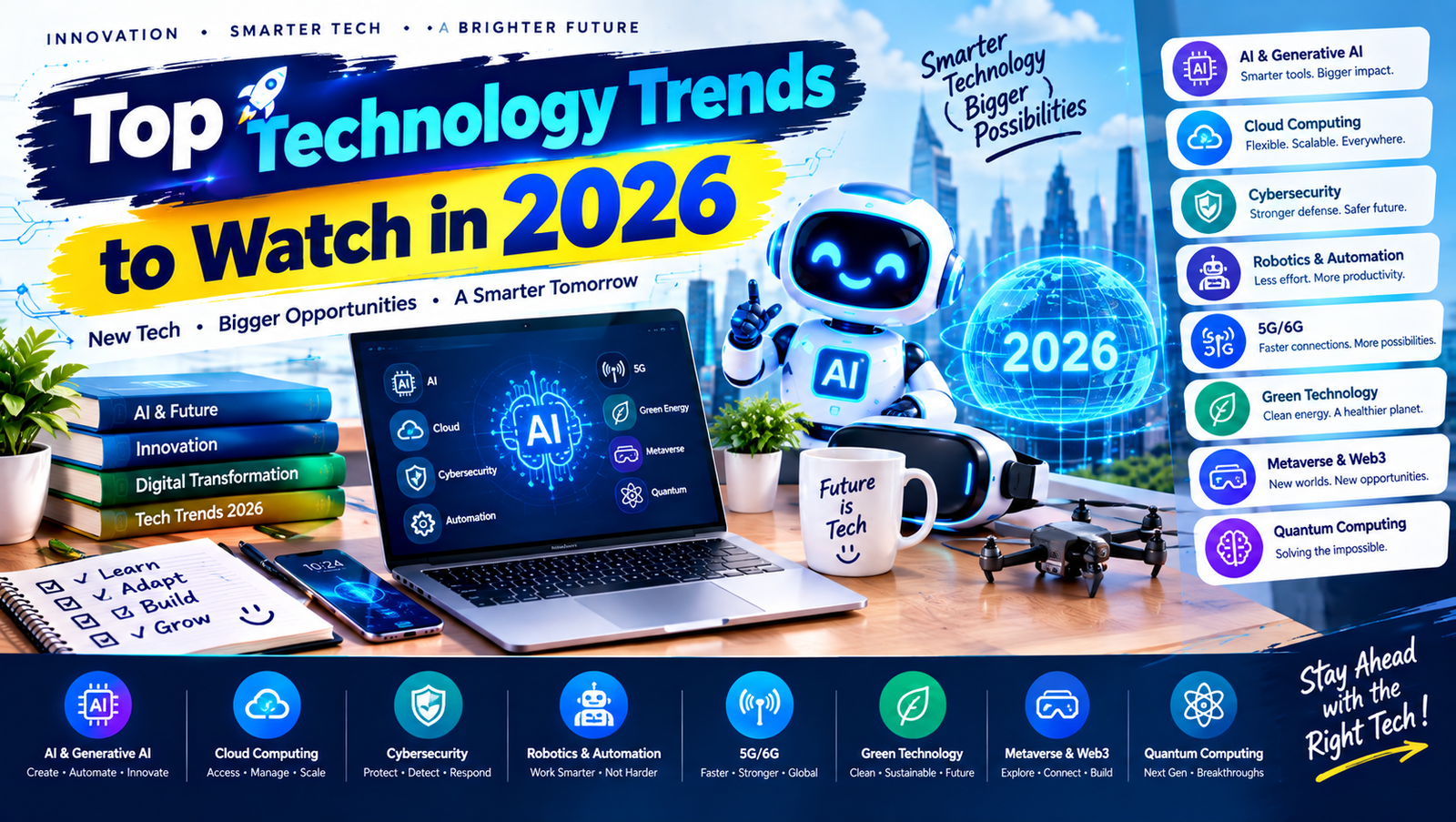
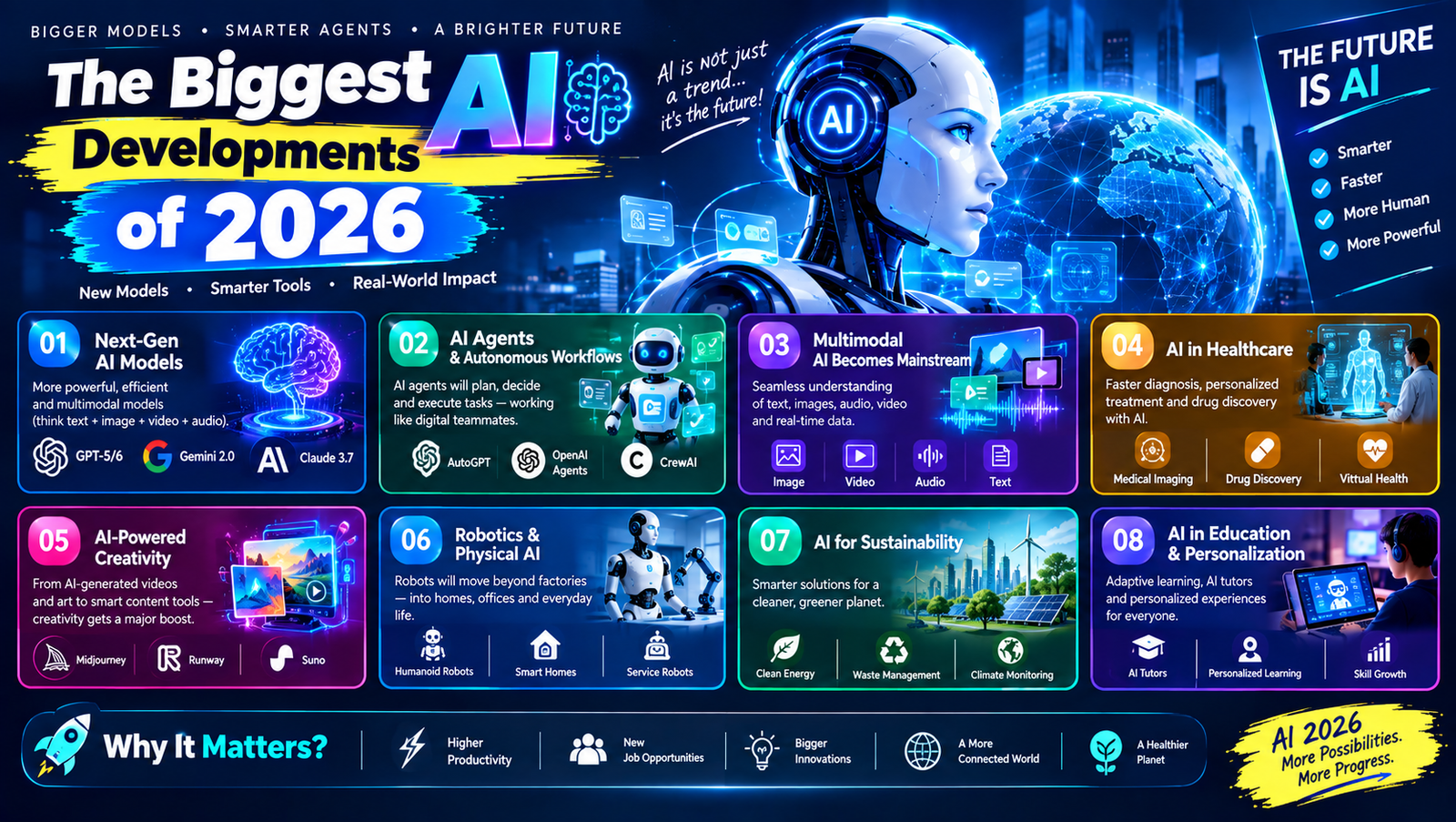
The Biggest Technology Trends to Watch in 2026
Several areas deserve attention this year.
| Technology Trend | Potential Impact |
|---|---|
| Artificial intelligence | Changes software, work and digital services |
| AI agents | Automates multi-step digital tasks |
| Robotics | Expands physical automation |
| Cloud and edge computing | Supports modern applications and AI |
| Cybersecurity | Protects increasingly connected systems |
| Quantum computing | Advances specialized computing research |
| Smart devices | Makes technology more connected |
| Digital twins | Improves simulation and monitoring |
| Spatial computing | Changes digital interaction |
| Sustainable technology | Focuses on efficiency and resource use |
Let’s explore these trends in more detail.
1. Artificial Intelligence Continues to Lead Technology
Artificial intelligence remains one of the most important technology trends in 2026.
AI is no longer limited to research laboratories or specialized software.
It is increasingly appearing in:
- Search
- Office software
- Smartphones
- Customer service
- Coding tools
- Design applications
- Education
- Marketing
- Cybersecurity
- Data analysis
- Business software
Generative AI can create text, images, audio, video, code, summaries, and other types of content.
This makes AI useful across a much broader range of activities than traditional software.
Why AI Matters
The major change is not simply that AI can generate content.
AI is increasingly becoming part of the tools people already use.
Instead of opening a separate AI application, users may interact with AI directly inside:
- Documents
- Email applications
- Search engines
- Development environments
- Design software
- Meeting platforms
- Customer support systems
This integration could make AI feel less like a separate product and more like a standard computing feature.
2. AI Agents and More Autonomous Software
Another important development is the growth of AI systems that can perform multiple steps rather than simply responding to a single prompt.
These systems are often described as AI agents.
A traditional chatbot might answer:
“How can I organize my project?”
An agent-based system could potentially help perform a sequence of tasks, depending on its permissions and integrations:
- Understand the objective
- Break it into smaller tasks
- Gather information
- Use connected software
- Complete individual steps
- Report the result
This represents a shift from AI that answers questions toward AI that can assist with workflows.
Potential Uses
AI agents could assist with:
- Research
- Customer support
- Software development
- Scheduling
- Data analysis
- Business operations
- Content workflows
- Administrative tasks
However, greater autonomy also creates new challenges.
Organizations need to think carefully about permissions, security, accuracy, monitoring, and accountability.
3. AI-Powered Software Development
AI is also changing how software is created.
Developers can use AI coding assistants to:
- Generate code
- Explain code
- Find potential bugs
- Create tests
- Refactor existing code
- Generate documentation
- Explore unfamiliar programming concepts
This does not mean software development has become completely automatic.
Professional development still requires architecture, testing, security, debugging, system design, and human judgment.
However, AI can reduce the amount of time spent on repetitive coding tasks.
The Bigger Change
The biggest impact may be that more people can experiment with software without having advanced programming knowledge.
Someone with an idea can describe what they want and use AI to help create an early prototype.
That could make software creation more accessible.
4. Robotics and Physical AI
Artificial intelligence is not limited to screens.
Robotics is another technology area receiving significant attention.
Modern robots can combine:
- Computer vision
- Sensors
- Machine learning
- Motion control
- Natural-language interfaces
- Advanced hardware
This allows robots to operate in increasingly complex environments.
Where Robotics Is Being Used
Robotics can be found in:
- Manufacturing
- Warehouses
- Logistics
- Agriculture
- Healthcare
- Research
- Transportation
- Industrial inspection
Humanoid robots are also receiving significant research and commercial attention.
However, widespread general-purpose humanoid robotics remains a developing area.
The important trend is the combination of AI with physical machines.
This could eventually allow robots to understand environments and perform a wider variety of tasks.
5. Cloud Computing Continues to Evolve
Cloud computing remains a fundamental part of modern technology.
Companies use cloud infrastructure for:
- Websites
- Applications
- Databases
- Storage
- Analytics
- AI systems
- Business software
- Collaboration
The cloud is particularly important for AI because modern AI systems can require significant computing resources.
Instead of purchasing and maintaining all the required hardware themselves, businesses can access computing resources through cloud providers.
6. Edge Computing
While cloud computing remains important, some applications also need computing closer to where data is generated.
This is where edge computing becomes useful.
Instead of sending every piece of information to a distant data center, some processing can happen closer to the device or network.
This can be useful for applications that require:
- Low latency
- Fast responses
- Local processing
- Reduced bandwidth use
Examples can include:
- Industrial systems
- Smart cameras
- Autonomous machines
- Connected vehicles
- Smart infrastructure
Cloud and edge computing are not necessarily competing technologies.
Many modern systems can use both.
7. Cybersecurity Becomes Even More Important
As more systems become connected and AI becomes more widely used, cybersecurity becomes increasingly important.
Organizations have to protect:
- Customer information
- Employee accounts
- Financial data
- Cloud infrastructure
- Applications
- Devices
- AI systems
- Internal networks
Cybersecurity threats can include:
- Phishing
- Malware
- Credential theft
- Ransomware
- Data breaches
- Social engineering
- Software vulnerabilities
AI is also becoming part of the cybersecurity landscape.
Security teams can use AI to analyze large amounts of information, detect unusual behavior, and support incident response.
At the same time, attackers can also use AI to make certain attacks more sophisticated.
This creates an ongoing technological competition between security defenders and attackers.
8. Quantum Computing Continues to Develop
Quantum computing is one of the more experimental technology trends.
Traditional computers use bits.
Quantum computers use quantum bits, commonly called qubits.
Quantum computing uses principles of quantum mechanics to approach certain computational problems differently from classical computers.
Potential areas of interest include:
- Scientific research
- Chemistry
- Materials science
- Optimization
- Cryptography
- Drug discovery
However, quantum computing should not be described as a replacement for everyday computers.
Most everyday applications will continue to use classical computing.
Quantum systems are being explored for specialized problems where their unique characteristics may provide advantages.
9. Spatial Computing and Immersive Technology
Spatial computing combines digital information with physical environments.
It can include technologies such as:
- Augmented reality
- Virtual reality
- Mixed reality
- 3D interfaces
- Spatial audio
These technologies can change how people interact with digital content.
Instead of looking at information only on a flat screen, users can potentially interact with digital objects in three-dimensional space.
Possible Applications
Spatial computing can be useful for:
- Training
- Education
- Product visualization
- Design
- Engineering
- Entertainment
- Remote collaboration
- Simulation
The technology is still developing, but improvements in hardware and software could make immersive computing more practical.
10. Smart Devices and Connected Technology
Smart devices are becoming increasingly interconnected.
Examples include:
- Smart watches
- Smart TVs
- Smart speakers
- Home security devices
- Smart appliances
- Connected vehicles
- Industrial sensors
The broader concept is often called the Internet of Things (IoT).
IoT devices collect and exchange information, allowing physical environments to become more digitally connected.
For consumers, this can make homes more convenient.
For businesses, connected sensors can provide information about:
- Equipment
- Inventory
- Energy use
- Production
- Maintenance
However, more connected devices also mean more security and privacy considerations.
11. Digital Twins
A digital twin is a digital representation of a physical object, system, or environment.
The concept can be used to model things such as:
- Machines
- Buildings
- Factories
- Vehicles
- Infrastructure
Sensors can provide information about the real-world object, while software creates a corresponding digital model.
Businesses can then use the model to:
- Monitor performance
- Simulate changes
- Identify potential problems
- Plan maintenance
- Improve efficiency
For example, an industrial company could create a digital representation of a machine and monitor its condition using sensor data.
12. Sustainable and Energy-Efficient Technology
Technology development increasingly includes questions about energy use and efficiency.
AI data centers, cloud infrastructure, connected devices, and large-scale computing can require significant amounts of energy.
This creates interest in:
- Energy-efficient hardware
- Better cooling
- Renewable energy
- Efficient data centers
- Low-power devices
- Improved battery technology
Sustainable technology is therefore not just an environmental issue.
It can also be a business issue because energy efficiency can affect operating costs.
13. AI-Powered Search and Information Discovery
Search is also changing.
Traditional search generally provides a list of webpages.
AI-powered search can provide a conversational response that combines information into a more direct explanation.
This can make information discovery easier for many users.
However, users should still verify important information.
AI-generated answers can contain errors, misunderstand sources, or leave out important context.
The future of search is therefore likely to involve a combination of traditional web results, structured information, and AI-generated responses.
14. Personalized Technology Experiences
AI can make software more personalized.
Instead of every user receiving exactly the same interface or recommendations, AI systems can adapt based on:
- User preferences
- Previous interactions
- Work patterns
- Context
- Goals
For example, a productivity application might prioritize the tasks that appear most relevant to a user’s current work.
A learning platform could adapt educational material based on a student’s progress.
Personalization can improve usability, but it also raises questions about privacy and data collection.
15. AI in Healthcare and Scientific Research
Healthcare and scientific research are also areas where AI is being explored.
AI can assist researchers and professionals with:
- Data analysis
- Image analysis
- Research literature
- Drug discovery
- Scientific modeling
- Administrative tasks
In healthcare, AI can support certain workflows, but medical decisions require appropriate professional oversight.
The important trend is the use of computing and AI to process information that would be difficult to analyze manually at large scale.
16. Advanced Battery and Energy Technologies
Energy storage is another important area for technology development.
Batteries affect:
- Smartphones
- Electric vehicles
- Renewable energy
- Portable devices
- Robotics
- Data centers
Research continues into improving:
- Energy density
- Charging speed
- Safety
- Lifespan
- Manufacturing cost
Better energy storage could support wider adoption of electric transportation and renewable energy systems.
17. Low-Code and No-Code Development
Not everyone who needs software is a professional developer.
Low-code and no-code platforms allow users to build applications and workflows using visual interfaces and simplified development tools.
AI is making this trend even more interesting.
Users can increasingly describe what they want in natural language and receive help creating:
- Forms
- Automations
- Websites
- Databases
- Internal applications
- Business workflows
This could allow small businesses and individual creators to build useful digital tools without maintaining large development teams.
How These Technology Trends Connect
One of the most important things to understand about technology in 2026 is that these trends don’t exist independently.
They increasingly work together.
For example:
AI + Cloud Computing
AI models require significant computing resources, much of which can be delivered through cloud infrastructure.
AI + Robotics
AI gives robots more advanced capabilities for understanding environments and performing tasks.
AI + Cybersecurity
AI can help analyze security information and detect unusual patterns.
AI + IoT
AI can analyze information collected from connected devices.
AI + Edge Computing
AI processing can sometimes happen closer to the device for faster responses.
AI + Spatial Computing
AI can help users interact naturally with immersive digital environments.
This combination of technologies may be more important than any individual technology by itself.
How Technology Trends Could Affect Businesses
Businesses may experience several major changes.
Greater Automation
Repetitive administrative work may increasingly be assisted by software and AI.
Smaller Teams With More Digital Tools
A small company may be able to accomplish tasks that previously required larger teams.
Faster Product Development
AI-assisted development can shorten some stages of software and content creation.
Increased Cybersecurity Requirements
More digital systems mean more responsibility for protecting data.
New Business Models
Emerging technologies can create new services and markets that were previously difficult to build.
Businesses that experiment with technology carefully may discover new opportunities, but they also need to evaluate costs, risks, and practical value.
How Technology Trends Could Affect Individuals
Technology is not only changing companies.
It is changing everyday activities too.
People may use AI and other technologies for:
- Learning
- Writing
- Communication
- Shopping
- Entertainment
- Work
- Personal organization
- Travel
- Creativity
The most useful skill may therefore not be knowing every new technology.
Instead, it may be knowing how to evaluate technology and learn new tools quickly.
Technology Skills Worth Learning in 2026
If you want to prepare for the changing technology landscape, consider developing skills in areas such as:
AI Literacy
Understand what AI can and cannot do.
Cybersecurity Awareness
Learn how to protect accounts, devices and information.
Data Literacy
Understand basic data analysis and interpretation.
Digital Communication
Learn to work effectively with digital collaboration tools.
Automation
Understand how repetitive workflows can be streamlined.
Critical Thinking
Learn how to evaluate AI-generated information.
Adaptability
Technology changes quickly, so the ability to learn new tools is increasingly valuable.
How to Keep Up With Technology Trends
Technology news can become overwhelming.
You don’t need to follow every new product announcement.
Instead:
Follow Reliable Sources
Look for official documentation, research organizations, reputable technology publications and company announcements.
Test Tools Yourself
When practical, use new technology instead of relying entirely on promotional claims.
Focus on Problems
Ask:
“What problem does this technology solve?”
rather than:
“Is this technology popular?”
Watch Adoption
A technology can receive significant attention without becoming widely useful.
Look at practical adoption, usability and real-world results.
Common Mistakes When Following Technology Trends
1. Believing Every Hype Cycle
Not every new technology will become mainstream.
2. Confusing Demonstrations With Mature Products
A technology demo may look impressive while still being difficult or expensive to use at scale.
3. Ignoring Security
New technology can introduce new vulnerabilities.
4. Focusing Only on Hardware
Software, infrastructure, data and cybersecurity are equally important.
5. Learning Tools Instead of Skills
Individual applications can change quickly.
Fundamental skills are more durable.
Frequently Asked Questions
What is the biggest technology trend in 2026?
Artificial intelligence is one of the most significant technology trends because it is being integrated into many different areas, including software, search, business applications, cybersecurity, robotics and creative tools.
What technology will grow in the future?
AI, robotics, cloud computing, cybersecurity, connected devices, advanced computing and energy technologies are all areas receiving significant development and investment. The pace and scale of adoption will vary by technology and industry.
Is AI the future of technology?
AI is likely to remain an important part of future technology, but it will work alongside other technologies such as cloud computing, robotics, cybersecurity, advanced hardware and connected devices.
Should beginners learn AI?
Learning basic AI concepts and how to use AI tools can be useful for many people. Understanding AI limitations and responsible use is just as important as learning how to operate the tools.
Will robots replace humans?
Robots can automate certain physical tasks, but the extent of automation varies by industry and task. Many roles will continue to require human judgment, communication, creativity and responsibility.
Is quantum computing ready for everyday use?
Quantum computing remains primarily focused on specialized research and applications. It is not a replacement for ordinary computers used for everyday tasks.
Why is cybersecurity becoming more important?
As more information, devices and business processes move online, protecting digital systems becomes increasingly important.
Final Thoughts
The technology trends in 2026 show that the future is not being shaped by one invention alone.
Artificial intelligence is clearly an important driver, but its impact becomes even more significant when combined with cloud computing, robotics, cybersecurity, connected devices, edge computing, spatial technology, advanced energy systems and other innovations.
For businesses, these technologies can create new opportunities while introducing new responsibilities.
For individuals, they can change how we work, learn, communicate and create.
The most practical way to prepare is not to chase every new technology.
Instead, focus on understanding the major trends, experiment with useful tools, protect your data, verify information, and develop skills that remain valuable even when individual technologies change.
Technology will continue to evolve.
The people and organizations that learn how to evaluate and use these changes thoughtfully will be better prepared to adapt to whatever comes next.
The future of technology isn’t just about more powerful machines. It is about how people use those machines to solve real problems.





Leave a Reply