

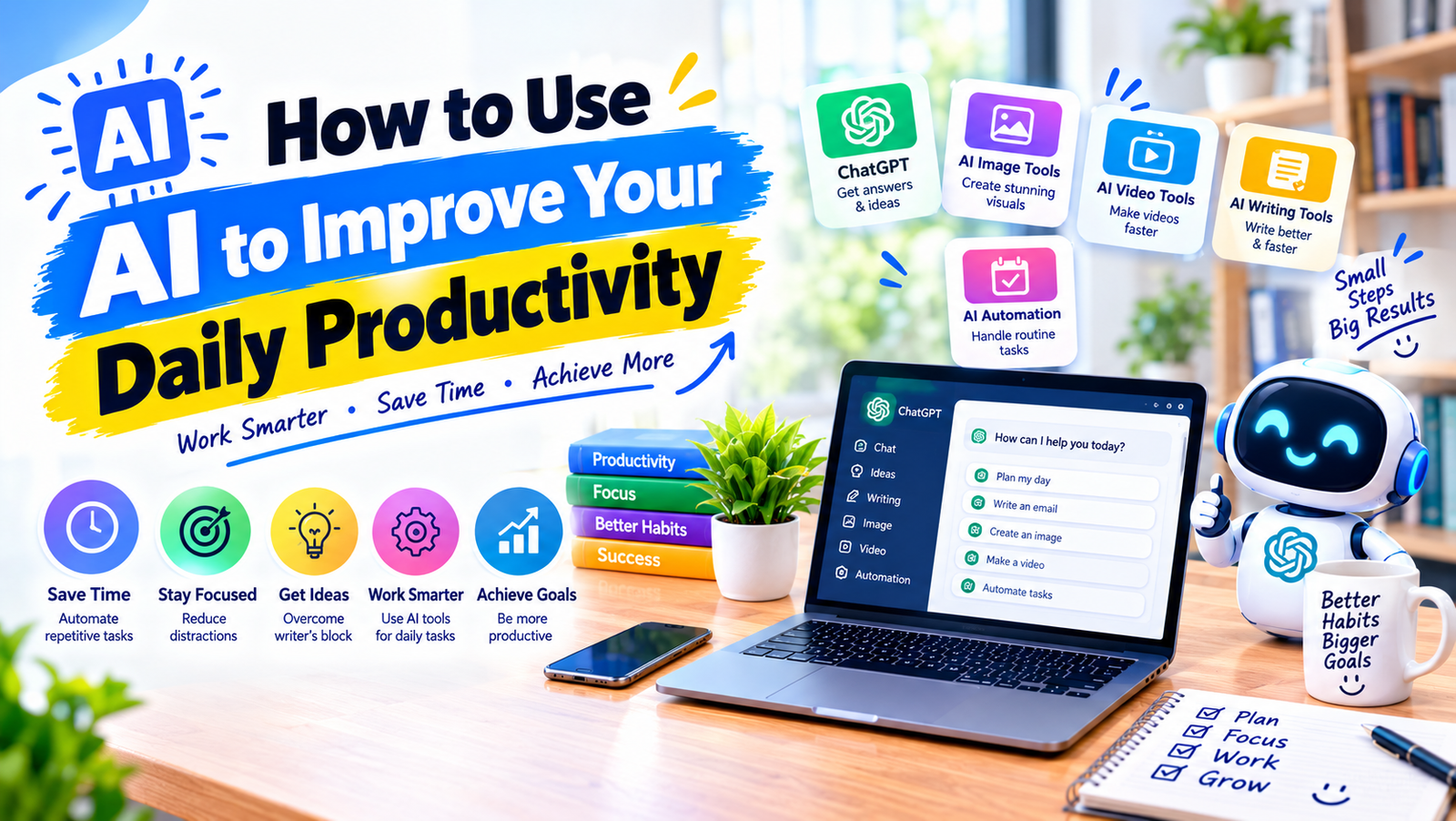
Meta Title: How to Use AI to Improve Your Daily Productivity in 2026
Meta Description: Learn how to use AI to improve daily productivity, manage tasks, plan your schedule, write faster, organize information, and save time.
Focus Keyword: How to Use AI to Improve Your Daily Productivity
Secondary Keywords: AI productivity, AI productivity tools, AI for daily tasks, AI time management, AI personal assistant, productivity with AI, how AI improves productivity
Suggested URL Slug: /how-to-use-ai-to-improve-your-daily-productivity/
Introduction
Being productive does not always mean working longer hours.
In fact, one of the biggest productivity problems today is spending too much time on small, repetitive tasks. Checking emails, organizing notes, preparing documents, creating lists, summarizing information, planning meetings, and deciding what to do next can take a surprising amount of time.
Artificial intelligence can help with many of these tasks.
AI tools can act like a digital assistant that helps you organize information, create drafts, brainstorm ideas, summarize documents, plan your day, and turn complicated tasks into manageable steps.
The important thing is to use AI as an assistant rather than a replacement for your judgment.
You decide what matters. AI helps you get there faster.
In this guide, we’ll explore practical ways to use AI to improve your daily productivity, whether you are a student, employee, freelancer, blogger, business owner, or simply someone who wants to manage time more effectively.
What Is AI Productivity?
AI productivity means using artificial intelligence to help you complete tasks more efficiently.
Traditional productivity tools usually require you to manually enter information, organize tasks, create lists, or search through documents.
AI adds another layer.
Instead of only storing information, AI can help you understand, organize, summarize, rewrite, prioritize, and transform information.
For example, a traditional notes application might store a page of meeting notes.
An AI assistant can potentially turn those notes into:
- A short summary
- Important decisions
- Action items
- Deadlines
- Questions
- A follow-up email
That difference is what makes AI useful for productivity.
Why Should You Use AI for Productivity?
AI can help reduce the amount of time you spend on repetitive work.
Here are some of the biggest benefits.
1. Save Time
AI can quickly create drafts, summaries, lists, and outlines.
2. Reduce Repetitive Work
Tasks you perform repeatedly can often be assisted by AI.
3. Organize Information
AI can turn messy information into structured notes and categories.
4. Get Started Faster
If you don’t know how to begin a task, AI can give you a starting point.
5. Improve Communication
AI can help make emails and documents clearer and easier to understand.
6. Support Better Planning
AI can help turn large goals into smaller, actionable tasks.
However, these benefits depend on how you use the technology. AI does not automatically make every workflow better.
1. Use AI to Plan Your Day
One of the easiest ways to begin using AI is daily planning.
Instead of looking at a long list of tasks and wondering where to start, give your tasks to an AI assistant.
For example:
“I need to finish a report, answer 15 emails, attend a meeting at 11 AM, prepare a presentation, and research a new project. I have eight working hours today. Create a realistic schedule and prioritize the most important tasks.”
AI can organize your responsibilities into a schedule.
You should then adjust that schedule based on your actual commitments.
Example
| Time | Activity |
|---|---|
| 8:30–9:00 | Review priorities |
| 9:00–10:30 | Work on report |
| 10:30–11:00 | Answer urgent emails |
| 11:00–12:00 | Meeting |
| 12:00–12:30 | Break |
| 12:30–2:00 | Finish report |
| 2:00–3:00 | Remaining emails |
| 3:00–4:00 | Presentation |
| 4:00–4:30 | Project research |
The schedule is only a framework.
Unexpected tasks and interruptions are normal, so leave some flexibility.
2. Use AI to Prioritize Your Tasks
A long to-do list can make everything appear equally important.
AI can help categorize your tasks according to:
- Urgency
- Importance
- Deadline
- Effort
- Potential impact
For example:
| Task | Priority |
|---|---|
| Submit report today | High |
| Respond to urgent client | High |
| Prepare next week’s plan | Medium |
| Organize old files | Low |
| Read optional material | Low |
You can ask:
“Analyze these tasks and identify which three should receive my attention first. Consider deadlines and importance.”
The final decision should remain yours.
AI doesn’t know every detail of your situation unless you provide it.
3. Break Big Projects Into Smaller Tasks
Large projects often feel difficult because the goal is too broad.
For example:
“Launch a website”
is a large task.
AI can break it into smaller actions:
- Define the website purpose
- Choose a niche
- Select a domain
- Choose hosting
- Plan categories
- Create navigation
- Create important pages
- Prepare content
- Add images
- Test the website
- Check mobile usability
- Review SEO
- Publish
Now you don’t have to think about the entire project at once.
You only need to focus on the next task.
Useful prompt
“Break this project into small, actionable steps. Put them in logical order and identify which tasks should be completed first.”
This method can work for websites, business projects, courses, events, marketing campaigns, and personal goals.
4. Use AI as a Daily Personal Assistant
You can use an AI assistant for many small tasks throughout the day.
For example, you might ask it to:
- Create a checklist
- Summarize a document
- Rewrite a message
- Explain something
- Brainstorm ideas
- Create a schedule
- Organize notes
- Prepare questions
- Generate a template
The value comes from combining these small improvements.
Saving five minutes on one task may not seem significant.
Saving five minutes across ten tasks can make a meaningful difference.
5. Use AI to Write Emails Faster
Email is one of the easiest areas where AI can save time.
Instead of writing every email from scratch, give AI your key information.
For example:
“Write a professional email telling the client that the website is almost complete but needs two more days for testing. Thank them for their patience and ask them to confirm the final content.”
AI can turn your instructions into a polished draft.
You should then check:
- Names
- Dates
- Deadlines
- Claims
- Tone
- Attachments
- Requested actions
Never send an important AI-generated email without reviewing it.
6. Use AI to Improve Existing Writing
AI isn’t only useful for creating new content.
It can also improve text you’ve already written.
For example:
“Rewrite this email to make it clearer and more professional while keeping my original meaning.”
You can also ask:
“Make this shorter.”
“Make this more friendly.”
“Remove unnecessary repetition.”
“Rewrite this in simple English.”
This can be especially useful when English isn’t your first language.
7. Use AI to Summarize Long Documents
Long documents can consume a lot of time.
AI can help extract:
- Main ideas
- Important facts
- Decisions
- Deadlines
- Action items
- Questions
- Recommendations
For example:
“Summarize this document in 10 key points. Then list the decisions, deadlines, and actions mentioned in it.”
This can help you understand the overall document before reading every section in detail.
For important business, legal, financial, or other high-stakes information, the original document should still be checked carefully.
8. Use AI to Organize Messy Notes
Many people take notes quickly and organize them later.
The problem is that “later” often never comes.
Suppose your notes say:
Client website. Need homepage. Blog. Maybe store. Launch next month. Send proposal Friday. Ask about payment method.
AI can turn them into:
Project
Client Website
Requirements
- Homepage
- Blog
- Possible online store
Timeline
- Target launch: next month
Action Items
- Prepare proposal
- Confirm ecommerce requirements
- Ask about payment method
- Follow up Friday
This turns messy information into something actionable.
9. Use AI Before Meetings
Meetings are more productive when you know what you want to accomplish.
AI can help prepare:
- Agendas
- Questions
- Talking points
- Background summaries
- Discussion topics
- Possible objections
For example:
“I have a meeting with a potential client about a website. Create a 30-minute agenda covering goals, audience, required features, budget, timeline, content, and next steps.”
This can make meetings more focused.
10. Use AI After Meetings
The work doesn’t end when the meeting ends.
You may still need to:
- Write notes
- Send a summary
- Assign tasks
- Record decisions
- Schedule follow-ups
AI can help organize these tasks.
For example:
“Turn these meeting notes into a summary with decisions, action items, responsible people, and deadlines.”
Always review the result before sharing it with others.
11. Use AI to Create Checklists
Checklists are simple but extremely useful.
If you repeatedly perform a process, ask AI to create a checklist.
For example, a blog publishing checklist could include:
- Check title
- Review headings
- Check grammar
- Add meta description
- Add featured image
- Add internal links
- Check external links
- Check formatting
- Test mobile display
- Preview
- Publish
Once you create the checklist, you can reuse it.
12. Use AI to Create Weekly Plans
Daily planning is useful, but weekly planning can provide a bigger picture.
Tell AI:
- Your projects
- Deadlines
- Meetings
- Available working hours
- Important personal commitments
Then ask:
“Create a realistic weekly plan. Give priority to deadlines and important projects. Leave buffer time for unexpected tasks.”
This can help you avoid discovering a deadline at the last minute.
13. Use AI for Time Blocking
Time blocking means assigning specific periods to specific activities.
For example:
8:30–10:30: Deep work
10:30–11:00: Email
11:00–12:00: Meeting
12:00–1:00: Break
1:00–3:00: Project work
3:00–4:00: Administrative tasks
AI can help create a time-blocking plan around your existing commitments.
The important thing is not to fill every minute.
Leave space for unexpected work.
14. Use AI to Reduce Task Switching
Switching constantly between unrelated tasks can make work feel harder.
Instead, group similar activities.
Communication block
- Messages
- Calls
Creative block
- Writing
- Design
- Video planning
Administrative block
- Reports
- Invoices
- File organization
AI can help turn a long task list into these groups.
This can make your day easier to organize.
15. Use AI for Brainstorming
Sometimes productivity isn’t about working faster.
Sometimes the problem is simply not knowing what to do.
AI can become a brainstorming partner.
For example:
“Give me 20 practical ways to increase traffic to a new technology website.”
Or:
“Give me 15 ideas for improving customer service for a small online business.”
You don’t need to use every idea.
The purpose is to generate possibilities that you can evaluate.
16. Use AI to Create Templates
Templates can save time when you repeatedly create similar content.
Useful templates include:
- Email replies
- Project updates
- Meeting agendas
- Reports
- Proposals
- Customer support messages
- Social media posts
- Checklists
For example:
Project Update Template
Project:
Completed:
In Progress:
Problems:
Next Steps:
Expected Completion:
Once you create a good template, you can reuse it repeatedly.
17. Use AI to Learn New Skills
AI can also improve productivity by helping you learn.
Instead of searching randomly for information, ask AI to create a structured learning plan.
For example:
“Create a 30-day beginner plan for learning SEO. Give me one topic per day, a practical exercise, and five questions to test my understanding.”
AI can explain concepts at different levels.
You can ask:
“Explain this like I’m a complete beginner.”
Then:
“Now explain the technical version.”
This makes AI useful as an interactive learning assistant.
18. Use AI to Create Study Plans
Students can use AI to organize:
- Subjects
- Assignments
- Exams
- Revision
- Practice
- Breaks
For example:
“I have three exams in two weeks. Create a realistic study plan based on these subjects and the number of chapters remaining.”
AI can create a starting schedule.
You should adjust it based on your actual learning speed.
19. Use AI for Content Creation
If you are a blogger, freelancer, or social media creator, AI can assist with:
- Topic ideas
- Headlines
- Outlines
- Drafts
- Editing
- Social captions
- Video scripts
- Content calendars
- Repurposing
For example:
One article
can become:
- 5 Facebook posts
- 3 short-video scripts
- 1 email
- 10 social media hooks
- 5 discussion questions
This means you can get more value from the same original idea.
20. Use AI to Create Social Media Content
Social media requires consistency.
AI can help turn one topic into different formats.
For example:
Topic: Benefits of AI productivity
AI can create:
Short post
“AI isn’t only about generating content. It can also help you plan your day, organize notes, and reduce repetitive work.”
Video hook
“Still spending hours on tasks AI can help you finish in minutes?”
Carousel idea
- AI for planning
- AI for email
- AI for meetings
- AI for research
- AI for organization
You can then customize the content to match your own style.
21. Use AI for End-of-Day Reviews
An end-of-day review can help you prepare for tomorrow.
Give AI:
- Completed tasks
- Unfinished tasks
- New responsibilities
- Upcoming deadlines
Then ask:
“Create tomorrow’s priority list based on this information.”
You can also ask:
“What tasks should I move, cancel, delegate, or schedule for later?”
This creates continuity between your workdays.
22. Use AI to Reduce Decision Fatigue
People make many small decisions every day.
AI can help structure those decisions.
For example:
“I have four tasks left and two hours. Help me decide which task should receive the most attention based on urgency, importance, and deadline.”
Or:
“Give me three practical ways to organize these responsibilities and explain the advantages of each approach.”
AI provides options.
You make the final decision.
23. Use AI to Create a Better Work Routine
AI can help you design routines for:
- Morning planning
- Deep work
- Meetings
- Learning
- Content creation
- End-of-day review
For example:
Morning
15 minutes planning
↓
90 minutes focused work
↓
30 minutes communication
↓
Break
Afternoon
Project work
↓
Meeting
↓
Administrative tasks
↓
End-of-day review
The routine should match your real working conditions.
24. Don’t Create Unrealistic AI Schedules
One of the biggest mistakes is asking AI to fill every available minute.
A schedule might look productive but be impossible to follow.
For example:
8:00: Write article
9:00: Finish project
10:00: Learn a skill
11:00: Attend meeting
12:00: Create social media content
1:00: Research
2:00: Complete another project
Real life doesn’t work perfectly.
Emails arrive.
Meetings run late.
Technical problems happen.
You get tired.
A good AI schedule should include buffer time.
25. Use AI for Repetitive Work, Not Every Decision
A useful rule is:
Let AI help with repetitive tasks
Examples:
- Summaries
- Drafts
- Formatting
- Categorization
- Brainstorming
- Rewriting
- Checklists
Keep human control over important decisions
Examples:
- Business strategy
- Financial decisions
- Sensitive communication
- Confidential matters
- Final approvals
- Important commitments
AI can support your thinking without replacing it.
26. Protect Your Privacy
Productivity work can contain sensitive information.
Before entering information into an AI tool, consider whether it contains:
- Passwords
- Financial information
- Customer information
- Private company data
- Personal identification information
- Confidential contracts
- Sensitive business information
If you are using AI at work, follow your organization’s policies.
Don’t assume that every AI service has identical privacy practices.
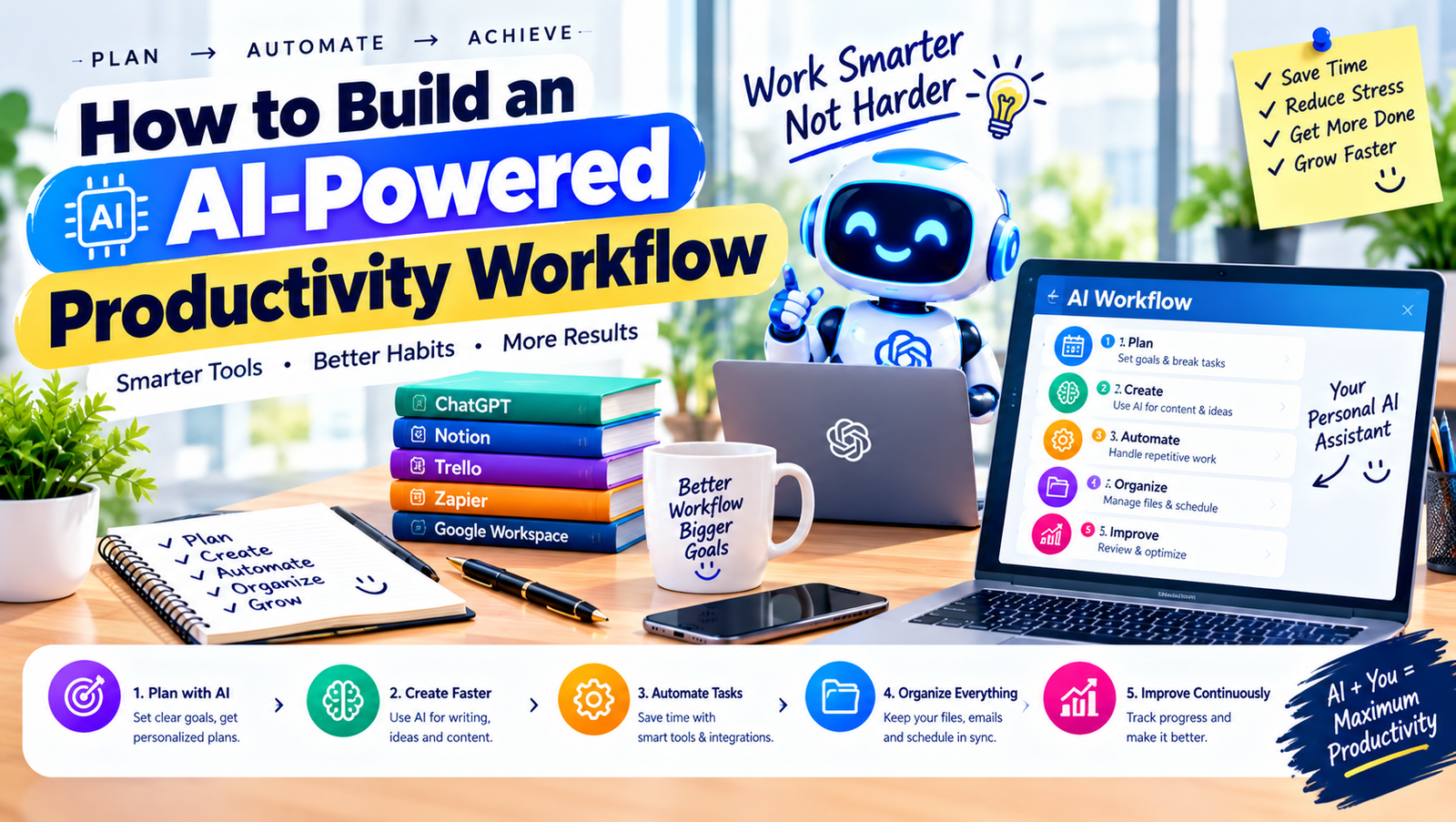
27. How to Create a Simple AI Productivity System
You don’t need dozens of applications.
Start with one general AI assistant.
Then create five basic workflows.
Workflow 1: Morning Planning
Tasks → AI → Priorities → Schedule
Workflow 2: Email
Notes → AI → Draft → Human review → Send
Workflow 3: Meetings
Meeting → Notes/transcript → AI summary → Action items
Workflow 4: Content
Idea → AI outline → Draft → Human editing → Publish
Workflow 5: Evening Review
Completed work → AI review → Tomorrow’s priorities
This simple system is enough for many people.
28. 10 AI Prompts for Daily Productivity
Prompt 1: Plan My Day
“Here are today’s tasks and deadlines. Create a realistic schedule with priorities and buffer time.”
Prompt 2: Prioritize
“Organize these tasks according to urgency, importance, deadline, and impact.”
Prompt 3: Break Down a Project
“Break this large project into small actionable steps and put them in the correct order.”
Prompt 4: Write an Email
“Turn these notes into a professional and concise email.”
Prompt 5: Summarize
“Summarize this information into the most important points and list any actions I need to take.”
Prompt 6: Meeting Preparation
“Create a meeting agenda and five useful questions based on these topics.”
Prompt 7: Meeting Notes
“Turn these notes into a summary with decisions, action items, deadlines, and unanswered questions.”
Prompt 8: Brainstorm
“Give me 20 practical ideas for solving this problem. Group them by approach.”
Prompt 9: Learning
“Create a 30-day learning plan for this skill with daily lessons and practical exercises.”
Prompt 10: Tomorrow’s Plan
“Review these completed and unfinished tasks and create my top priorities for tomorrow.”
Common Mistakes When Using AI for Productivity
Mistake 1: Using Too Many AI Tools
More tools don’t automatically mean more productivity.
Start with one or two.
Mistake 2: Trusting AI Without Checking
AI can make mistakes.
Review important outputs.
Mistake 3: Giving Poor Instructions
“Write an email” provides very little context.
Explain the audience, purpose, tone, and desired outcome.
Mistake 4: Automating Important Decisions
AI should not automatically make decisions that require your judgment.
Mistake 5: Sharing Confidential Information
Be careful with private and sensitive information.
Mistake 6: Measuring Productivity by Busyness
Completing many small tasks doesn’t necessarily mean you accomplished something important.
Measure progress by meaningful results.
A 7-Day AI Productivity Challenge
If you’re new to AI productivity, try this simple seven-day experiment.
Day 1
Use AI to plan your day.
Day 2
Use AI to draft emails.
Day 3
Use AI to summarize a long document.
Day 4
Use AI to organize messy notes.
Day 5
Use AI to prepare for a meeting.
Day 6
Use AI to create a checklist or template.
Day 7
Review which uses actually saved you time.
Keep the workflows that provide genuine value.
Frequently Asked Questions
Can AI really improve daily productivity?
Yes. AI can reduce the time spent on repetitive tasks such as drafting, summarizing, planning, organizing, and brainstorming.
What is the easiest way to start using AI?
Start with one repetitive task. Email writing, summarization, brainstorming, and daily planning are good starting points.
Can AI plan my whole day?
AI can create a schedule based on your tasks and deadlines, but you should review and adjust the schedule according to your real circumstances.
Can students use AI for productivity?
Yes. Students can use AI for study planning, explanations, summaries, quizzes, brainstorming, and organizing assignments. They should still do their own learning and verify important information.
Can AI replace productivity apps?
Not necessarily. Calendars, task managers, note-taking applications, and other traditional tools remain useful. AI adds value by helping interpret and transform information.
Is AI productivity safe?
It depends on the tool, settings, and information you provide. Avoid sharing sensitive information without understanding how the service handles it.
Does AI make people more productive automatically?
No. AI is a tool. Poorly designed workflows can become more complicated when too many AI tools are added. The goal should be to reduce unnecessary work.
Final Thoughts
AI can become a valuable part of your daily productivity system.
You can use it to plan your day, prioritize tasks, write emails, summarize documents, prepare meetings, organize notes, create checklists, brainstorm ideas, learn new skills, and manage repetitive work.
But productivity isn’t about doing more work every minute.
It’s about using your available time more intelligently.
A practical approach is:
Plan with AI → Focus on important work → Use AI for repetitive tasks → Review the results → Improve your workflow.
Start small.
Choose one task that regularly consumes too much time. Use AI to make that task easier. Once you understand what works, add another workflow.
Over time, AI can become a practical assistant that helps you spend less time on repetitive work and more time on meaningful activities.
Use AI for efficiency, but keep human judgment at the center of your productivity system.





Leave a Reply