
Meta Title: Best AI Meeting and Note-Taking Tools in 2026
Meta Description: Discover the best AI meeting and note-taking tools in 2026. Learn how AI can transcribe meetings, create summaries, capture action items, and save time.
Focus Keyword: AI meeting and note-taking tools
Secondary Keywords: best AI meeting tools, AI note-taking tools, AI meeting assistant, meeting transcription AI, AI meeting summary, automatic meeting notes, AI productivity tools
Suggested URL Slug: /best-ai-meeting-and-note-taking-tools/
Introduction
Meetings are an important part of modern work, but they can also create a surprising amount of additional work.
Someone has to take notes, remember important decisions, identify action items, record deadlines, and share the information with people who could not attend.
When a meeting lasts one hour, the work does not necessarily end when everyone leaves the call.
You may still need to spend another 15 or 30 minutes organizing your notes and writing a follow-up message.
This is one reason AI meeting and note-taking tools have become increasingly useful.
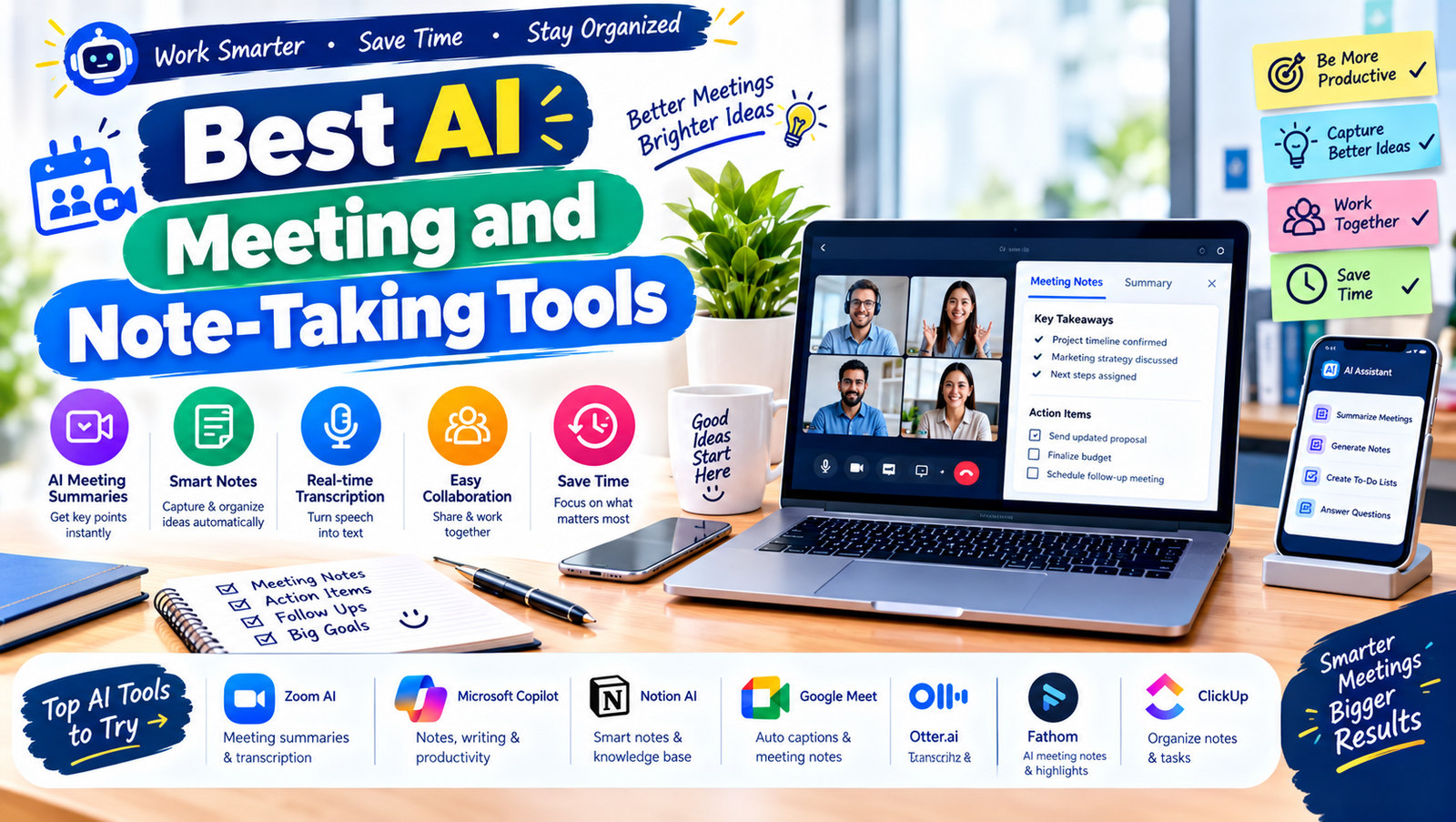
Modern AI meeting assistants can help with tasks such as:
- Transcribing conversations
- Creating meeting summaries
- Identifying important topics
- Extracting action items
- Organizing decisions
- Capturing questions
- Helping people catch up after joining late
- Searching meeting information
- Creating follow-up content
Some tools work directly inside platforms such as Google Meet, Microsoft Teams, and Zoom, while others work as dedicated meeting assistants across multiple platforms.
In this guide, we’ll explain how AI meeting tools work, what features to look for, the major options available in 2026, and how to use them effectively.
What Are AI Meeting and Note-Taking Tools?
AI meeting tools use artificial intelligence to help capture and organize information from meetings.
Depending on the software, an AI meeting assistant may be able to:
- Listen to a meeting
- Convert speech into text
- Identify speakers
- Understand important topics
- Generate a summary
- Extract action items
- Identify decisions
- Create searchable meeting records
The exact features vary from one service to another.
Some tools require an AI bot or notetaker to join the meeting as a participant. Others are integrated directly into the meeting platform.
For example, Google Meet’s “Take notes for me” feature can automatically create meeting notes in Google Docs and provide a recap after the meeting.
Why Use AI for Meeting Notes?
Traditional meeting notes have several problems.
A person taking notes may miss something while trying to write down another statement.
They may also focus too much on individual comments and fail to capture the overall decision.
AI can help reduce this problem by processing the conversation and creating structured information.
Major benefits include:
Save Time
You don’t have to manually write every important point.
Better Organization
AI can turn a long conversation into sections such as:
- Summary
- Decisions
- Action items
- Questions
- Next steps
Easier Follow-Up
After the meeting, you can use the summary to prepare follow-up emails and task lists.
Easier Catch-Up
Someone who missed the meeting may be able to review the summary rather than asking another employee to explain everything.
Searchable Information
Some AI meeting systems allow you to search or ask questions about meeting content.
How AI Meeting Assistants Work
Although different tools use different technologies, the basic workflow is similar.
Step 1: Meeting Capture
The tool receives meeting audio, captions, or other permitted meeting information.
Step 2: Transcription
Speech is converted into text.
Step 3: AI Processing
The system analyzes the transcript to identify important information.
Step 4: Summary
The AI creates a shorter version of the discussion.
Step 5: Action Items
Important tasks and follow-up items may be extracted.
Step 6: Review
Users check the output before treating it as the official meeting record.
This final step is important because AI-generated transcripts and summaries can contain errors.
Best AI Meeting and Note-Taking Tools in 2026
There is no single tool that is perfect for every organization.
The right option depends on:
- Your meeting platform
- Company software
- Team size
- Privacy requirements
- Budget
- Required integrations
- Meeting languages
- Whether you need a bot
- Whether you need advanced search
Here are some major options to consider.
1. Google Meet with Gemini
Google Meet includes AI-powered meeting features for eligible Google Workspace editions and Google AI plans.
One of its key features is “Take notes for me.”
It can automatically capture meeting notes, organize them in Google Docs, and provide a meeting recap. If someone joins late, the system can also provide a “Summary so far” in supported situations.
After the meeting, the notes document can be saved in the organizer’s Google Drive and connected with the Google Calendar event.
Useful Features
- Automatic meeting notes
- Meeting summaries
- Action items
- Google Docs integration
- Google Calendar integration
- “Summary so far”
- Ask Gemini during meetings
Google’s Ask Gemini in Meet can help users summarize discussions, identify key takeaways, decisions, and action items, and catch up on certain information during a meeting.
Best For
Google Workspace users who already use:
- Gmail
- Google Calendar
- Google Docs
- Google Meet
Important Limitation
Google currently documents supported languages for “Take notes for me” and notes that the feature supports one meeting language at a time.
2. Microsoft Teams with Copilot and Intelligent Recap
Microsoft Teams provides several AI-powered meeting features.
Teams meeting recap can bring together information such as recordings, transcripts, shared content, notes, agendas, and follow-up tasks. Intelligent recap adds AI-generated summaries and other meeting insights.
Microsoft also provides AI meeting notes and recommended tasks through its meeting features.
Useful Features
Depending on the Teams setup and available license, users may have access to:
- AI meeting summaries
- Meeting notes
- Action items
- Speaker information
- Meeting chapters
- Topics
- Timeline markers
- Recap information
- Follow-up tasks
Microsoft also provides Facilitator, which can generate real-time AI notes, summarize decisions and open questions, answer questions, and help create structured information from meeting discussions.
Best For
Organizations already using:
- Microsoft Teams
- Microsoft 365
- Outlook
- Word
- SharePoint
Important Consideration
Microsoft notes that AI-generated meeting information can be inaccurate or incomplete, so users should review it before relying on it.
3. Zoom AI Companion
Zoom has expanded its AI capabilities beyond simple meeting summaries.
AI Companion can help generate meeting information and assist users with follow-up tasks.
Zoom also provides AI note-taking capabilities designed to work across different meeting environments.
Its current AI note-taking functionality can capture information from Zoom, Microsoft Teams, Google Meet, and in-person conversations in supported scenarios.
Useful For
- Meeting summaries
- Notes
- Key takeaways
- Action items
- Cross-platform meetings
Best For
Businesses that already use Zoom or want AI assistance across different meeting platforms.
4. Otter AI
Otter is a dedicated AI meeting notetaker rather than simply an AI feature inside one meeting platform.
Its current Otter Notetaker can automatically join Zoom, Google Meet, and Microsoft Teams meetings, record and transcribe them, and provide AI-generated summaries.
It also provides features such as:
- Real-time transcription
- Meeting summaries
- Automated live summaries
- Slide capture
- AI chat
- Meeting Q&A
Otter can connect with calendars so scheduled meetings can be synchronized and the notetaker can automatically join selected meetings.
Best For
People or teams that regularly use multiple meeting platforms.
Useful Example
Suppose your company uses Google Meet for some clients, Teams for internal meetings, and Zoom for another group.
A cross-platform tool such as Otter can provide a more consistent note-taking workflow.
5. Fireflies.ai
Fireflies is another dedicated AI meeting assistant focused on capturing and organizing conversations.
Its platform provides meeting transcription, summaries, search, speaker recognition, and action items. Fireflies currently advertises support for more than 100 languages and provides AI-generated meeting summaries.
Useful Features
- Meeting transcription
- AI summaries
- Action items
- Searchable conversations
- Speaker recognition
- Multiple language support
- Meeting analysis
It can be particularly useful for teams that want to build a searchable collection of meeting information.
Best For
- Sales teams
- Customer-facing teams
- Managers
- Remote teams
- Organizations with many meetings
AI Meeting Tools Comparison
| Tool | Main Strength | Platform Focus | Useful For |
|---|---|---|---|
| Google Meet + Gemini | Integrated AI notes | Google Workspace | Google-based teams |
| Microsoft Teams + Copilot | Meeting recap and workplace integration | Microsoft 365 | Microsoft-based organizations |
| Zoom AI Companion | AI meeting assistance | Zoom + supported workflows | Zoom users |
| Otter | Cross-platform meeting notes | Zoom, Meet, Teams | Multi-platform users |
| Fireflies.ai | Transcription and conversation analysis | Multiple meeting platforms | Teams with many meetings |
The table is a general comparison of capabilities; exact features can depend on your account, subscription, administrator settings, and current product configuration.
What Features Should You Look For?
Choosing an AI meeting tool isn’t only about transcription.
Consider the following features.
1. Accurate Transcription
If the transcript is inaccurate, the summary may also be inaccurate.
Look for tools that work well with the languages and accents used by your team.
2. Automatic Summaries
A transcript can be extremely long.
A useful AI system should turn the transcript into something easier to read.
For example:
Meeting Summary
- Project progress reviewed
- Homepage design approved
- Mobile testing still required
- Client review scheduled for Friday
This is much easier to use than reading an entire transcript.
3. Action Items
One of the most valuable meeting features is extracting tasks.
For example:
| Action | Person | Deadline |
|---|---|---|
| Update homepage | Sarah | Wednesday |
| Test mobile version | Ahmed | Thursday |
| Send client preview | Manager | Friday |
AI can help identify these items, but the participants should verify who is actually responsible.
4. Decision Tracking
Meetings often contain important decisions.
A useful AI system should help distinguish decisions from general discussion.
For example:
Decision: The company will launch the new website on October 15.
Discussion: Several possible designs were reviewed.
This distinction makes meeting records more useful.
AI Meeting Notes vs Traditional Notes
Traditional notes:
Website discussed. Design looks good. Need mobile test. Client meeting Friday.
AI-organized notes:
Meeting Summary
The team reviewed the website design and agreed that the current direction is suitable.
Decision
The current design will move forward.
Action Items
- Complete mobile testing.
- Prepare client preview.
- Review final changes before Friday.
Next Meeting
Client review scheduled for Friday.
The second format is easier to scan and use.
How to Use AI Meeting Tools Effectively
Simply turning on an AI notetaker doesn’t guarantee better meetings.
Use a structured process.
Before the Meeting
Prepare:
- Meeting objective
- Agenda
- Participants
- Important questions
- Expected decisions
During the Meeting
Make sure participants understand that AI note-taking or recording is being used where applicable.
Keep discussions structured.
Clearly state important decisions and action items.
After the Meeting
Review the AI summary.
Check:
- Names
- Decisions
- Dates
- Deadlines
- Assigned tasks
- Important numbers
Then share the corrected version.
Why Human Review Is Still Important
AI meeting tools are powerful, but they are not perfect.
An AI system may misunderstand:
- A person’s name
- A technical term
- A number
- A deadline
- A speaker
- A joke or informal statement
- The difference between a suggestion and a final decision
For example, someone might say:
“We could launch this on Friday.”
An AI summary might incorrectly interpret this as:
“The team decided to launch on Friday.”
These are completely different meanings.
Human review helps prevent such mistakes.
Privacy and Consent
Meeting information can contain sensitive business or personal information.
Before using an AI meeting assistant, check:
- Company policy
- Meeting platform settings
- Data retention rules
- Who can access transcripts
- Who can access summaries
- Whether external participants need to be informed
- Whether recording or transcription requires consent
Google, for example, documents consent and host controls for its meeting AI features. When “Take notes for me” is active, participants are informed that notes are being taken.
Google also notes that meeting hosts should consider consent from external participants when using Ask Gemini in Meet.
Always follow applicable laws and organizational policies.
AI Meeting Notes for Remote Teams
Remote teams can benefit significantly from automated meeting documentation.
Imagine a team with members in different cities.
One employee cannot attend the weekly meeting.
Instead of asking another employee:
“What happened in the meeting?”
they can review:
- Summary
- Decisions
- Action items
- Key discussion points
This reduces repeated communication and makes information easier to access.
AI for Client Meetings
AI meeting tools can also help freelancers, agencies and businesses manage client conversations.
A client meeting may include:
- Requirements
- Budget
- Deadlines
- Revisions
- Responsibilities
- Future plans
After the meeting, AI can help organize these details.
For example:
Client Requirements
- New homepage
- Mobile-friendly design
- Contact form
- Updated pricing section
Client Decisions
- New layout approved
- Blue color scheme selected
Next Steps
- Send design preview
- Complete mobile version
- Schedule final review
This creates a useful reference for both sides.
AI Meeting Tools for Sales Teams
Sales teams often have many conversations with prospects and customers.
Meeting AI can help organize:
- Customer requirements
- Questions
- Objections
- Follow-up tasks
- Product requests
- Next meeting dates
This can reduce the amount of manual note-taking required after calls.
It can also make it easier for another team member to understand what happened during a customer conversation.
However, teams should follow their organization’s rules regarding customer data and recording.
AI Meeting Tools for Students and Education
AI note-taking can also be useful for students and educational meetings.
For example, students may use AI-supported notes to organize:
- Lecture discussions
- Study meetings
- Project meetings
- Research conversations
- Group assignments
A student could turn a long discussion into:
- Main topics
- Important concepts
- Questions
- Tasks
- Study points
Students should still verify information against their course materials and instructor guidance.
How to Turn Meeting Notes Into a Follow-Up Email
One of the most useful workflows is connecting meeting notes to follow-up communication.
After the meeting, you can ask an AI assistant:
“Turn these meeting notes into a professional follow-up email. Include the decisions, action items, deadlines, and next meeting date.”
The result can provide a first draft.
Then review it before sending.
Example Structure
Subject: Meeting Follow-Up – Website Project
Summary:
The team reviewed the current website design.
Decisions:
The homepage design was approved.
Action Items:
- Team A will complete mobile testing.
- Team B will update the pricing page.
Next Step:
Client review will take place Friday.
This workflow can save additional time after the meeting.
How to Turn Meeting Notes Into a Task List
You can also transform the summary into a project task list.
Prompt:
“Extract all actionable tasks from these meeting notes. Create columns for task, owner, priority and deadline. If an owner or deadline is not explicitly mentioned, leave it blank instead of guessing.”
That final instruction is important.
It prevents AI from inventing information.
How to Use AI Meeting Tools Without Creating More Work
The purpose of an AI meeting assistant is to reduce administrative work.
Don’t create a complicated system that requires constant manual management.
A simple workflow is enough:
Meeting → AI notes → Human review → Action list → Follow-up
This keeps the process practical.
Common Mistakes to Avoid
1. Trusting the Summary Without Checking
Always verify important decisions.
2. Ignoring Consent
Participants should know when applicable recording, transcription, or AI note-taking is active.
3. Using an Unapproved Tool
Companies may have approved platforms for handling workplace information.
4. Recording Everything Automatically
Not every conversation needs to be recorded or transcribed.
Consider whether AI capture is appropriate for the meeting.
5. Treating Suggestions as Decisions
AI may not always understand the difference between discussion and final agreement.
6. Forgetting Action Owners
A task isn’t useful if nobody knows who is responsible.
7. Sharing Sensitive Summaries Too Widely
Meeting notes may contain information intended only for specific participants.
Check sharing permissions before distributing them.
10 Useful AI Prompts for Meeting Notes
1. Meeting Summary
“Summarize this meeting in five key points.”
2. Action Items
“Extract all action items and include the responsible person and deadline when explicitly stated.”
3. Decisions
“List only the decisions that were clearly confirmed during the meeting.”
4. Questions
“Identify all unanswered questions from this meeting.”
5. Follow-Up Email
“Create a professional follow-up email based on these meeting notes.”
6. Project Tasks
“Turn these meeting notes into a structured project task list.”
7. Executive Summary
“Create a short executive summary for a manager who did not attend this meeting.”
8. Client Summary
“Create a client-friendly summary using simple and professional language.”
9. Risk Identification
“Identify risks or unresolved issues mentioned in the meeting. Do not add risks that were not discussed.”
10. Next Meeting Agenda
“Create a proposed agenda for the next meeting based only on the unresolved topics and action items in these notes.”
How to Choose an AI Meeting Tool
Before choosing a tool, answer these questions:
Which meeting platform do you use?
If your organization primarily uses Google Meet, its integrated Gemini features may fit naturally.
If your company relies on Teams, Microsoft’s meeting AI features may integrate better with your existing environment.
If you use multiple platforms, a dedicated cross-platform tool may be more convenient.
Do you need automatic meeting attendance?
Some dedicated tools can automatically join scheduled meetings.
Do you need searchable conversations?
If your team has many meetings, searchable meeting history can become valuable.
Do you need multiple languages?
Check the exact language support of the tool before choosing it.
Do you handle sensitive information?
If yes, pay particular attention to privacy, retention, permissions and company policies.
A Simple AI Meeting Workflow
Here is a practical system for everyday work.
Before the Meeting
Create an agenda.
During the Meeting
Enable the approved AI meeting assistant if appropriate.
Immediately After
Review the summary.
Then
Confirm:
- Decisions
- Action items
- Owners
- Deadlines
Finally
Send the follow-up message and update your task system.
This can turn a one-hour meeting into a much more organized workflow.
Frequently Asked Questions
What is an AI meeting assistant?
An AI meeting assistant is software that can help transcribe meetings, summarize discussions, identify action items and organize meeting information.
What is the best AI note-taking tool?
The appropriate tool depends on your meeting platform, required features, privacy requirements, budget and workflow. Google Meet, Microsoft Teams, Zoom, Otter and Fireflies all provide different approaches to AI meeting assistance.
Can AI automatically take meeting notes?
Yes. Several modern meeting platforms and dedicated AI tools can automatically generate meeting notes or summaries when the appropriate feature is enabled.
Can AI identify action items?
Yes. AI meeting tools can identify potential action items from meeting discussions. However, users should verify the task, owner and deadline before treating them as official.
Can AI record meetings?
Some AI meeting tools can record or process meeting audio, while others work from captions or other meeting data. The exact behavior depends on the product and settings.
Can AI meeting tools work with Google Meet?
Yes. Google Meet has its own Gemini-powered meeting features, while third-party tools such as Otter also support Google Meet.
Can AI meeting tools work with Microsoft Teams?
Yes. Microsoft Teams has its own AI-powered meeting capabilities, and third-party tools such as Otter can also work with Teams meetings.
Are AI meeting summaries accurate?
They can be useful, but they are not guaranteed to be perfect. Always review important decisions, names, numbers and deadlines.
Is AI meeting transcription safe?
Safety depends on the specific service, account settings, data policies and organization rules. Review privacy and retention settings before using AI with sensitive meetings.
Final Thoughts
AI meeting and note-taking tools can remove a large amount of repetitive administrative work.
Instead of trying to write down every sentence during a meeting, you can focus more on the actual conversation and use AI to help organize the information afterward.
Modern tools can provide:
- Transcripts
- Summaries
- Action items
- Decisions
- Meeting recaps
- Searchable information
- Follow-up assistance
Google Meet, Microsoft Teams, Zoom, Otter and Fireflies all offer different approaches to AI-powered meeting productivity. The right choice depends on the software your




Leave a Reply