

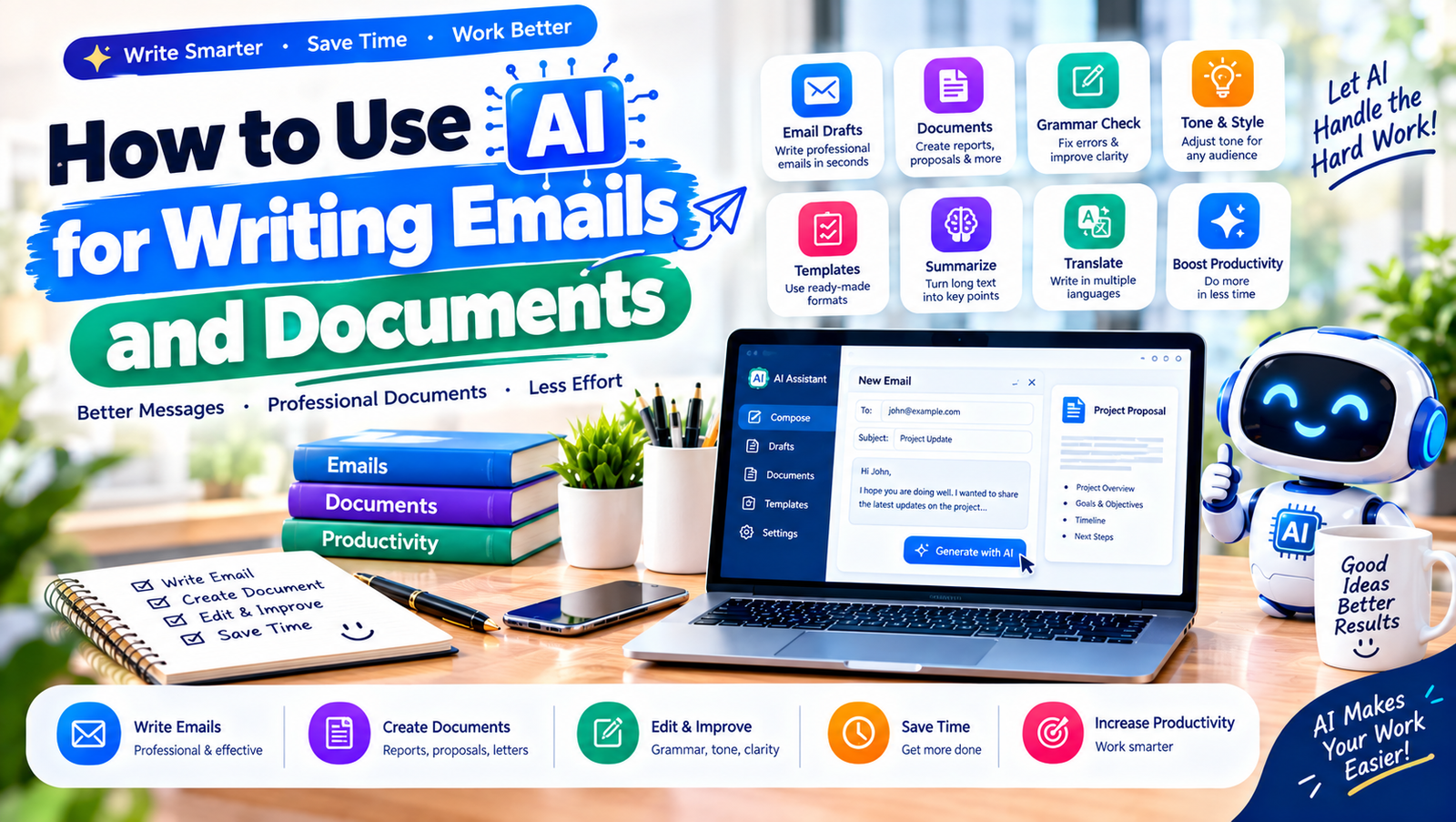
Meta Title: How to Use AI for Writing Emails and Documents in 2026
Meta Description: Learn how to use AI for writing professional emails and documents faster. Discover practical prompts, examples, workflows, benefits, and common mistakes.
Focus Keyword: AI for writing emails and documents
Secondary Keywords: AI email writing, AI writing tools, AI document writing, write professional emails with AI, AI productivity, AI office tools, AI writing assistant
Suggested URL Slug: /ai-for-writing-emails-and-documents/
Introduction
Writing is one of the most common tasks in an office, business, school, freelance job, or online workplace.
Every day, people write emails, reports, proposals, notices, business documents, project updates, meeting summaries, customer messages, and other forms of communication.
Although writing is important, it can also consume a lot of time.
You may know exactly what you want to say but struggle to organize your thoughts. Sometimes you write a message and then spend several minutes trying to make it sound professional. In other situations, you may have a long document that needs to be summarized, rewritten, or improved.
This is where AI for writing emails and documents can be useful.
Modern AI writing assistants can help you create drafts, improve grammar, change tone, summarize information, organize ideas, and turn simple notes into structured documents.
However, using AI effectively is not simply about telling it to “write something.”
The quality of the result depends heavily on the information and instructions you provide.
In this guide, you’ll learn how to use AI for emails and documents, create better prompts, improve existing writing, and build a practical AI-assisted writing workflow.
What Is AI Writing Assistance?
AI writing assistance refers to using artificial intelligence to help create, edit, organize, or improve written content.
Depending on the tool, AI can help with:
- Email drafting
- Grammar correction
- Sentence improvement
- Rewriting
- Summarization
- Document outlines
- Reports
- Proposals
- Business letters
- Meeting summaries
- Project updates
- Customer responses
- Brainstorming
- Translation
- Formatting suggestions
Instead of starting with a blank page, you can give AI your ideas or rough notes and ask it to create a structured first draft.
You remain responsible for reviewing and approving the final content.
Why Use AI for Emails and Documents?
There are several reasons AI writing tools have become useful in modern workplaces.
1. Save Time
Creating a first draft can take much longer than reviewing one.
AI can help you produce an initial version quickly.
2. Improve Clarity
AI can identify confusing sentences and suggest simpler alternatives.
3. Adjust Tone
The same information may need different wording depending on whether you’re writing to:
- A customer
- A manager
- A colleague
- A business partner
- A job applicant
- A supplier
AI can help adapt the tone.
4. Organize Ideas
You can provide random notes and ask AI to turn them into a structured document.
5. Reduce Writer’s Block
When you don’t know how to begin, AI can provide an outline or starting point.
How AI Email Writing Works
Using AI to write an email is usually simple.
You provide information about:
- Who the email is for
- Why you’re writing
- Important details
- Desired tone
- Desired length
- Required action
The AI then creates a draft.
For example, instead of:
“Write an email to my client.”
Try:
“Write a professional and friendly email to a client explaining that the website project will be completed two days later than originally planned. Briefly explain that additional testing is required and ask them to confirm whether the revised delivery date works.”
This gives the AI enough context to produce a more useful draft.
The Basic AI Email Prompt Formula
A useful email prompt can follow this structure:
Role + Audience + Purpose + Context + Tone + Length + Action
For example:
“Act as a professional business communication assistant. Write an email to a client explaining a two-day project delay. Keep the tone polite and transparent, stay under 150 words, and ask the client to confirm the revised deadline.”
This structure can be adapted to almost any email.
How to Write a Professional Email with AI
Let’s look at a practical process.
Step 1: Identify the Purpose
Before asking AI to write an email, know why you’re sending it.
Examples:
- Requesting information
- Following up
- Giving an update
- Making an apology
- Scheduling a meeting
- Sending a proposal
- Responding to a complaint
Step 2: Provide the Important Facts
Give AI the information it needs.
For example:
- Project name
- Deadline
- Meeting date
- Amount
- Customer request
- Next step
Don’t expect AI to know facts you haven’t provided.
Step 3: Specify the Tone
You can ask for:
- Professional
- Friendly
- Formal
- Concise
- Warm
- Direct
- Persuasive
- Neutral
Step 4: Specify the Length
For example:
“Keep it under 100 words.”
This prevents unnecessary detail.
Step 5: Review the Result
Check:
- Names
- Dates
- Numbers
- Facts
- Attachments
- Links
- Tone
- Promises
Then make any necessary changes.
AI Prompts for Common Emails
Request Email
“Write a concise professional email asking my supplier for an updated delivery date. Mention that the original delivery was expected on Monday and ask for the new expected date.”
Follow-Up Email
“Write a polite follow-up email regarding the proposal I sent last week. Keep it friendly and avoid sounding pushy.”
Meeting Request
“Write a professional email requesting a 30-minute meeting next week to discuss the website project. Ask the recipient to suggest a suitable time.”
Customer Response
“Write a polite response to a customer whose order has been delayed. Apologize, explain that the shipment is being processed, and provide the updated delivery information.”
Job Application
“Write a concise professional email to accompany my job application. Mention that my resume is attached and express interest in the position.”
How to Use AI to Improve an Existing Email
You don’t always need AI to create an email from scratch.
Sometimes you already have a draft but want to improve it.
You can paste your draft and ask:
“Improve the grammar and clarity of this email while keeping my original meaning and tone.”
This is often more useful than asking AI to completely rewrite the message.
You can also give more specific instructions:
“Make this email more concise.”
or:
“Make this email sound professional but not overly formal.”
or:
“Make this message more friendly while keeping the request clear.”
How to Change Email Tone with AI
Tone matters because communication can easily be misunderstood.
Consider this sentence:
“You haven’t sent the document yet. Send it today.”
It is direct, but it may sound harsh.
You could ask AI:
“Rewrite this sentence to sound polite and professional without making the request unclear.”
A possible result could communicate the same idea in a more appropriate way.
The important point is that you don’t have to change the underlying message. AI can help adjust how the message is communicated.
Using AI for Business Documents
AI is also useful for longer documents.
Examples include:
- Business reports
- Project proposals
- Internal policies
- Training documents
- Business plans
- Project summaries
- Research documents
- Standard operating procedures
- Product descriptions
- Marketing documents
For large documents, don’t necessarily ask AI to write everything in one step.
A better approach is to build the document in stages.
A Better AI Document-Writing Workflow
Step 1: Define the Objective
Start with:
“The purpose of this document is…”
Explain what the document needs to achieve.
Step 2: Identify the Audience
Tell AI who will read it.
For example:
- Employees
- Customers
- Managers
- Investors
- Students
- Technical users
- General readers
Step 3: Create an Outline
Ask AI:
“Create a detailed outline for this document with logical H2 and H3 sections.”
Review the outline before writing the complete document.
Step 4: Add Your Information
Provide your actual facts, notes, statistics, requirements, and other relevant material.
Step 5: Draft Section by Section
Instead of generating a huge document at once, work through individual sections.
Step 6: Edit and Verify
Check the content yourself.
Step 7: Finalize Formatting
Add:
- Headings
- Tables
- Bullet points
- References
- Page structure
- Branding
Example: Creating a Business Report with AI
Suppose you need to create a monthly sales report.
You could start with:
“Create a professional outline for a monthly sales report. Include an executive summary, sales performance, comparison with the previous month, key challenges, major achievements, customer trends, and recommendations.”
Once you approve the structure, you can provide the actual data.
Then ask AI to help organize the information.
This approach gives you much more control than simply asking:
“Write my sales report.”
AI for Summarizing Long Documents
Another powerful use of AI is summarization.
Imagine you receive a 20-page report but only need to understand the key points.
You could ask:
“Summarize this document in 10 bullet points. Then list the major decisions, important numbers, risks, and recommended actions.”
You can also request different summary formats.
Executive Summary
“Create a short executive summary for a manager who has only two minutes to read it.”
Beginner Summary
“Explain this document in simple language for someone unfamiliar with the subject.”
Action Summary
“List only the actions that need to be completed and the information required for each action.”
The best format depends on what you need to do with the information.
AI for Grammar and Proofreading
AI can also function as a proofreading assistant.
You can ask it to check:
- Grammar
- Spelling
- Punctuation
- Sentence structure
- Repetition
- Clarity
- Word choice
A useful prompt is:
“Proofread this document for grammar, spelling and clarity. Do not change the meaning. Show the major changes and explain why they were made.”
This is particularly helpful when English isn’t your first language.
AI for Simplifying Complex Writing
Sometimes professional writing becomes unnecessarily complicated.
AI can help simplify it.
For example:
“Rewrite this paragraph in simple English for a general audience. Keep all important information and avoid technical jargon.”
This can be useful for:
- Customer instructions
- Internal announcements
- Training documents
- Website content
- Help articles
- Product documentation
Simple writing is often easier to understand and act on.
AI for Creating Document Templates
If you regularly create similar documents, AI can help build templates.
Examples include:
Meeting Report Template
- Meeting date
- Parti






Leave a Reply