

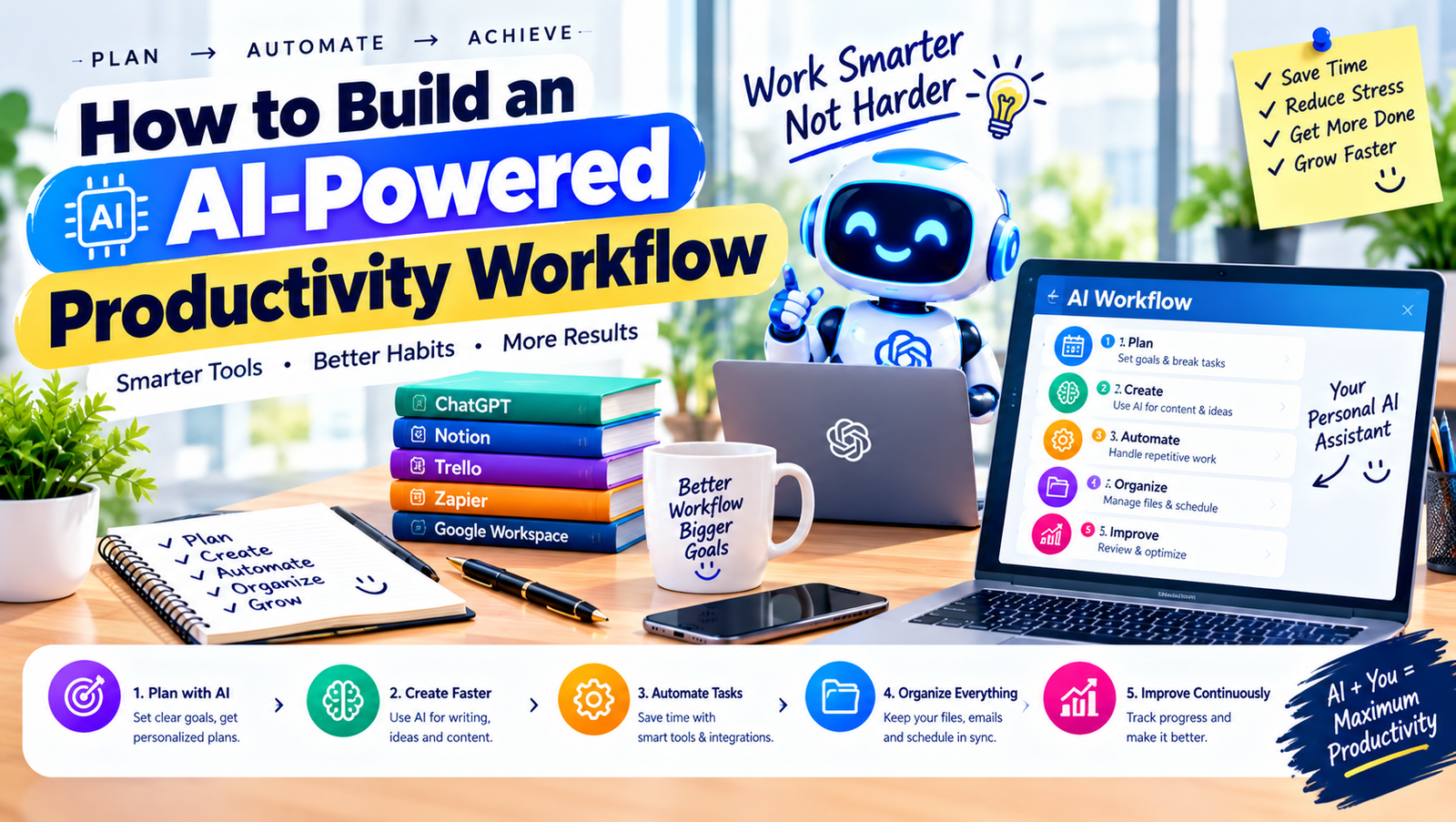
Meta Title: How to Build an AI-Powered Productivity Workflow in 2026
Meta Description: Learn how to build an AI-powered productivity workflow that saves time, organizes tasks, improves focus, and helps you work smarter with AI.
Focus Keyword: AI-powered productivity workflow
Secondary Keywords: AI productivity workflow, AI productivity system, AI workflow automation, AI tools for productivity, AI work routine, automate daily tasks with AI, AI office workflow
Suggested URL Slug: /ai-powered-productivity-workflow/
Introduction
Being busy does not always mean being productive.
Many people spend their workday answering emails, attending meetings, checking messages, organizing files, creating documents, and switching between different applications.
At the end of the day, they may have worked for eight hours but still feel that the most important tasks were not completed.
Artificial intelligence can help solve part of this problem.
Instead of using AI only when you need to write something, you can build a complete AI-powered productivity workflow around your daily work.
An AI productivity workflow is a repeatable system that uses AI to help you capture information, organize tasks, plan your time, create content, summarize information, and review your progress.
The goal isn’t to automate everything.
The goal is to remove unnecessary repetitive work so you can spend more time on tasks that require human thinking, creativity, communication, and decision-making.
In this guide, you’ll learn how to build a practical AI-powered productivity workflow from the ground up.
What Is an AI-Powered Productivity Workflow?
An AI-powered productivity workflow is a structured process where artificial intelligence assists with different stages of your work.
A simple workflow might look like this:
Capture → Organize → Prioritize → Create → Review → Complete
For example:
You receive several emails and tasks.
AI helps summarize the important information.
You organize the tasks by priority.
AI helps create drafts or plans.
You review the results.
You complete the work.
The system becomes a repeatable routine rather than random AI usage.
Why Build an AI Productivity Workflow?
Using AI occasionally can be helpful, but creating a workflow can make the benefits more consistent.
1. Reduce Repetitive Work
AI can assist with tasks you perform repeatedly.
2. Save Mental Energy
You don’t need to make the same small decisions again and again.
3. Improve Organization
AI can help turn unstructured information into structured tasks and notes.
4. Start Work Faster
Instead of staring at a blank page, you can use AI to create a first draft or outline.
5. Improve Consistency
Templates and repeatable AI prompts can help you maintain consistent processes.
The Five Parts of an AI Productivity System
A practical AI productivity workflow can be divided into five major stages:
| Stage | Purpose |
|---|---|
| Capture | Collect information |
| Organize | Structure information |
| Prioritize | Decide what matters |
| Execute | Complete the work |
| Review | Improve the workflow |
Let’s explore each stage.
Stage 1: Capture Everything
The first step is getting information out of your head and into a system.
During the day, you may receive:
- Emails
- Messages
- Meeting notes
- Ideas
- Customer requests
- Tasks
- Deadlines
- Documents
- Research information
If you try to remember everything, your brain becomes overloaded.
Instead, create one central place for capturing information.
This could be:
- A task manager
- A notes application
- A project management platform
- A document
- Your company’s approved productivity system
The exact tool is less important than having a consistent capture process.
Use AI to Process Captured Information
Once you have collected your notes, AI can help organize them.
Suppose you write:
Client wants homepage changes. Need to check pricing information. Meeting Friday. Send updated design. Maybe add testimonials.
This is unstructured.
You could ask AI:
“Organize these notes into tasks, questions, decisions and deadlines. Do not invent missing information.”
AI might turn them into:
Tasks
- Review homepage changes
- Check pricing information
- Prepare updated design
- Consider testimonials
Meeting
- Client meeting Friday
Question
- Confirm whether testimonials should be added
This makes the information easier to act on.
Stage 2: Organize Your Work
After capturing information, organize it into meaningful categories.
A simple structure could include:
Today
Tasks that must be handled today.
This Week
Important tasks that can be completed during the week.
Waiting
Tasks that depend on another person.
Later
Tasks that are useful but not urgent.
Reference
Information that does not require an immediate action.
AI can help classify incoming information.
For example:
“Classify these 15 tasks into Today, This Week, Waiting and Later. Explain the reason for each classification.”
You should still make the final decision.
Stage 3: Prioritize Tasks with AI
One of the biggest productivity problems is having too many tasks.
A long to-do list can make everything look equally important.
AI can help you analyze your list.
For example:
“Here are my tasks for today. Group them into urgent, important, routine and optional. Consider deadlines, business impact and dependencies. Do not remove any task.”
The AI can provide a starting point.
You can then decide which tasks actually deserve your attention.
Use the Impact vs Effort Method
A useful way to organize work is to consider:
Impact: How much does this task matter?
Effort: How much time or energy does it require?
This creates four general groups:
| Low Effort | High Effort | |
|---|---|---|
| High Impact | Do quickly | Schedule carefully |
| Low Impact | Batch or delegate | Consider postponing |
AI can help classify tasks, but you should provide the context.
For example:
“Analyze these tasks based on business impact and estimated effort. Ask me if information is missing rather than assuming.”
Stage 4: Plan Your Day
Once your tasks are organized, create a realistic schedule.
Don’t schedule every minute of the day.
Leave space for:
- Unexpected messages
- Meetings
- Breaks
- Technical problems
- New urgent tasks
A simple schedule could look like:
| Time | Activity |
|---|---|
| 8:30–9:00 | Review and plan |
| 9:00–10:30 | Deep work |
| 10:30–10:45 | Break |
| 10:45–12:00 | Project work |
| 12:00–12:30 | Emails |
| 12:30–1:30 | Lunch |
| 1:30–3:00 | Meetings/client work |
| 3:00–4:00 | Follow-up tasks |
| 4:00–4:30 | Review and planning |
AI can help create a schedule based on your priorities.
Prompt:
“Create a realistic work schedule for these tasks. Give priority to high-impact tasks, group similar tasks together, include short breaks, and leave 20% of the day unscheduled for unexpected work.”
Use AI for Time Blocking
Time blocking means assigning specific periods of time to specific types of work.
Instead of:
“Work on marketing.”
You create:
“10:00–11:30 — Marketing strategy.”
AI can help group similar tasks into blocks.
For example:
Communication Block
- Emails
- Messages
- Client replies
Creative Block
- Writing
- Design ideas
- Content planning
Analysis Block
- Research
- Reports
- Spreadsheet analysis
Grouping similar tasks can reduce unnecessary context switching.
Stage 5: Use AI During Execution
This is where AI can become your daily work assistant.
Different tasks require different forms of assistance.
AI for Writing
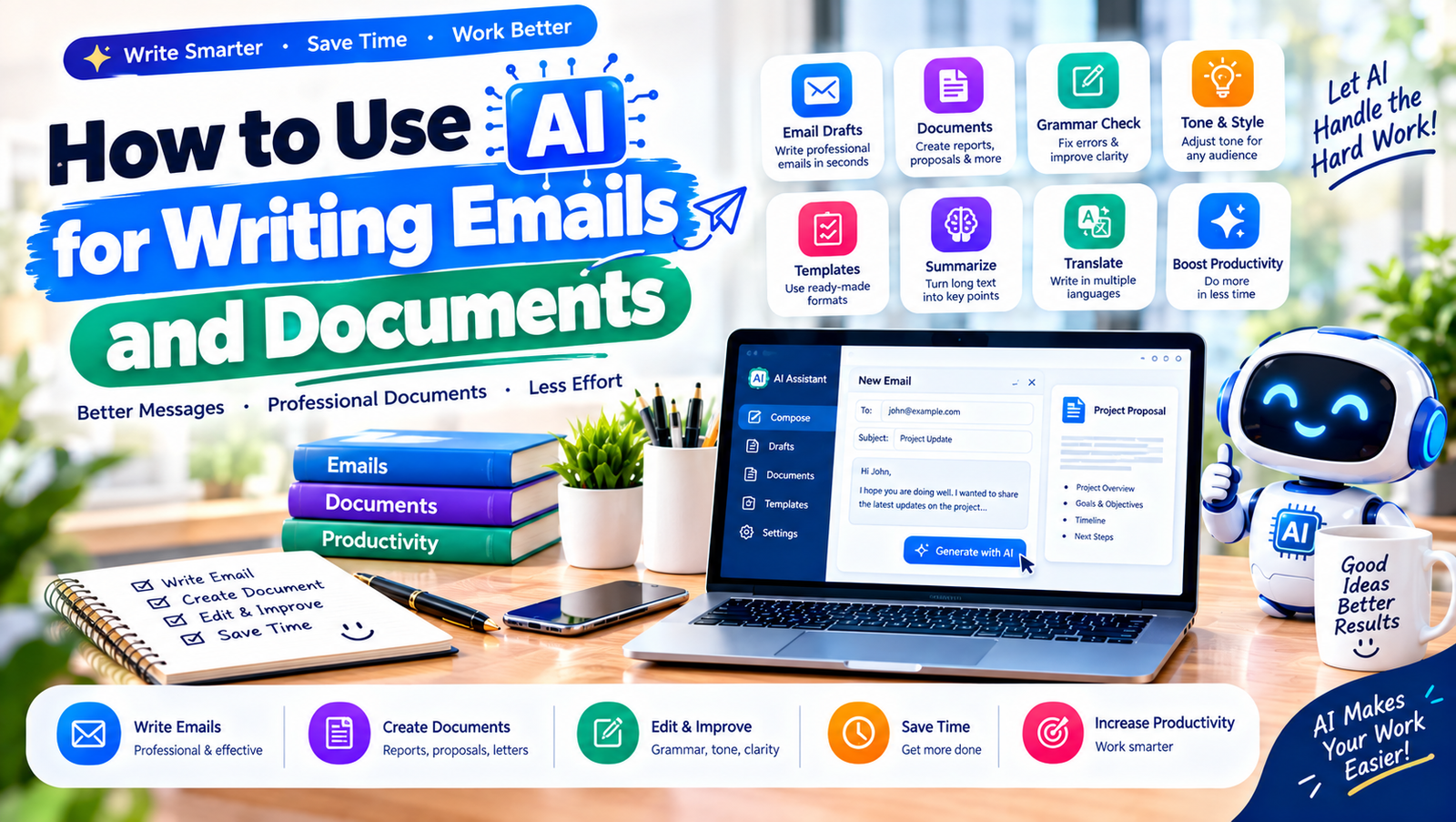
Use AI for:
- First drafts
- Emails
- Reports
- Proposals
- Summaries
- Rewriting
- Grammar
- Outlines
Instead of asking:
“Write something about marketing.”
Give AI more information:
“Create a 700-word internal report explaining why our website traffic declined this month. Use the data I provide below and clearly separate confirmed facts from possible explanations.”
Specific instructions usually produce more useful results.
AI for Research
Research can consume a lot of time.
AI can help you create:
- Research questions
- Comparison criteria
- Summaries
- Checklists
- Interview questions
- Analysis frameworks
For example:
“Create a research framework for comparing five project management platforms. Include pricing, features, integrations, security, ease of use and reporting.”
You can then research each category.
For important factual decisions, verify information against reliable sources.
AI for Meetings
Meetings can generate a lot of information.
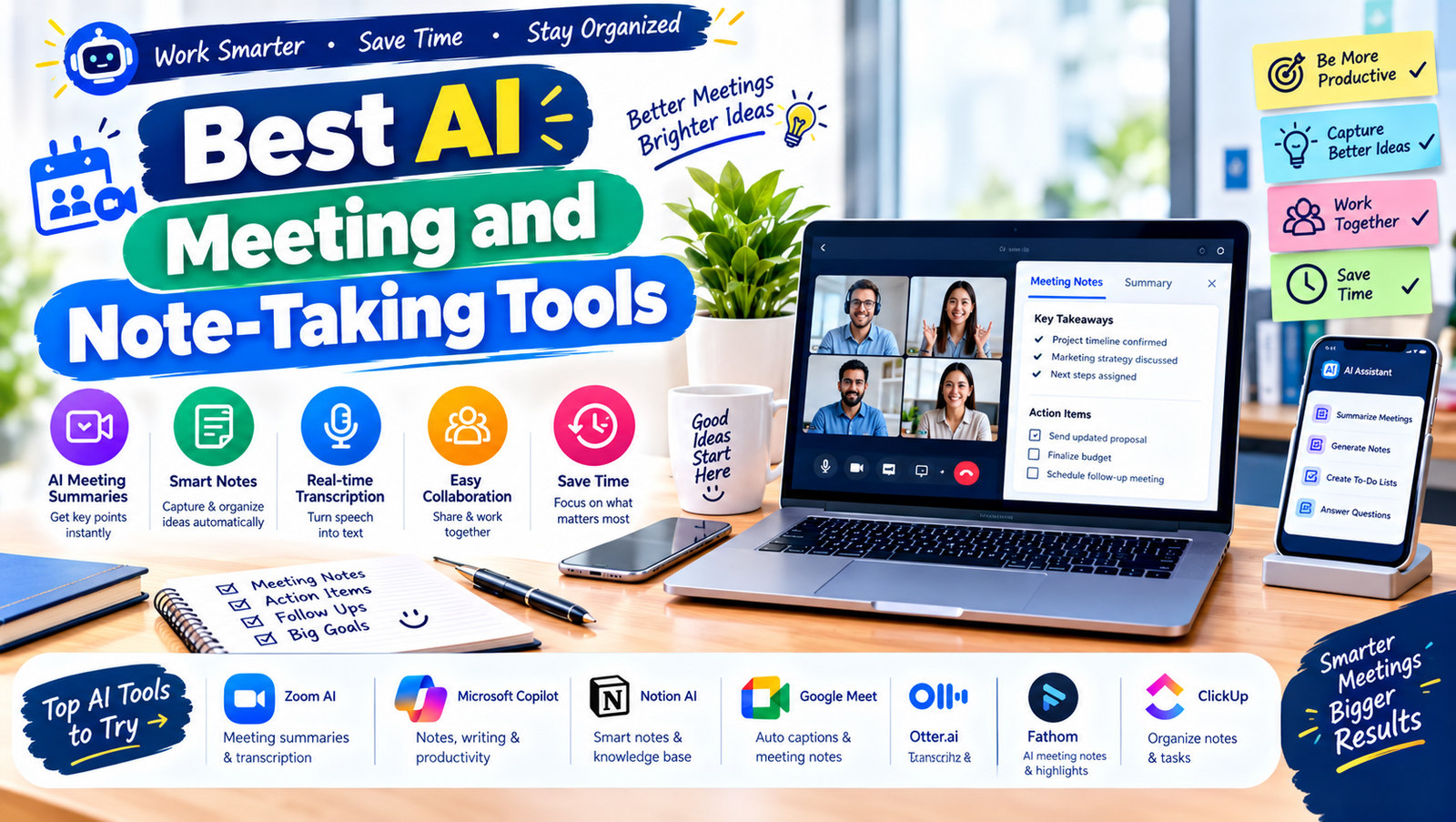
AI meeting tools can help with:
- Transcription
- Summaries
- Action items
- Decisions
- Follow-up tasks
After a meeting, you can ask an AI assistant:
“Turn these meeting notes into a task list with the task, owner and deadline. If an owner or deadline isn’t explicitly mentioned, leave it blank.”
This is safer than asking AI to guess missing information.
AI for Email Management
Email can easily become a major distraction.
Instead of constantly checking your inbox, consider creating specific email processing periods.
For example:
Morning: Quick email review
Midday: Response block
Afternoon: Final email check
AI can help summarize long messages and draft responses.
For example:
“Summarize these five emails and identify which ones require a response today.”
You then decide what actually needs immediate attention.
AI for Document Management
AI can help organize information inside documents.
For example, you can ask:
“Summarize this document into key points, decisions, action items and unanswered questions.”
You can also create standardized templates for:
- Reports
- Project updates
- Meeting summaries
- Client updates
- Research
- Proposals
Templates reduce the amount of work required each time you create a similar document.
Build Reusable AI Prompt Templates
One of the easiest ways to improve your workflow is to stop writing the same prompts repeatedly.
Create a small prompt library.
Email Prompt
“Rewrite this email in a clear, professional and friendly tone. Keep the original meaning and remove unnecessary wording.”
Meeting Prompt
“Extract decisions, action items, owners and deadlines from these meeting notes. Do not invent missing information.”
Summary Prompt
“Summarize this content into five key points followed by a list of actions.”
Planning Prompt
“Organize these tasks by priority and create a realistic schedule.”
Review Prompt
“Review this work for errors, missing information, contradictions and unclear wording.”
Save these prompts somewhere convenient.
Create an AI Morning Routine
Your morning routine can be simple.
Step 1: Review Calendar
Look at today’s meetings and deadlines.
Step 2: Review Tasks
Identify what needs attention.
Step 3: Ask AI to Help Organize
For example:
“Here are today’s meetings and tasks. Help me identify my three most important outcomes for today.”
Step 4: Create Your Schedule
Reserve time for the highest-priority work.
Step 5: Start the First Task
Avoid spending the entire morning planning.
The purpose of the system is to start productive work sooner.
Create an AI End-of-Day Review
The end of the day is another useful place for AI.
Provide your completed and incomplete tasks.
Ask:
“Review my workday based on these completed and incomplete tasks. Summarize what I achieved, what remains, what should be moved to tomorrow, and any potential blockers.”
This creates a simple feedback loop.
The AI Weekly Review
Once a week, perform a deeper review.
Ask:
“Analyze this week’s completed, incomplete and postponed tasks. Identify recurring problems, tasks that consume too much time, and areas where I could improve my workflow.”
This can reveal patterns.
For example:
You might discover that you spend too much time:
- Answering repetitive emails
- Attending unnecessary meetings
- Reformatting documents
- Searching for information
- Switching between applications
Those are potential areas for automation or process improvement.
Automate Repetitive Tasks
Once you’ve identified repetitive work, ask whether it can be automated.
Examples include:
- Moving information between applications
- Creating standard documents
- Sending routine notifications
- Organizing form responses
- Updating task records
- Creating recurring reports
However, automation should be introduced carefully.
A good rule is:
Automate stable processes, not confusing processes.
If a process is already poorly organized, automating it can simply make the problem happen faster.
AI Workflow Example for a Freelancer
Imagine a freelancer receives a new client inquiry.
Step 1: Capture
Client message is added to the project system.






Leave a Reply