

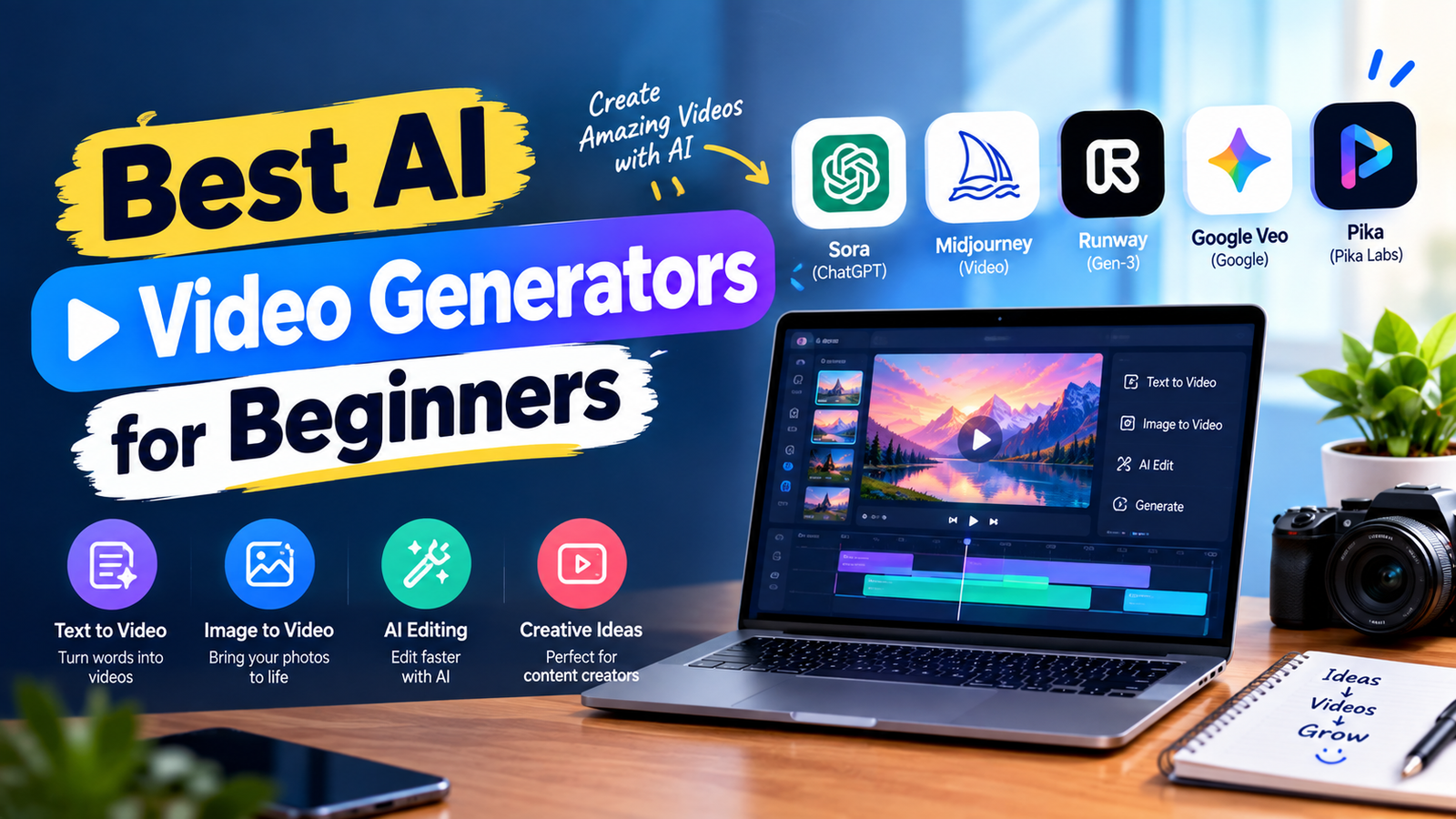
Meta Title: Best AI Video Generators for Beginners in 2026
Meta Description: Discover the best AI video generators for beginners in 2026. Learn how AI video tools work, what they can create, and how to choose the right tool.
Focus Keyword: Best AI Video Generators for Beginners
Secondary Keywords: AI video generators, best AI video tools, AI video maker, text to video AI, image to video AI, AI video generation, AI video tools for beginners
Suggested URL Slug: /best-ai-video-generators-for-beginners/
Introduction
Creating a professional-looking video traditionally required a camera, lighting equipment, editing software, a good microphone, and plenty of time.
Artificial intelligence is changing that process.
Modern AI video generators can create short video clips from text prompts, animate still images, transform existing footage, and in some cases generate synchronized audio, dialogue, sound effects, and music.
For beginners, this is particularly interesting because many AI video tools allow users to start with a simple description instead of learning complicated video-production software first.
For example, you could describe:
“A cinematic sunrise over a mountain lake, slow camera movement, soft morning mist, realistic natural lighting.”
An AI video model can turn that description into a short video clip.
However, choosing the right tool can be confusing. There are many AI video platforms, and they differ in realism, editing controls, speed, audio capabilities, consistency, pricing, and ease of use.
This guide explains the best AI video generators for beginners in 2026, how they work, what they are useful for, and how to get better results.
What Is an AI Video Generator?
An AI video generator is a software system that uses artificial intelligence to create or transform video content.
Depending on the tool, you may be able to generate video from:
- Text
- Images
- Existing videos
- Reference frames
- Characters
- Scripts
- Audio
- Other creative inputs
The two most common approaches are text-to-video and image-to-video.
Text-to-Video
You describe a scene using text and the AI generates a video.
Image-to-Video
You provide an image and ask the AI to animate it.
For example, you could upload a photograph of a city street and ask the AI to create:
“A slow cinematic camera movement through the street while people naturally walk in the background.”
The exact controls vary from one model to another.
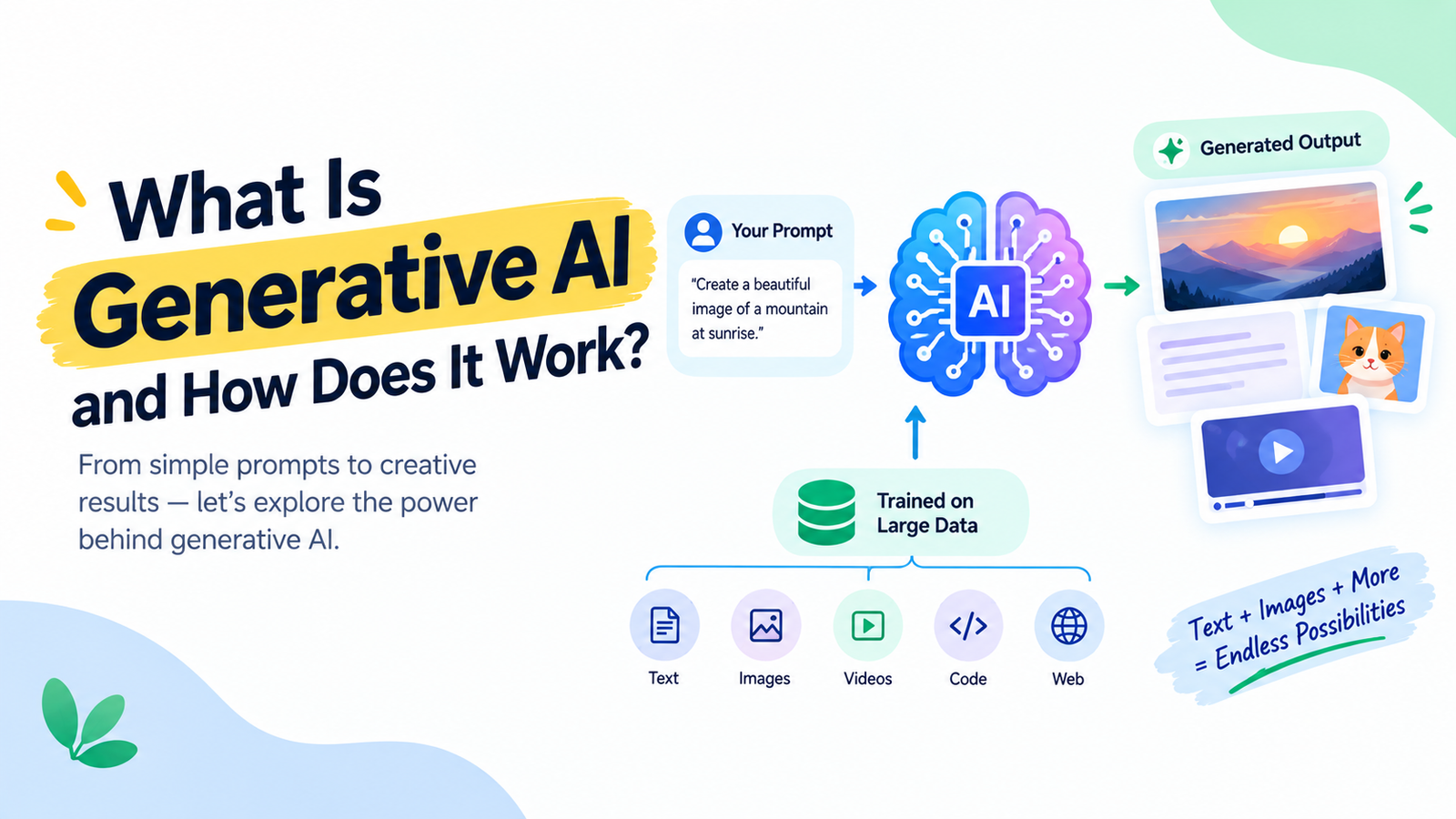
How Does AI Video Generation Work?
The technology behind AI video generation is highly sophisticated, but the basic workflow is easy to understand.
The model is trained to learn relationships between visual content, motion, language, and sometimes audio.
When you provide a prompt, the model attempts to create a sequence of frames that matches your description while maintaining motion and visual consistency.
A simplified workflow looks like this:
Prompt/Input → AI Model → Scene Generation → Motion → Audio if Supported → Video Output
Modern systems are increasingly moving beyond simple video generation toward editing, scene extension, character consistency, camera control, and other production features.
For example, Google’s current Veo 3.1 supports text-to-video, image-to-video, reference images, scene extension, first-and-last-frame generation, object insertion and removal, camera controls, and native audio generation.
Why Are AI Video Generators Popular?
AI video tools have become popular because they reduce the technical barrier to video creation.
1. No Camera Required for Many Concepts
You can create a visual concept without physically filming it.
2. Faster Experimentation
You can generate several versions of a scene and choose the one that fits your project.
3. Useful for Social Media
Short-form video platforms require a constant supply of visual content. AI can help creators experiment with new ideas.
4. Useful for Storytelling
Writers can turn written concepts into visual scenes.
5. Useful for Businesses
Companies can create visual concepts for marketing, presentations, product demonstrations, and internal projects.
Best AI Video Generators for Beginners in 2026
There is no single tool that is perfect for every beginner.
The right option depends on what you want to create.
Some tools focus heavily on cinematic generation. Others are designed around editing, professional workflows, or easy content creation.
1. Google Veo
Google’s Veo family is one of the major AI video-generation systems available in 2026.
The current Google DeepMind page highlights Veo 3.1 and describes capabilities including text-to-video, image-to-video, native audio, reference images, character consistency, scene extension, camera controls, object insertion and removal, and first-and-last-frame generation.
Veo can generate video with audio, including dialogue, sound effects, and ambient sounds.
Why Beginners May Like Veo
You can describe a scene in ordinary language.
For example:
“A young traveler walks through a quiet European street at sunset. The camera slowly follows from behind. Warm golden light, realistic movement, natural street ambience.”
The model can use the details in the prompt to guide the generation.
Google also provides a prompt guide recommending details such as shot framing, camera movement, visual style, lighting, and character descriptions.
Useful For
- Cinematic clips
- Social media videos
- Storytelling
- Image-to-video
- Short advertisements
- Visual concepts
- Character-based scenes
Veo 3.1 also supports native vertical video generation, which is useful for mobile-first platforms.
2. Google Flow
Google Flow is designed as an AI filmmaking and storytelling environment built around Google’s generative media models.
Google describes Flow as a creative tool for building cinematic clips, scenes, and stories using its generative AI models.
For beginners who want more than a single isolated video clip, a filmmaking-oriented workflow can be useful.
Instead of thinking only:
Prompt → Video
you can think:
Idea → Scene → Character → Shot → Story
This makes tools like Flow particularly interesting for people who want to experiment with AI filmmaking.
Good For
- Short films
- Storytelling
- Cinematic scenes
- Multi-shot projects
- Character consistency
- Creative experimentation
3. Runway
Runway is another major name in generative video.
Runway’s official documentation describes multiple generation modes, including tools designed for precise control and apps optimized for specific use cases.
Runway’s current Gen-4.5 is also available through Adobe Firefly, where Adobe describes it as supporting realistic, cinematic, and stylized visual output, along with strong prompt adherence and coherent motion.
Why Beginners May Consider Runway
Runway provides a combination of generation and creative tools rather than focusing on only one generation method.
Depending on the workflow, creators can work with:
- Text prompts
- Images
- Existing videos
- Editing
- Variations
- Timeline-based workflows
Good For
- Creative video
- Cinematic scenes
- Image-to-video
- Video editing
- Visual effects
- Short-form content
4. Adobe Firefly Video
Adobe Firefly is especially interesting for people who want AI generation combined with a broader creative workflow.
Adobe’s current Firefly video tools allow users to generate video from text prompts and specify details such as content, emotions, settings, and camera movements.
Firefly also provides access to different partner video models.
Adobe’s current documentation lists options including Google Veo models and Runway models inside Firefly.
Why Firefly Is Useful
Instead of using separate platforms for every stage, creators can work within a broader creative environment.
This can be useful for:
- Video generation
- Editing
- Creative projects
- Marketing
- Brand content
- Professional workflows
Adobe also provides video generation options such as vertical 9:16 and widescreen 16:9 for supported models.
5. Google Vids
Google Vids takes a somewhat different approach.
It is designed as a video creation and editing environment, with AI capabilities integrated into the workflow.
Google announced updates in 2026 adding high-quality video generation, custom music generation, and AI avatars to Google Vids. Google also stated that users with a Google account could generate video clips at no cost under the announced rollout.
Later updates added Gemini Omni capabilities and personal avatars, allowing users to generate and edit clips using everyday language and create personalized video presentations.
Good For
- Business presentations
- Tutorials
- Workplace videos
- Simple storytelling
- Explainer videos
- Presentation-based content
This can be more approachable for someone who wants to create a complete video rather than simply generate cinematic clips.
AI Video Generator Comparison
Here is a practical comparison for beginners.
| Tool | Main Strength | Beginner Friendly | Useful For |
|---|---|---|---|
| Google Veo | Realistic video and native audio | Yes | Cinematic clips |
| Google Flow | AI filmmaking workflow | Moderate | Stories and scenes |
| Runway | Generation and creative control | Yes | Creative video |
| Adobe Firefly | Integrated creative workflow | Yes | Business and creative work |
| Google Vids | AI-assisted video creation | Yes | Presentations and explainers |
This table is not a ranking. Each tool is designed around somewhat different workflows.
Text-to-Video vs Image-to-Video
Understanding this difference is important for beginners.
Text-to-Video
You start with words.
Example:
“A futuristic city at night with flying cars, neon lights, cinematic camera movement.”
The AI creates a video based on the description.
Advantages
- Easy to start
- No source image required
- Good for visual brainstorming
Limitations
- Character appearance may vary
- Composition may not always match your expectations
- Multiple generations may look different
Image-to-Video
You start with an image.
Example:
Upload a character image and ask:
“Make the character slowly turn toward the camera while the background moves naturally.”
Advantages
- More visual control
- Useful for existing artwork
- Helpful for consistent starting points
Limitations
- Motion can sometimes look unnatural
- Complex movement may require several attempts
Google’s Veo 3.1 supports image-to-video and reference-image workflows, including tools intended to improve consistency.
What Can Beginners Create With AI Video?
AI video generation can be used for many projects.
1. Social Media Videos
Short clips can be created for:
- TikTok
- YouTube Shorts
- Other short-form platforms
Vertical 9:16 video is particularly useful for mobile-first content. Google specifically documents native vertical generation for Veo 3.1.
2. YouTube Content
AI-generated clips can support:
- Educational videos
- Storytelling
- Explainer videos
- Background footage
- Intro sequences
- Visual concepts
However, simply generating random clips does not automatically create a good YouTube video.
A strong video still needs:
- A clear idea
- Good storytelling
- Useful information
- Editing
- Appropriate audio
- Audience understanding
3. Marketing Videos
Businesses can use AI video to create concepts for:
- Product promotions
- Social ads
- Website videos
- Campaign ideas
- Brand storytelling
AI can make it easier to experiment with different visual approaches before producing a final campaign.
4. Educational Videos
Teachers, students, bloggers, and businesses can use AI-generated visuals to explain concepts.
For example:
“Create a simple animated visualization showing how solar panels convert sunlight into electricity.”
Visual explanations can make abstract concepts easier to understand.
5. Storytelling
Writers can turn scenes from a story into short visual clips.
For example:
Scene 1: A character enters an old house.
Scene 2: The character discovers a hidden room.
Scene 3: A mysterious object begins glowing.
AI video can help turn these written ideas into visual experiments.
How to Write Better AI Video Prompts
Prompt writing is one of the most important skills for AI video generation.
A weak prompt might say:
“A woman walking.”
This leaves many details unspecified.
A stronger prompt could be:
“A young woman in a beige coat walks slowly through a quiet city street after light rain. The camera follows her from behind at walking height. Reflections from streetlights appear on the wet pavement. Natural movement, realistic clothing physics, cinematic photography, soft evening lighting.”
The second prompt provides much more direction.
Important Elements of an AI Video Prompt
1. Subject
Who or what appears in the scene?
2. Action
What is happening?
3. Environment
Where does the scene take place?
4. Camera
How should the camera move?
Examples:
- Slow push-in
- Tracking shot
- Pan
- Tilt
- Wide shot
- Close-up
- Over-the-shoulder shot
5. Lighting
Examples:
- Morning sunlight
- Golden hour
- Soft studio lighting
- Neon lighting
- Overcast daylight
6. Style
Examples:
- Photorealistic
- Cinematic
- Documentary
- Animation
- Vintage film
7. Motion
Explain how characters or objects should move.
8. Audio
If supported, describe:
- Dialogue
- Ambient sound
- Music
- Sound effects
Google’s Veo prompting guidance specifically recommends describing shot framing and motion, style, lighting, and character details to gain more control over the result.
Example AI Video Prompt
Here is a beginner-friendly example:
“Create an 8-second photorealistic cinematic video of a young man walking through a modern city street at sunset. The camera slowly tracks backward in front of him. Warm sunlight reflects from the buildings, pedestrians move naturally in the background, realistic clothing movement, subtle wind, natural facial expression, shallow depth of field, realistic ambient city sounds.”
This prompt provides:
- Duration
- Subject
- Location
- Action
- Camera movement
- Lighting
- Background
- Motion
- Style
- Audio
How to Create Better Character Consistency
One challenge with AI video is keeping the same character consistent across multiple scenes.
A character may look slightly different between generations.
Reference images can help.
Google’s current Veo documentation describes using reference images for scenes, characters, and objects to guide generation and maintain consistency.
A useful workflow is:
Character Reference → Scene 1 → Scene 2 → Scene 3 → Editing
Keep important character details consistent in your prompts.
For example:
- Age range
- Hair
- Clothing
- Facial characteristics
- Accessories
- General appearance
AI Video for TikTok and Shorts
Short-form content is one of the easiest places for beginners to experiment.
For vertical videos, use a 9:16 composition when your chosen tool supports it.
Google’s Veo 3.1 supports native vertical video generation, while Adobe Firefly’s current Veo workflow provides vertical 9:16 and widescreen 16:9 options.
A simple short-video structure could be:
0–2 Seconds
Strong visual hook.
2–6 Seconds
Main action or information.
6–8 Seconds
Payoff or conclusion.
The exact duration depends on the platform and your storytelling needs.
AI Video for Bloggers
Bloggers can use video generation to support written content.
For example, a technology blog can create short clips explaining:
- AI concepts
- Software features
- Future technology
- Digital trends
- How-to tutorials
A blog article can then include an original video alongside the written explanation.
This can create a more engaging content experience when the video genuinely adds value.
AI Video for Businesses
Businesses can use AI video for early-stage creative development.
For example, before producing an expensive commercial, a company could generate rough visual concepts.
AI can help visualize:
- Camera angles
- Product placement
- Backgrounds
- Advertising concepts
- Storyboards
- Scene transitions
This can help teams discuss an idea before investing heavily in production.
For final advertising campaigns, businesses should still review legal, brand, licensing, and quality requirements.
AI Video and Audio
One major development in current AI video generation is the integration of audio.
Google says Veo 3.1 can generate audio natively, including dialogue, sound effects, and ambient sounds.
This can make generated scenes feel more complete.
For example, instead of creating:
Video + separate sound editing
the AI may generate:
Video + Dialogue + Ambient Sound + Effects
However, generated audio should still be reviewed carefully for pronunciation, timing, realism, and appropriateness.
Free vs Paid AI Video Generators
Some AI video platforms provide free trials, limited generations, or free access with restrictions.
Others require subscriptions or credits.
Before choosing a plan, check:
- Number of generations
- Video duration
- Resolution
- Watermarks
- Commercial-use rights
- Model availability
- Generation speed
- Editing features
- Audio capabilities
- Storage
- Export options
Don’t choose a service only because it offers free generations.
The important question is whether it fits your actual workflow.
Common Mistakes Beginners Make
Mistake 1: Writing Very Short Prompts
A vague prompt often produces unpredictable results.
Mistake 2: Trying to Create an Entire Movie in One Prompt
AI video works better when complex stories are divided into smaller scenes.
Mistake 3: Ignoring Camera Movement
A video prompt should often explain how the camera behaves.
Mistake 4: Forgetting Aspect Ratio
A landscape video may not work well for a vertical short-form platform.
Mistake 5: Not Checking Faces and Hands
AI-generated human details can still contain visual errors.
Mistake 6: Publishing Without Reviewing
Watch the complete generated clip before publishing.
Look for:
- Strange movements
- Visual artifacts
- Incorrect objects
- Unnatural facial expressions
- Audio errors
- Text mistakes
- Inconsistent characters
A Beginner-Friendly AI Video Workflow
If you’re completely new to AI video generation, start with this process.
Step 1: Choose a Simple Idea
Don’t start with a complicated story.
Step 2: Write a Short Prompt
Describe the subject, action, setting, and style.
Step 3: Choose the Format
Select vertical 9:16 for suitable short-form content or 16:9 for traditional widescreen projects.
Step 4: Generate the First Version
Don’t expect the first attempt to be perfect.
Step 5: Identify the Problem
Maybe the camera moves too quickly or the character looks inconsistent.
Step 6: Rewrite the Prompt
Make the problematic part more specific.
Step 7: Generate Again
Compare the new result.
Step 8: Edit the Clips
Combine your best clips into a complete video.
Step 9: Add Final Elements
Depending on the project, add:
- Captions
- Music
- Voiceover
- Logo
- Transitions
- Sound effects
Step 10: Review Before Publishing
Watch the final video from beginning to end.
Are AI Video Generators Replacing Video Editors?
Not necessarily.
AI video generators can automate parts of video production, but professional video creation involves much more than generating individual clips.
Editors still contribute:
- Storytelling
- Pacing
- Sound design
- Color correction
- Creative direction
- Shot selection
- Audience understanding
- Brand consistency
AI can make certain parts faster, but human creative decisions remain important.
A useful way to think about it is:
AI generates footage; the creator builds the story.
Privacy and Responsible AI Video Creation
AI video tools can involve sensitive inputs.
Be careful when uploading:
- Private photographs
- Client footage
- Confidential business videos
- Unreleased products
- Personal information
- Images of other people
Before uploading sensitive material, review the service’s privacy and data-use policies.
Also avoid creating misleading videos that could cause people to believe something happened when it did not.
When AI-generated content could reasonably be mistaken for real footage, transparency may be appropriate depending on the context and platform requirements.
The Future of AI Video Generation
AI video generation is moving toward increasingly complete creative workflows.
The future is likely to involve more than simply:
Text → Video
Instead, creators may work with:
Idea → Script → Characters → Images → Video → Audio → Editing → Final Production
Google’s current Veo 3.1 already combines several of these capabilities, including reference images, character consistency, scene extension, camera controls, object editing, audio, and high-resolution output.
Adobe is also bringing multiple video models into a broader creative environment, including Veo and Runway models within Firefly.
This suggests that AI video creation is becoming less about a single generation button and more about an integrated production workflow.
Frequently Asked Questions
What is the best AI video generator for beginners?
The right tool depends on your goal. Google Veo can be useful for cinematic generation, Runway provides creative generation and editing capabilities, Adobe Firefly offers an integrated creative environment, and Google Vids is designed around accessible video creation and editing.
Can AI generate videos from text?
Yes. Text-to-video is one of the main forms of AI video generation.
Can AI animate a photo?
Yes. Many current AI video models support image-to-video generation, allowing users to animate a still image.
Can AI generate video with sound?
Some current models can. Google says Veo 3.1 supports native audio including dialogue, sound effects, and ambient sound.
Can AI make vertical videos for TikTok?
Yes. Some current AI video systems support native 9:16 generation. Google documents native vertical generation for Veo 3.1.
Can beginners use Runway?
Yes. Runway provides beginner-oriented generation workflows as well as more advanced controls. Its official getting-started guide provides a workflow for creating a first generation.
Can AI video generators create realistic people?
Yes, modern systems can generate highly realistic human characters. However, faces, hands, motion, identity consistency, and other details should always be reviewed.
Are AI-generated videos free to use commercially?
Not automatically. Commercial rights depend on the specific platform, model, plan, inputs, and applicable terms. Always check the provider’s current licensing conditions before using AI-generated video commercially.
Final Thoughts
AI video generators have made video creation much more accessible.
Beginners can now experiment with text-to-video, image-to-video, AI editing, character references, cinematic camera movements, and even generated audio without having to build every element manually.
Tools such as Google Veo, Google Flow, Runway, Adobe Firefly, and Google Vids offer different approaches to AI-assisted video creation. Their features and availability can change quickly, so it is worth checking the current capabilities of the platform before choosing a workflow.
For beginners, the most important skill is not learning every AI video tool.
It is learning how to describe a scene clearly.
Think about:
Subject + Action + Environment + Camera + Lighting + Style + Motion + Audio
Then generate, review, refine, and edit.
The first result may not be perfect—and that’s normal.
AI video creation works best as an iterative process:
Idea → Prompt → Generate → Review → Improve → Edit → Publish
When combined with human creativity, storytelling, editing, and quality control, AI video generators can become powerful tools for creators, bloggers, marketers, students, businesses, and beginners exploring the future of digital content.





Leave a Reply