

Meta Title: What Is Generative AI and How Does It Work? Beginner’s Guide
Meta Description: Learn what generative AI is, how it works, its benefits, examples, uses, limitations, and future impact in this simple beginner-friendly guide.
What Is Generative AI
generative AI explained, how generative AI works, generative AI tools, AI content generation, generative artificial intelligence, examples of generative AI/what-is-generative-ai-and-how-does-it-work/
Introduction
Artificial intelligence has moved from being a technology discussed mainly by researchers to something people use in everyday life. Today, AI can help write an email, create an image, summarize a document, generate computer code, produce a video concept, translate text, and answer questions.
One of the biggest developments in this field is generative AI.
Unlike traditional software that mainly follows predefined instructions, generative AI can create new content based on patterns it has learned from large amounts of data. This ability has changed how people think about writing, design, education, programming, marketing, research, and many other areas.
But what exactly is generative AI? How does it create content? Is it actually thinking like a human? What are its benefits and limitations? And how can beginners use it responsibly?
This guide explains what generative AI is and how it works in simple language.
What Is Generative AI?
Generative AI is a type of artificial intelligence designed to generate new content.
The word “generative” comes from the idea of generating something new. Depending on the AI model, that content can include:
- Text
- Images
- Videos
- Audio
- Music
- Computer code
- Summaries
- Presentations
- Product descriptions
- Creative ideas
For example, a traditional search engine may help you find a webpage about a topic. A generative AI system can take your instructions and produce a new response based on what it has learned.
If you ask an AI assistant:
“Write a simple introduction to digital marketing for beginners.”
the system can generate an original response matching your instructions.
Similarly, an image-generation system can take a description such as:
“A futuristic city at sunset with flying vehicles.”
and create an image based on that description.
This is what makes generative AI different from many older forms of software.
How Is Generative AI Different From Traditional AI?
Artificial intelligence is a broad field. Generative AI is only one part of it.
Traditional AI systems can be designed to recognize patterns, classify information, make predictions, or make decisions based on existing data.
For example, an AI system might examine an email and determine whether it is likely to be spam.
Generative AI goes a step further by producing new output.
| Traditional AI | Generative AI |
|---|---|
| Classifies information | Creates new content |
| Detects patterns | Generates patterns-based output |
| Makes predictions | Produces text, images, audio, etc. |
| Often focused on specific tasks | Can handle many creative tasks |
| Example: spam detection | Example: writing an email |
The two areas can overlap. Modern AI systems may include both predictive and generative capabilities.
How Does Generative AI Work?
Understanding the technical details of modern AI can become complicated, but the basic idea is easier to understand.
Generative AI models are trained using large amounts of data. During training, the model processes examples and learns statistical patterns and relationships within that information.
For a language model, these patterns can involve:
- Words
- Sentences
- Grammar
- Context
- Common phrases
- Relationships between concepts
- Different writing styles
When a user provides a prompt, the model uses what it learned during training to predict and generate an appropriate sequence of output.
It does not simply copy one sentence from a database every time it answers.
Instead, the model generates output based on learned patterns and the context provided in the conversation.
Step 1: Data Is Used for Training
AI models need data to learn patterns.
Training data can include large collections of text, images, audio, code, or other information depending on the type of model.
For example, a language model needs language-related training data to learn how written communication works.
During training, the model processes enormous numbers of examples.
The goal is not simply to memorize every example. Modern machine-learning systems are designed to learn relationships and patterns that can be used to produce new outputs.
Step 2: The Model Learns Patterns
This is one of the most important parts of generative AI.
Imagine reading thousands of examples of sentences.
Over time, you would start recognizing patterns such as which words commonly appear together, how questions are structured, and how different writing styles work.
AI models perform a highly sophisticated mathematical version of this process.
They learn relationships between elements in their training data.
For language models, these relationships help the system determine what words or tokens are likely to come next based on the context.
Step 3: Neural Networks Process Information
Modern generative AI systems commonly use artificial neural networks.
A neural network is a mathematical system inspired loosely by the way biological neural networks process information.
Modern AI models can contain very large numbers of parameters. These parameters are adjusted during training so that the model becomes better at recognizing patterns and producing useful outputs.
The technical architecture differs between AI systems.
However, the general process can be simplified as:
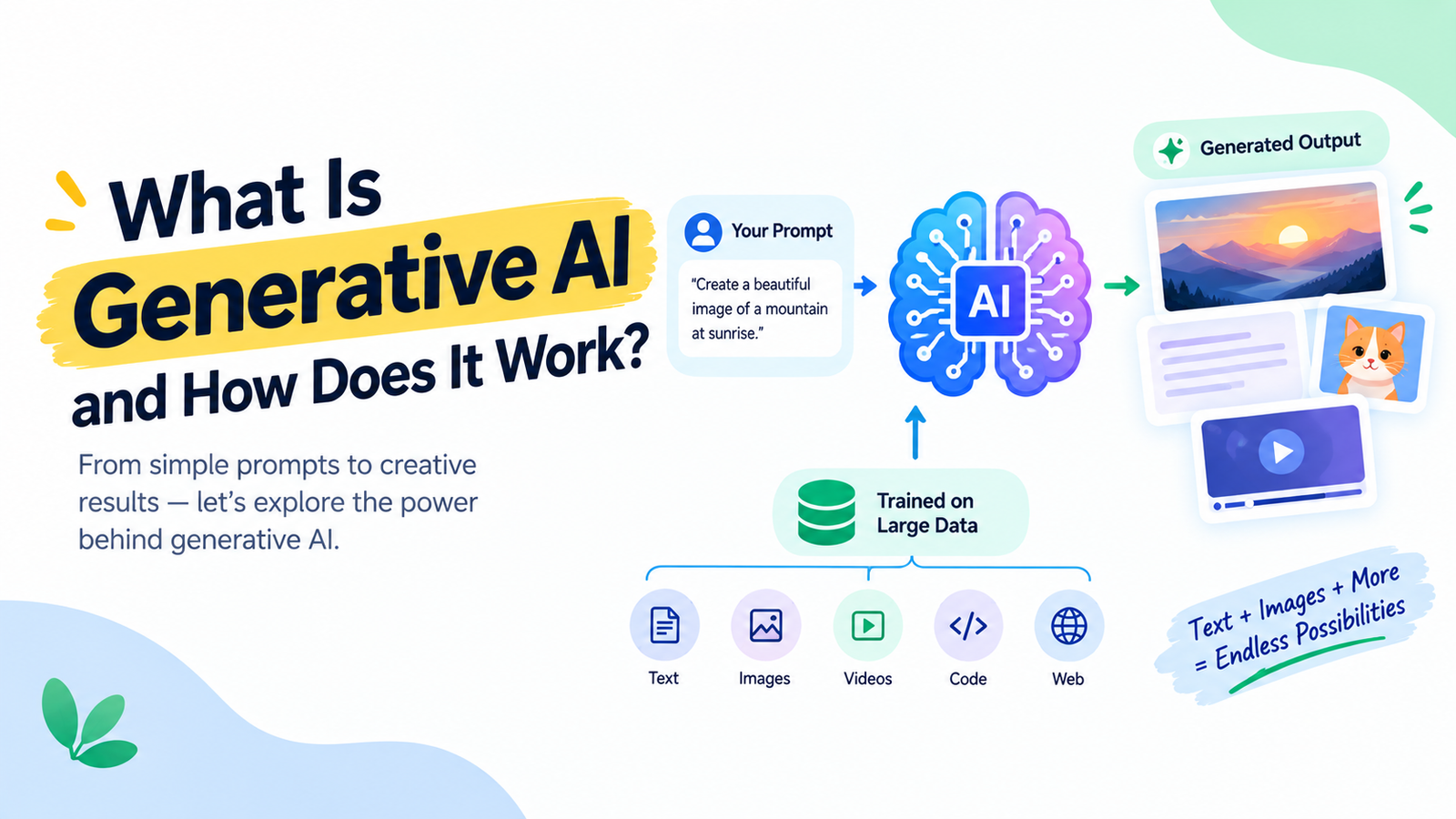
Data → Training → Pattern Learning → Model → User Prompt → Generated Output
What Is a Large Language Model?
Large language models, often called LLMs, are generative AI systems designed primarily to work with language.
They can perform tasks such as:
- Answering questions
- Writing articles
- Summarizing information
- Rewriting text
- Translating languages
- Creating outlines
- Generating code
- Brainstorming ideas
- Explaining difficult concepts
A language model does not understand language exactly like a human does.
Instead, it processes language using mathematical representations and learned patterns.
This distinction is important because an AI-generated answer can sound confident and natural while still containing incorrect information.
What Is a Prompt?
A prompt is the instruction or information you provide to a generative AI system.
For example:
“Explain blockchain to a beginner in 300 words.”
This is a simple prompt.
A more detailed prompt could specify:
- Topic
- Audience
- Tone
- Length
- Format
- Examples
- Goals
- Restrictions
For example:
“Explain blockchain to a beginner in simple English. Use three real-world examples, short paragraphs, and a comparison table. Keep the explanation around 500 words.”
The second prompt provides more context, which can make it easier for the AI system to produce the desired output.
Why Prompt Quality Matters
Generative AI responds to the information provided in the prompt.
A vague prompt can produce a generic answer.
A detailed prompt can provide stronger direction.
Compare these two examples.
Simple Prompt
“Write about AI.”
This gives the AI very little information.
Detailed Prompt
“Write a beginner-friendly 1,000-word article explaining how generative AI can help small businesses with content creation. Use simple English, practical examples, H2 headings, and a short FAQ section.”
The second prompt defines the task much more clearly.
This is why prompt engineering has become an important skill for people working with AI tools.
What Can Generative AI Create?
Generative AI is not limited to text.
Different AI models specialize in different types of content.
1. AI Text Generation
Text-based AI can help create:
- Blog drafts
- Emails
- Social media posts
- Product descriptions
- Scripts
- Reports
- Summaries
- Study notes
- Ideas
- FAQs
Writers can use it for brainstorming and first drafts, while human editing remains important for accuracy and originality.
2. AI Image Generation
Image-generation models can create visual content from text prompts.
For example:
“Create a realistic photograph of a modern workspace beside a large window during sunrise.”
Depending on the system, the generated image may be useful for concepts, illustrations, marketing materials, thumbnails, or creative projects.
AI image generation has become especially useful for designers, marketers, bloggers, and social-media creators.
3. AI Video Generation
Generative AI can also be used to create or modify video content.
Potential applications include:
- Short videos
- Marketing concepts
- Product demonstrations
- Storyboards
- Visual effects
- Educational content
- Social media clips
Video generation is developing quickly, although quality, consistency, control, and production requirements can vary considerably between tools.
4. AI Audio Generation
Generative AI can work with audio as well.
Depending on the system, it can assist with:
- Voice generation
- Speech synthesis
- Transcription
- Audio editing
- Music creation
- Sound effects
This has opened new possibilities for podcasts, videos, games, advertisements, and educational projects.
5. AI Code Generation
Developers can use generative AI to assist with programming.
For example, AI can help:
- Explain code
- Generate code snippets
- Find possible bugs
- Write documentation
- Convert code between languages
- Create test cases
- Suggest solutions
However, generated code should be reviewed and tested before being used in production.
Popular Uses of Generative AI
Generative AI is being used across many industries.
Content Creation
Bloggers and marketers can use AI to brainstorm topics, create outlines, summarize research, and develop first drafts.
Education
Students can use AI to explain difficult concepts, generate practice questions, organize notes, and explore different explanations.
Business
Businesses can use generative AI for customer communication, internal documentation, brainstorming, marketing, and data-related workflows.
Software Development
Developers can use AI assistants to speed up repetitive coding and documentation tasks.
Design
Designers can experiment with visual ideas and generate early concepts.
Customer Support
Companies can use AI systems to answer common questions and assist support teams.
Research
Researchers can use AI for summarization, organization, brainstorming, and information processing, while verifying important claims independently.
Benefits of Generative AI
Generative AI can provide several practical advantages.
1. Saves Time
AI can handle repetitive tasks quickly.
Instead of spending 30 minutes creating a basic outline, a user may generate an initial structure in seconds and then improve it.
The biggest benefit is often not replacing human work but reducing time spent on repetitive parts of the process.
2. Helps With Brainstorming
Sometimes the hardest part of a project is deciding where to start.
Generative AI can provide:
- Topic ideas
- Headlines
- Questions
- Business ideas
- Content angles
- Marketing concepts
- Story ideas
The user can then select and improve the useful ideas.
3. Makes Complex Topics Easier to Understand
AI can explain the same concept at different levels.
For example, you could ask:
“Explain machine learning like I’m a complete beginner.”
Then you could follow up:
“Now explain the same topic at an intermediate level.”
This makes AI useful as a learning assistant.
4. Supports Creativity
AI can help users explore ideas that they might not have considered.
Writers can brainstorm characters.
Designers can explore concepts.
Marketers can test different campaign ideas.
Developers can investigate alternative approaches.
The human remains responsible for selecting, editing, and applying the ideas.
5. Improves Productivity
When used properly, AI can become part of a larger workflow.
For example:
Research → AI-assisted outline → Human writing → AI editing → Human fact-checking → Final publication
This approach combines machine assistance with human judgment.
Limitations of Generative AI
Generative AI is powerful, but it is not perfect.
Understanding its limitations is just as important as understanding its benefits.
1. AI Can Make Mistakes
Generative AI can sometimes produce information that sounds convincing but is incorrect.
This is particularly important when dealing with:
- Medical information
- Legal information
- Financial decisions
- Current events
- Technical specifications
- Statistics
- Historical details
Important information should be independently verified.
2. AI Does Not Guarantee Truth
An AI model can produce fluent language without actually guaranteeing that every statement is factually correct.
This is sometimes described as an AI “hallucination.”
A response can look professional and still contain an incorrect fact.
Therefore:
Fluent writing does not automatically mean accurate information.
3. Knowledge Can Have Limits
AI systems can have limitations involving training data, knowledge cutoffs, access to current information, or the specific tools available to them.
If something has changed recently, users should check reliable current sources rather than automatically trusting an AI response.
4. Lack of Human Experience
AI can imitate many styles of communication, but it does not have human life experience in the same way people do.
For personal stories, professional judgment, sensitive communication, and creative work, human input can make a major difference.
5. Privacy Concerns
Users should be careful about entering sensitive information into AI tools.
Avoid sharing information such as:
- Passwords
- Banking credentials
- Private documents
- Confidential business information
- Personal identification information
Always review the privacy practices and settings of the specific AI service you use.
Generative AI vs Search Engines
Generative AI and search engines serve different purposes.
A search engine primarily helps users discover existing webpages and information.
Generative AI can produce a response directly from the information and patterns available to the model and its connected tools.
| Feature | Search Engine | Generative AI |
|---|---|---|
| Finds webpages | Yes | Sometimes |
| Generates text | Limited | Yes |
| Creates images | Usually not its primary function | Yes, with suitable models |
| Summarizes content | Often through additional features | Yes |
| Brainstorming | Limited | Strong use case |
| Current information | Often strong | Depends on tools/access |
| Verification | User checks sources | User should still verify |
In many workflows, the two can complement each other.
Is Generative AI the Same as Artificial General Intelligence?
No.
These concepts should not be confused.
Generative AI refers to AI systems capable of producing content.
Artificial General Intelligence (AGI) is a broader theoretical concept involving highly general-purpose intelligence capable of performing a wide range of intellectual tasks at a human-like level or beyond, depending on the definition.
Today’s generative AI systems should not automatically be described as AGI.
How Businesses Can Use Generative AI
Small businesses and large organizations can use generative AI in practical ways.
For example, an online store could use AI to assist with:
- Product description drafts
- Customer email templates
- Social media ideas
- FAQ creation
- Marketing brainstorming
- Internal documentation
- Meeting summaries
- Customer-support workflows
However, businesses should establish rules for privacy, accuracy, human review, and acceptable use.
How Bloggers Can Use Generative AI
For bloggers, generative AI can be a useful assistant throughout the content process.
A practical workflow could look like this:
Step 1: Find a Topic
Choose a topic based on your audience and search intent.
Step 2: Create an Outline
Use AI to brainstorm possible headings.
Step 3: Research
Collect reliable information and verify important facts.
Step 4: Write
Create the article using your own expertise, examples, opinions, and insights.
Step 5: Edit
Use AI to identify grammar problems or unclear sentences.
Step 6: Fact-Check
Verify statistics, names, dates, product information, and claims.
Step 7: Optimize
Improve headings, internal links, metadata, readability, and search intent.
Step 8: Publish
Only publish content after human review.
This approach can be more valuable than simply asking AI to generate an entire article and publishing it without checking.
Generative AI and the Future of Work
Generative AI is likely to change many types of work.
Some tasks may become faster or more automated, while new roles and workflows may develop around AI.
Skills that can become increasingly useful include:
- Critical thinking
- Research
- Communication
- Creativity
- Data literacy
- Prompt writing
- AI tool evaluation
- Fact-checking
- Domain expertise
The ability to work with AI may become more important than simply knowing how to use one particular AI tool.
How Beginners Can Start Using Generative AI
If you’re new to generative AI, don’t try to learn everything at once.
Start with one practical task.
For example:
Week 1
Learn how to write clear prompts.
Week 2
Use AI for writing and summarization.
Week 3
Experiment with image generation.
Week 4
Explore AI tools related to your work or studies.
Keep notes about which workflows actually save you time.
The goal is not to use AI everywhere.
The goal is to use it where it genuinely provides value.
Tips for Getting Better AI Results
Here are some simple practices that can improve your results.
Be Specific
Tell the AI exactly what you need.
Provide Context
Explain your audience, goal, and situation.
Specify the Format
Ask for a table, list, outline, email, article, or another format.
Give Examples
If you want a particular style, provide an example.
Break Large Tasks Into Steps
Instead of asking AI to complete an entire complicated project at once, divide the project into smaller tasks.
Review the Output
Always check important information before using it.
Add Your Own Expertise
Your experience and judgment can make AI-assisted content more useful and distinctive.
The Future of Generative AI
Generative AI is still developing rapidly.
Future systems may become better at handling multiple types of information, following complex instructions, working with external tools, and assisting with longer workflows.
We may see greater use of AI in:
- Education
- Software development
- Marketing
- Healthcare research
- Business operations
- Entertainment
- Design
- Scientific research
- Personal productivity
At the same time, questions around privacy, copyright, misinformation, security, transparency, and responsible AI use will remain important.
The future of AI is therefore not only about making models more powerful. It is also about making their use safer, more reliable, and more useful for people.
Frequently Asked Questions About Generative AI
What is generative AI in simple words?
Generative AI is technology that can create new content such as text, images, audio, video, and code based on instructions and patterns learned from data.
How does generative AI work?
Generative AI models are trained on large datasets and learn patterns within that data. When a user provides a prompt, the model uses those learned patterns and the provided context to generate an output.
Is ChatGPT generative AI?
Yes. ChatGPT is an example of a generative AI application designed to generate and work with language.
Can generative AI create images?
Yes. Specialized generative AI models can create images based on text prompts and other inputs.
Can generative AI create videos?
Yes. Some modern generative AI systems can generate or transform video content, although capabilities vary between models and services.
Is generative AI always accurate?
No. Generative AI can produce incorrect or misleading information, so important claims should be verified.
Can generative AI replace humans?
Generative AI can automate or assist with many tasks, but human judgment, expertise, creativity, accountability, and decision-making remain important.
Is generative AI free?
Some generative AI services offer free access, while others use subscriptions, usage limits, credits, or paid plans. Availability and pricing vary by provider.
Is generative AI difficult to learn?
Basic use is usually accessible to beginners. More advanced applications require knowledge of prompting, AI workflows, data, evaluation, and sometimes programming.
Final Thoughts
Generative AI has changed the way people interact with artificial intelligence.
Instead of simply analyzing information or following fixed instructions, modern generative AI systems can produce new text, images, audio, video, code, and other forms of content.
The basic process can be summarized simply:
Training Data → Pattern Learning → AI Model → Prompt → Generated Output → Human Review
The technology can save time, support creativity, improve productivity, and make many digital tasks easier. But it also has limitations. AI can make mistakes, produce inaccurate information, and create outputs that require human review.
For beginners, the best approach is not to treat generative AI as a replacement for human thinking. Instead, use it as a powerful assistant.
Learn how to write better prompts, verify important information, protect private data, and add your own knowledge and creativity to the final result.
As generative AI continues to evolve, understanding how it works and how to use it responsibly can become a valuable digital skill for students, professionals, creators, bloggers, and business owners.





Leave a Reply