
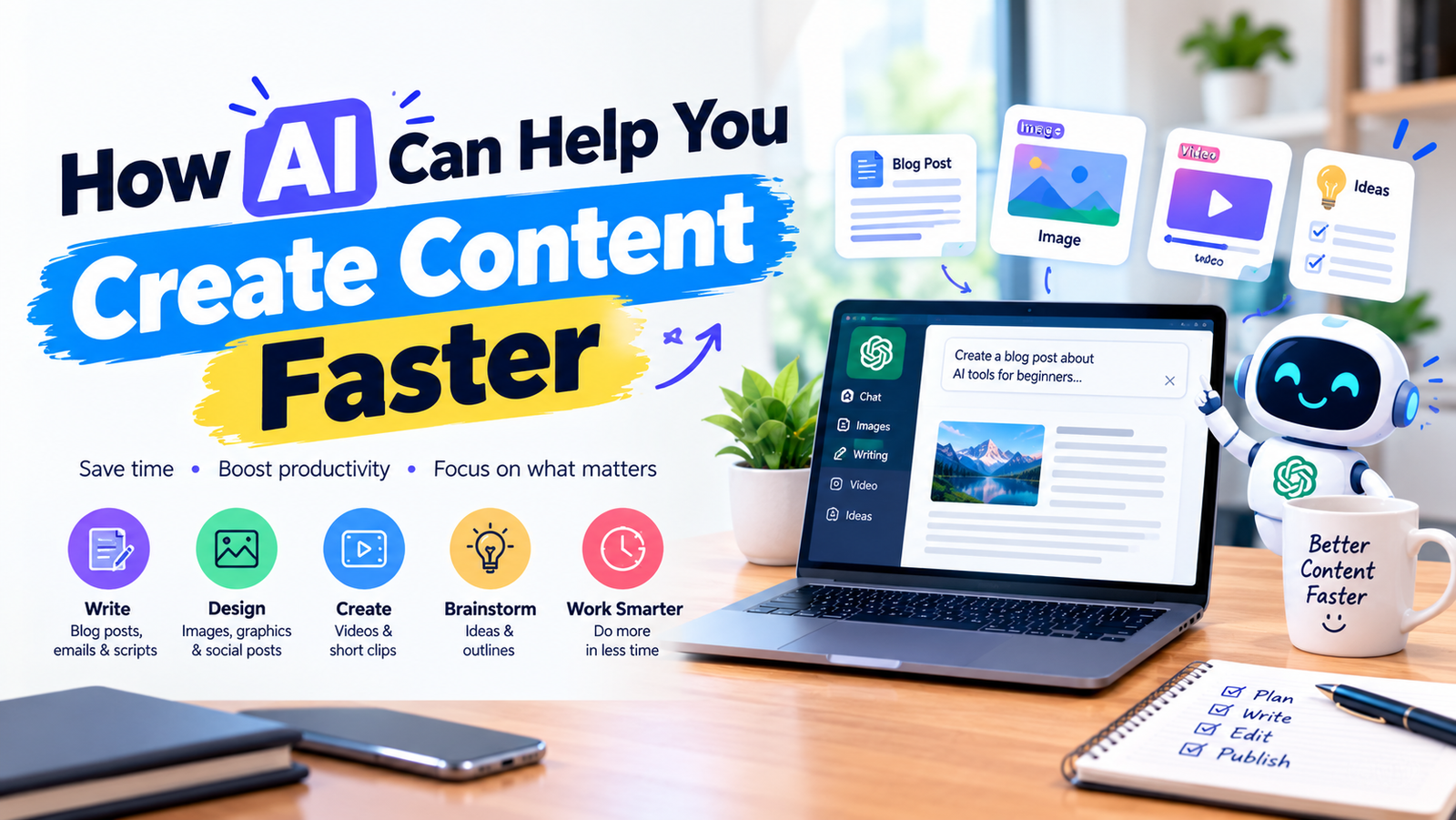
Meta Title: How AI Can Help You Create Content Faster in 2026
Meta Description: Learn how AI can help you create blog posts, social media content, videos, images, emails, and more faster while keeping your content useful and human-focused.
Focus Keyword: How AI Can Help You Create Content Faster
Secondary Keywords: AI content creation, AI writing tools, AI content tools, create content with AI, AI for bloggers, AI for social media, AI productivity tools
Suggested URL Slug: /how-ai-can-help-you-create-content-faster/
Introduction
Creating good content takes time.
Whether you are a blogger, YouTuber, social media manager, freelancer, business owner, or student, content creation can involve many different tasks. You may need to find ideas, research a topic, create an outline, write the first draft, edit the content, create images, make videos, write social media captions, and finally publish everything.
Doing all of this manually can take hours.
Artificial intelligence is changing this process. Modern AI tools can help with many parts of content creation, from brainstorming ideas to creating drafts, improving writing, generating visuals, and repurposing existing content.
However, AI should not simply be treated as a button that creates everything for you.
The best results usually come when AI handles repetitive work while a human provides ideas, experience, judgment, accuracy checks, and the final creative direction.
In this guide, we will explore how AI can help you create content faster while keeping your content useful, original, relevant, and focused on real readers.
What Does AI Content Creation Mean?
AI content creation means using artificial intelligence tools to assist with creating different types of digital content.
Depending on the tool, AI can help create or improve:
- Blog posts
- Articles
- Social media posts
- Video scripts
- YouTube descriptions
- Email newsletters
- Product descriptions
- Images
- Videos
- Presentations
- Headlines
- Content ideas
- SEO outlines
- Ad copy
- Summaries
- Translations
- Captions
- Content calendars
AI can work with text, images, audio, video, and other formats.
For example, instead of spending 30 minutes brainstorming blog topics, you can give an AI tool your niche and audience and ask it to generate potential ideas.
You can then select the useful ideas and develop them yourself.
This makes AI especially useful as a content assistant.
Why Is AI Useful for Content Creation?
The biggest advantage of AI is not necessarily that it can replace the entire creative process.
Its biggest advantage is that it can reduce the amount of time spent on repetitive tasks.
For example, imagine that you want to publish a blog post.
A traditional workflow might look like this:
Idea → Research → Outline → Draft → Edit → SEO → Images → Social Posts → Publish
Each stage takes time.
AI can assist with many of these steps:
Idea → AI brainstorming → Research assistance → AI outline → Human-guided draft → AI editing → SEO assistance → AI images → AI social posts → Human review → Publish
You still remain responsible for the final content, but many time-consuming tasks become easier.
1. AI Can Help You Find Content Ideas
One of the hardest parts of content creation is deciding what to publish.
You might know your niche very well but still struggle to come up with new topics.
AI can help you brainstorm ideas based on:
- Your niche
- Your target audience
- Your website
- Your products
- Your social media platform
- Your existing content
- Beginner questions
- Common problems
- Trends
- Different search intents
For example, suppose you run a website about artificial intelligence.
Instead of simply asking:
“Give me AI topics.”
You can give AI more context:
“I run a beginner-friendly AI technology website. Give me 30 useful article ideas for people who are new to AI. Separate them into beginner guides, AI tools, tutorials, productivity, images, video, and business.”
The second prompt gives the AI much more direction.
Why this saves time
Without AI, you might spend an hour brainstorming.
With a well-written prompt, you can quickly generate a large list of possibilities and then manually select the strongest topics.
Remember that an AI-generated idea is only a starting point.
You should still check whether the topic is useful and relevant to your audience.
2. AI Can Help You Research a Topic
Research is another time-consuming part of content creation.
AI can help you understand a subject, identify important concepts, explain complicated terms, and organize research notes.
For example, if you are writing about AI image generators, you can ask an AI assistant to help you identify areas that a beginner would want to understand.
You might get categories such as:
- What AI image generation means
- How text-to-image systems work
- Prompt writing
- Reference images
- Image editing
- Commercial use
- Copyright considerations
- Common mistakes
- Practical examples
This can give you a research framework.
But don’t blindly trust AI
AI-generated information can sometimes be outdated, incomplete, or incorrect.
This is especially important when writing about:
- Software features
- Prices
- Laws
- Medical topics
- Financial information
- Product specifications
- Current events
- Company policies
For current information, verify important claims using reliable and up-to-date sources.
AI should make research more organized, not eliminate fact-checking.
3. AI Can Create Content Outlines
An outline gives your article structure before you start writing.
Without an outline, writers often jump between ideas or repeat the same information.
AI can quickly turn a topic into a logical structure.
For example:
Topic: How to Start a Blog
An AI-assisted outline might include:
- What blogging is
- Choosing a niche
- Choosing a domain
- Selecting hosting
- Creating a website
- Publishing useful content
- Basic SEO
- Getting visitors
- Monetization
- Common beginner mistakes
- Frequently asked questions
You can then modify the outline based on your own experience and audience.
Why outlines save time
Instead of starting with a completely blank page, you have a roadmap.
This reduces the mental effort required to decide what comes next.
4. AI Can Help You Write First Drafts
Writing a first draft is often the slowest part of content creation.
AI can help you create a starting draft from your outline.
For example, you can provide:
- Topic
- Target audience
- Tone
- Word count
- Main points
- Examples
- Questions readers have
The AI can then produce a draft that you can improve.
But there is an important difference between AI-generated content and good content.
A generated draft may be grammatically correct but still feel generic.
Your job is to improve it by adding:
- Personal insights
- Real examples
- Original explanations
- Useful comparisons
- Specific details
- Practical steps
- Reader-focused advice
Think of AI as a fast first-draft assistant rather than the final author.
5. AI Can Make Editing Faster
Editing can take almost as much time as writing.
AI tools can help identify:
- Grammar mistakes
- Spelling errors
- Awkward sentences
- Repeated phrases
- Unclear explanations
- Long sentences
- Inconsistent tone
You can also ask AI to simplify complicated writing.
For example:
“Rewrite this paragraph in simple English for a beginner audience without changing the meaning.”
This can be particularly useful when your audience includes people who are not native English speakers.
AI can help with different writing styles
You can ask an AI tool to make text:
- More professional
- More conversational
- More concise
- More detailed
- More beginner-friendly
- More persuasive
- More informative
You should still review the final version yourself.
6. AI Can Help You Create Better Headlines
A headline is extremely important because it is often the first thing a reader sees.
AI can generate multiple headline variations based on the same topic.
For example:
Topic: AI productivity
Possible headlines could include:
- How AI Can Help You Save Time Every Day
- 10 Ways to Use AI to Improve Your Productivity
- How to Use AI Tools for Everyday Productivity
- AI Productivity: Practical Ways to Get More Done
You can then choose or modify the headline based on your audience and search intent.
AI is particularly useful when you need several creative alternatives quickly.
7. AI Can Help With SEO Content
Search engine optimization involves more than inserting keywords into an article.
AI can help you organize SEO tasks such as:
- Keyword brainstorming
- Search-intent analysis
- Topic clustering
- Content outlines
- Related questions
- Meta descriptions
- Title ideas
- Internal-link suggestions
- FAQ ideas
- Content gap brainstorming
For example, if your primary topic is AI image generators, related topics could include:
- Best AI image generators
- How AI image generators work
- AI image prompts
- AI image editing
- AI-generated images for business
- AI image copyright
- Text-to-image tools
These related topics can help you build a broader content strategy.
Don’t write only for search engines
SEO should support the reader rather than replace good writing.
A page filled with keywords but lacking useful information is unlikely to provide a good experience.
A better approach is:
Search intent + useful information + clear structure + original value + good user experience.
8. AI Can Help Create Social Media Content
A single blog post can produce many social media posts.
For example, suppose you publish an article called:
“10 Ways AI Can Save You Time.”
You could turn that article into:
- Facebook posts
- LinkedIn posts
- X posts
- Instagram captions
- Short-video scripts
- Carousel ideas
- Pinterest descriptions
- Email content
Instead of creating every piece from scratch, AI can help repurpose your original content.
Example workflow
One article
↓
5 Facebook posts
↓
3 LinkedIn posts
↓
5 short-video ideas
↓
10 social media hooks
↓
1 email newsletter
This is called content repurposing.
It can dramatically reduce the time needed to maintain multiple platforms.
9. AI Can Help Create Video Scripts
Video content is becoming increasingly important.
But many creators struggle with writing scripts.
AI can help turn an idea into a structured video script.
A simple prompt could be:
“Create a 60-second beginner-friendly video script explaining what generative AI is. Start with a strong hook, explain the concept simply, and finish with a useful takeaway.”
AI can help create:
- Hooks
- Introductions
- Narration
- Scene ideas
- Dialogue
- Calls to action
- Short-form video scripts
- YouTube outlines
You can then rewrite the script to match your natural speaking style.
10. AI Can Help Create Images
Modern AI tools can also assist with visual content.
You can use AI image generators for:
- Blog illustrations
- Social media graphics
- Thumbnail concepts
- Background images
- Product concepts
- Educational diagrams
- Creative visuals
- Marketing materials
For example, an AI tool can generate a visual concept based on a description such as:
“A modern workspace with a laptop displaying an AI interface, clean technology-focused environment, realistic lighting, wide composition.”
The result can then be edited or refined depending on your needs.
Visual content can save time
Creating every image manually using traditional design software can take significant time.
AI can help you create an initial visual much faster.
However, you should still check the image carefully for mistakes, especially when AI generates:
- Text
- Logos
- Hands
- Faces
- Product details
- Technical diagrams
11. AI Can Help With Video Creation
AI video tools can help creators generate videos from text, images, or other instructions.
Depending on the tool, creators may be able to generate:
- Short clips
- Product videos
- Social media videos
- Explainer visuals
- B-roll
- Animated scenes
- Background footage
- Marketing videos
This can be particularly useful for creators who don’t have professional video equipment.
Instead of filming every visual manually, AI can help create supporting footage.
12. AI Can Help Turn Long Content Into Short Content
Long-form content contains many smaller ideas.
AI can help identify those ideas and convert them into shorter formats.
For example:
2,000-word article
can become:
- 10 social posts
- 5 short-video scripts
- 1 newsletter
- 1 infographic outline
- 10 discussion questions
- 5 quote-style posts
This is one of the most practical ways to use AI.
You are not creating 30 separate ideas.
You are creating one valuable piece of content and adapting it for different audiences and platforms.
13. AI Can Help With Email Content
Email marketing also requires regular content.
AI can help create:
- Newsletter outlines
- Subject line ideas
- Welcome emails
- Product announcements
- Educational emails
- Follow-up messages
- Promotional copy
For example, you can provide an article and ask:
“Turn this article into a short newsletter that summarizes the three most useful ideas and encourages readers to read the full article.”
This can save time while keeping your email strategy connected to your main content.
14. AI Can Help With Content Calendars
Consistency is one of the biggest challenges for content creators.
You might have ideas but not know what to publish on which day.
AI can help turn your ideas into a content calendar.
For example:
| Day | Content |
|---|---|
| Monday | Blog article |
| Tuesday | Educational social post |
| Wednesday | Short video |
| Thursday | Tips post |
| Friday | Newsletter |
| Saturday | Short video |
| Sunday | Community question |
You can then adjust the schedule based on your audience and available time.
15. AI Can Help You Repurpose Existing Content
You don’t always need to create something new.
Your old content may contain valuable information that can be reused.
For example, one old article can become:
- A new introduction
- A social-media series
- A video script
- An email
- A checklist
- A carousel
- A FAQ
- A short guide
AI can help identify useful sections and transform them into new formats.
This is especially helpful for websites with a large archive of existing content.
16. AI Can Help With Translation
If you want to reach audiences in different countries, translation can become a major part of content production.
AI can help translate and localize:
- Articles
- Captions
- Emails
- Product descriptions
- Video scripts
- Website pages
However, direct translation is not always enough.
Different languages have different:
- Expressions
- Cultural references
- Sentence structures
- Tone preferences
For important content, human review is still valuable.
17. AI Can Help You Personalize Content
Different audiences want different information.
For example, a beginner wants simple explanations.
An experienced professional may want:
- Technical details
- Advanced examples
- Industry-specific information
- Deeper comparisons
AI can help adapt the same basic idea for different audiences.
For example:
Version 1: Beginner guide
Version 2: Professional guide
Version 3: Social media summary
Version 4: Email newsletter
Version 5: Short video script
This allows creators to communicate the same core information in different ways.
18. AI Can Reduce the “Blank Page” Problem
Many writers don’t struggle because they have nothing to say.
They struggle because they don’t know how to start.
This is sometimes called the blank page problem.
AI can give you a starting point.
You can ask it for:
- Five introductions
- Ten questions
- A basic outline
- Examples
- Counterarguments
- Common mistakes
- Beginner explanations
You don’t have to use everything AI produces.
You simply use the useful parts to get moving.
Once you have momentum, your own ideas can take over.
19. AI Does Not Replace Human Creativity
This is one of the most important points.
AI can generate text and visuals, but content still needs human direction.
Human creators provide:
- Experience
- Opinions
- Personal stories
- Original ideas
- Context
- Judgment
- Emotional understanding
- Brand identity
- Audience knowledge
For example, two bloggers can ask an AI tool about the same topic and receive similar basic information.
What makes their final articles different is what they add themselves.
That is why the strongest workflow is often:
Human idea → AI assistance → Human improvement → AI editing → Human review
20. A Fast AI Content Creation Workflow
Here is a practical workflow you can use.
Step 1: Choose a topic
Start with a real audience problem.
Ask:
What does my audience want to know or solve?
Step 2: Research the topic
Collect reliable information.
For current topics, verify important facts from authoritative sources.
Step 3: Ask AI for an outline
Give AI:
- Topic
- Audience
- Goal
- Main points
- Desired structure
Step 4: Add your own ideas
Before generating the complete article, add your own:
- Experience
- Examples
- Opinions
- Data
- Stories
- Practical advice
Step 5: Create the draft
Use AI to help develop sections while maintaining your intended tone and structure.
Step 6: Edit the content
Remove:
- Repetition
- Generic statements
- Incorrect information
- Unnecessary sections
- Awkward wording
Add:
- Examples
- Context
- Original insights
- Clear explanations
Step 7: Optimize for search
Check:
- Title
- Search intent
- Headings
- Meta description
- Internal links
- Related topics
- Readability
Step 8: Create visuals
Use AI or traditional design tools to create appropriate images, diagrams, thumbnails, or other visuals.
Step 9: Repurpose
Turn the main content into:
- Social posts
- Short videos
- Emails
- Quotes
- Carousels
- FAQs
Step 10: Human review
Before publishing, ask:
Would I personally find this useful if I were the reader?
If the answer is no, improve it.
AI Content Creation Workflow at a Glance
| Task | How AI Can Help | Human Role |
|---|---|---|
| Ideas | Generate possibilities | Select valuable topics |
| Research | Organize information | Verify important facts |
| Outline | Create structure | Improve organization |
| Draft | Generate starting text | Add originality |
| Editing | Find language problems | Make final decisions |
| SEO | Suggest keywords and structure | Match search intent |
| Images | Generate visual concepts | Check quality and rights |
| Video | Create scripts and scenes | Direct creative style |
| Social Media | Repurpose content | Add personality |
| Translation | Translate drafts | Check natural language |
| Publishing | Create metadata | Final quality control |
Common Mistakes When Using AI for Content
AI can save time, but poor usage can create new problems.
Mistake 1: Publishing Everything AI Generates
Never assume that the first AI output is ready to publish.
Read it carefully.
Mistake 2: Using Generic Prompts
A short prompt often produces generic results.
Instead of:
“Write an article about AI.”
Try:
“Write a beginner-friendly guide explaining how AI image generators work. Explain the concept with simple examples, include practical use cases, common mistakes, and a short FAQ.”
More context usually gives you more useful results.
Mistake 3: Ignoring Fact-Checking
AI can make mistakes.
Always verify important claims.
Mistake 4: Removing Your Own Voice
If every sentence sounds like generic AI writing, your content may lack personality.
Add your own:
- Examples
- Experience
- Explanations
- Observations
- Perspective
Mistake 5: Focusing Only on Quantity
AI makes it possible to produce a lot of content.
That does not mean you should publish as much as possible.
Ten useful articles can be more valuable to your audience than 100 shallow articles.
Focus on usefulness first.
How to Write Better AI Prompts for Content
A useful AI prompt can include five important elements:
1. Role
Tell the AI what type of assistant you want.
Example:
“Act as a technology content writer.”
2. Goal
Explain what you want.
“Create a beginner-friendly article.”
3. Audience
Explain who will read it.
“The audience has little technical knowledge.”
4. Format
Explain how you want the answer structured.
“Use H2 and H3 headings, examples, tables, and FAQs.”
5. Tone
Explain the desired style.
“Use clear, natural, conversational English.”
Example Prompt
“Act as a technology content writer. Create a beginner-friendly article about AI productivity tools for small business owners. Use simple English, practical examples, H2 and H3 headings, a comparison table, common mistakes, FAQs, and a conclusion. Avoid unnecessary technical jargon.”
This gives the AI much more direction than simply asking it to “write an article.”
Can AI Help Small Content Creators?
Yes.
AI can be particularly useful for individuals who don’t have a large content team.
A solo creator may have to handle:
- Writing
- Design
- Video
- SEO
- Social media
- Research
AI can act as an assistant across several of these tasks.
For example, one person can create a blog article, turn it into a video script, create social posts, generate image concepts, and prepare an email newsletter from the same core idea.
This can make a small content operation much more efficient.
How Bloggers Can Use AI
Bloggers can use AI throughout the publishing process.
A practical blogging workflow could be:
Keyword/topic research
↓
Content outline
↓
Research notes
↓
First draft
↓
Human editing
↓
SEO optimization
↓
Image creation
↓
Internal-link planning
↓
Social media promotion
↓
Performance review
The important part is that AI assists the process rather than replacing the blogger’s responsibility for quality.
How Social Media Creators Can Use AI
Social media creators can use AI to reduce repetitive work.
For example, a creator can give AI a single topic and request:
- 10 hooks
- 5 captions
- 3 short-video scripts
- 5 questions for engagement
- 3 carousel concepts
The creator can then select the strongest ideas and customize them.
This can be especially useful when maintaining several social platforms.
How Businesses Can Use AI for Content
Businesses can use AI to support:
- Blog content
- Product descriptions
- Customer emails
- Social media
- Educational content
- FAQs
- Marketing campaigns
- Internal documentation
- Presentations
However, business content should still follow the company’s brand guidelines.
AI-generated content should be reviewed before publication, especially when it contains product specifications, pricing, legal claims, or promises to customers.
How AI Can Save You the Most Time
If your goal is productivity, don’t use AI for everything.
Instead, identify repetitive tasks.
For example:
High-value AI tasks
- Brainstorming
- Outlining
- Summarizing
- Repurposing
- First drafts
- Editing
- Formatting
- Caption creation
- Script variations
Tasks requiring strong human attention
- Final fact-checking
- Personal experiences
- Original opinions
- Sensitive information
- Strategic decisions
- Brand positioning
- Final publishing decisions
This division can give you the benefits of AI without losing human quality.
The Future of AI Content Creation
AI content tools are developing quickly.
The major change is that AI is moving beyond simple text generation.
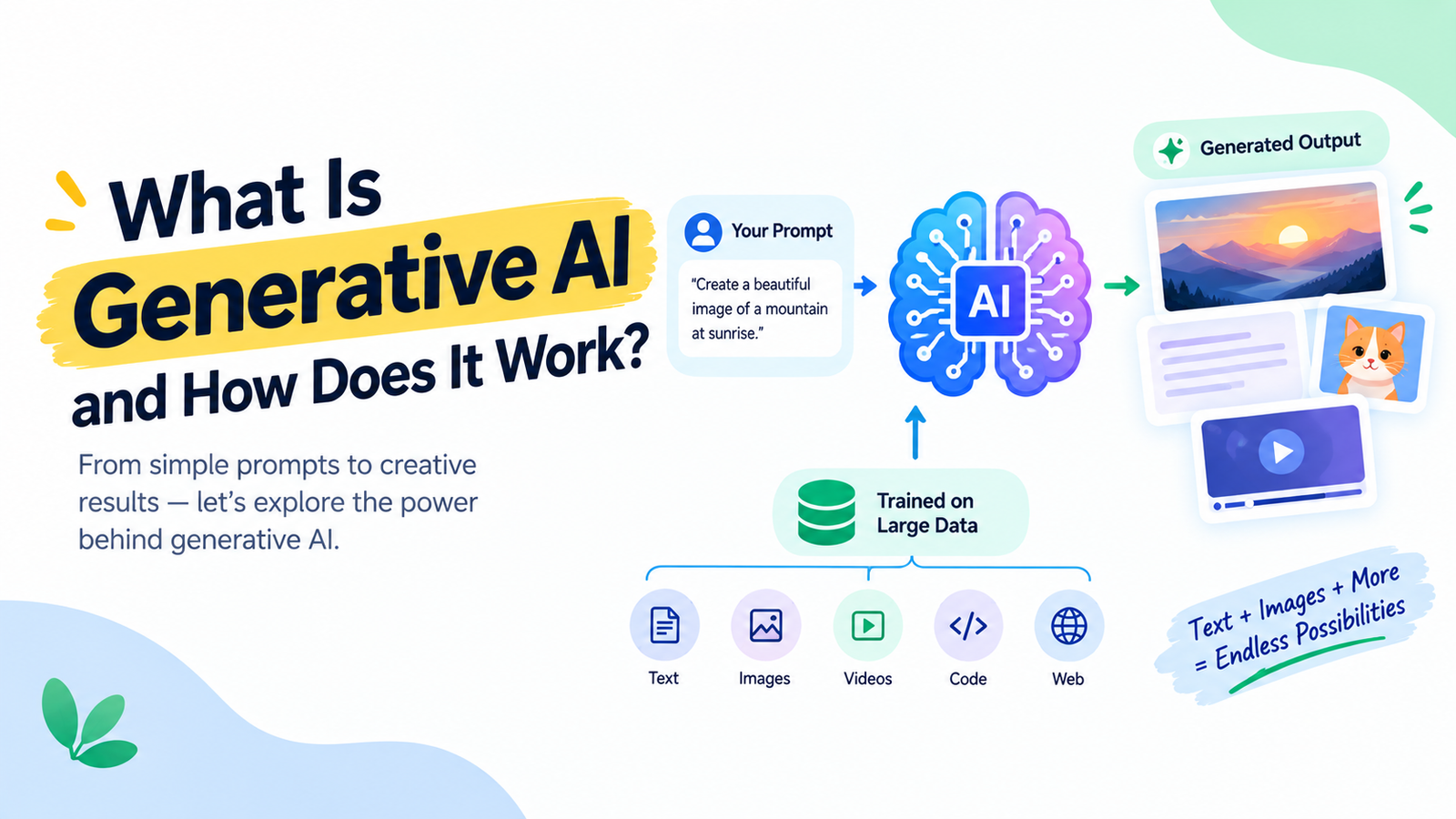
Modern creative systems increasingly work across multiple formats:
Text + Images + Audio + Video + Documents
This means a creator may eventually be able to start with one idea and develop an entire content package from it.
For example:
One topic
→ Blog article
→ Social posts
→ Video script
→ Video
→ Thumbnail
→ Newsletter
→ Podcast outline
→ Short clips
The creator’s role will increasingly involve choosing the right ideas, giving creative direction, checking accuracy, and improving the final result.
Frequently Asked Questions
Is AI good for content creation?
Yes. AI can help with brainstorming, research assistance, outlining, drafting, editing, repurposing, images, video scripts, and many other tasks.
The quality depends heavily on how the tool is used and how carefully the final content is reviewed.
Can AI create a complete blog post?
AI can generate a complete draft, but it is generally better to treat that draft as a starting point.
Human editing, fact-checking, examples, and original insights can make the final article much more useful.
Can AI help me create content faster?
Yes. AI can reduce the time spent on repetitive tasks such as brainstorming, outlining, rewriting, summarizing, formatting, and repurposing.
Will AI replace content creators?
AI can automate parts of content production, but content still benefits from human creativity, judgment, experience, and audience understanding.
The role of creators may change as AI becomes more capable.
Can AI create social media posts?
Yes. AI can generate captions, hooks, post ideas, scripts, content calendars, and variations for different platforms.
Can AI create images for blog posts?
Yes. AI image-generation tools can create visual concepts, illustrations, backgrounds, thumbnails, and other graphics.
Always check the tool’s current terms and the rights associated with generated or uploaded assets before using them commercially.
Should I publish AI-generated content without editing?
No. Review AI-generated content before publishing it.
Check for factual errors, repetition, generic language, unsupported claims, and anything that does not match your audience or brand.
How can beginners start using AI for content?
Start with one repetitive task.
For example:
- Choose a topic.
- Ask AI for ideas.
- Create an outline.
- Write your own key points.
- Use AI to help with the first draft.
- Edit the content yourself.
- Verify important facts.
- Publish the finished version.
- Repurpose it for social media.
You can gradually add more AI-assisted tasks as you become comfortable.
Final Thoughts
AI can make content creation significantly more efficient.
It can help you brainstorm ideas, organize research, create outlines, develop drafts, improve writing, generate visuals, create video scripts, repurpose content, and prepare social media posts.
But speed should not be the only goal.
The real goal is to create better content with less unnecessary effort.
The strongest approach is not:
“Let AI create everything.”
Instead, think:
“Let AI handle repetitive work while I focus on ideas, quality, accuracy, and creativity.”
When used this way, AI becomes more than a content generator. It becomes a productivity assistant that can help bloggers, creators, businesses, freelancers, and everyday users turn ideas into useful content faster.
The future of content creation is likely to involve a combination of human creativity and AI assistance. The people who learn how to use these tools thoughtfully can spend less time on repetitive production and more time on the parts of content creation that actually require human judgment.
Use AI for speed. Use human judgment for quality.






Leave a Reply